Showing posts with label manilabay. Show all posts

Thursday, May 4

Stilts at LPPCHEAA

On the 1st of April, a few WBCP-ers (led by Mike L. and Arne J.) attended the groundbreaking for a wetland park at the LPPCHEA (Las Piñas-Parañaque Critical Habitat and Ecotourism Area). Finally!  Hopefully, this project, led by Sen. Cynthia Villar, will focus on the importance of the mudflats as a wetland (it is a declared RAMSAR site!) and as a green space in a city choked by urban developments lacking environmental planning.

Adri and I were there but unwittingly skipped the ceremonies as we were captivated by several Black-winged Stilts foraging along a relatively clean beach.  We had lost track of the time and got caught up documenting the graceful stilts as they were feeding along the waterline.

When we arrived at sunrise, I was delighted to see that much of the trash along the coastline had been cleared (still a lot left of course, I would think it almost impossible to clean all of it up, with more trash coming in daily with the tide).  The beautiful shell beach was exposed - revealing a diversity of gastropods and bivalves, together with a bit of plant litter: seeds, twigs (and sadly some plastic knick knacks).  It was definitely a bit of beauty one seldom would expect to find along the Manila beaches of the bay.


I could only imagine all the possibilities of having a clean beach in Metro Manila for the city-dwellers to enjoy.


A lone Common Sandpiper was busy preening in the golden monring light, stanind on a bit of muddy, discarded rubber/canvas/plastic.


A few stilts were on the beach at first, some resting and preening, others busy foraging for food. Many of them were quite vocal, twittering loudly.


There were few other migrants at the beach, although in the distance at the river mouth we could see several egrets, some herons and quite a number of waders.

A few Common Greenshanks flew past us, twittering loudly.


It was not only the birds out foraging, a man and his two young boys were also busy looking for shellfish in the shallow waters.


As the shadows receded with the rising sun, more and more stilts began flying in.  It was nice to see varying plumage, from the usual greyish markings of younger birds to elegant black and white plumage of the full adults.


Adri and I found a nice large log to sit on, under the shade of the mangroves.  The birds soon got used to our presence and began to get comfortable.

We practice in-flight shots with two Whiskered Terns.


And got a good laugh trying to outdo each other with stilts-in-flight shots.


Some of the stilts were flying back and forth right in front of us!  Sometimes they were too close!
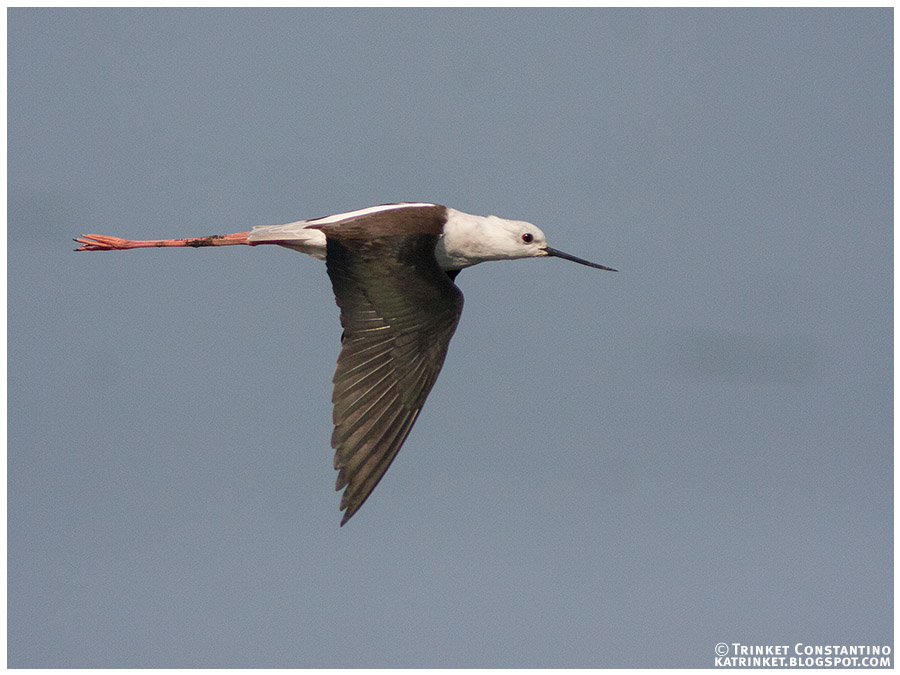


We were not the only humans on the beach, several meters away was a man busy with his boat, being ignored by most of the birds.


A few greenshanks decided to join the stilts.


And one of the beach dogs also came out to inspect the debris that had been carried in by the tide.


Soon the tide began to turn and we could tell the ground breaking event had finished, because we could see large groups of people descending on the beach.  In the distance, a large group in orange jackets were busy cleaning up the coast.


Nearby, a group decided to take the DENR trash boat (it had a huge net to catch floating trash out at sea) for a quick spin.  The Black-winged Stilts paid no attention to the people (probably because the people were not paying any attention to them either!)


The tide was eating up the thin stretch of beach so we decided to start heading back.  We ran into some of the participants and volunteers who were with Rey Aguinaldo (DENR Region IV and LPPCEHA Project Manager).  We were happy to show them some of the stilts through the scope.  They expressed their surprise at the number of birds along the beach, even commenting that they were happy that the event (with its many people and loud sound system) did not flush or scare them away.


As we walked back to the car along the more shaded inland trail, we spotted other migrants: a noisy Brown Shrike and a confiding Arctic Warbler.


We also ran into several groups of Barred Rails and Common Moorhens foraging under the mangroves.

At the end of the beach near the car, we saw a small group of three enjoying a swim in the water.  It was not something I would recommend!  I am still hopeful though, that one day, Manila Bay will be clean enough for more recreational activities.  With the threat of reclamation looming, perhaps a wetland park is just what LPPCHEA needs. Not just for humans, but for all the other wild ones that need it too.


Keeping my fingers crossed.


Saturday, September 24

Saturday morning at the LPPCHEA


I was happy to be back at the LPPCHEA (Las Piñas-Parañaque Critical Habitat and Ecotourism Area) for a bit of Saturday morning birding with some members of the WBCP. 


The beach at LPPCHEA on a Saturday morning.

I had not been back for a few years and I was curious to see the beach we once dubbed as "rubber slipper beach" when I was just starting out birding.  All sorts of trash littered the beach, from your usual plastic packaging to styrofoam boxes, discarded nets and rope, furniture, handbags, clothes, toys... ANYTHING you can think up, including A LOT of rubber slippers. Well, there was still a LOT of the city's trash washed up on the beach, but it was not as thick as previous times I was there (and no, I don't think we could play the finding a matching-pair-of-rubber-slippers thrown away game anymore).

I had hitched a ride from fellow QC-ers Art and Riza and we were joined by Cathy and Rage.  When we arrived, the group was just about ready to enter the inner trail of Long Island towards the ponds and DENR station.


I was impressed by how big the trees which had planted a few years ago have grown, especially the Agoho trees.  The ends of the Agoho leaf "needles" held drops of the previous nights' precipitation which twinkled in the morning light.


Agoho-lined trails at Long Island

I could not miss the harsh calls of the Brown Shrikes, I counted no less than 10 individuals perched on top of the different levels of vegetation.  The song of Philippine Pied Fantails, Pied Trillers, Zebra Doves and Golden-bellied Gerygones could be heard from the mangroves.  High above, egrets, Whiskered Terns and Rock Doves flew against the lightening skies.  Every so often, a Black-crowned Night Heron would call as it flew over.

I was happily surprised to see several pairs of Grey-backed Tailorbirds in the mangroves.  They were calling loudly as they chased each other in the dark undergrowth.

When we arrived at the ponds, I was disappointed not to find any of the Common Moorhens or Philippine Ducks that were usually there.

But I could see that some of the group had moved to the beach so I made my way through the mangroves. The tide was just beginning to go out, but a small strip of sand was barely visible under all the flotsam washed up, mostly trash and piles of the invasive water hyacinth.

Every time I get a glimpse of the sand at the LPPCHEA beach, I try to imagine what it would look like if there wasn't any garbage on the beach, fine grey sand full of white bleached shells.


Grey sand littered with broken shells.


Out over the water were several Whiskered Terns.  Towards the shallows of the river were Little Egrets. A few Black-crowned Night Heron were perched on sticks. A particularly tall stick seemed prime property as herons, egrets, terns and even a Common Sandpiper would take turns perching on it. A Collared Kingfisher was patrolling by one of the prickly amor plants.


A Black-crowned Night Heron and a Little Egret


On the beach,  we observed a Little Egret which was very successful in catching breakfast.  In the midst of all the pollution, the shallows still provided what seemed like an abundance of small fish. We would constantly see schools jumping at the surface of the water.


Fresh catch of the day by a Little Egret still sporting its plumes.


And it was not just the birds who were taking advantage of this bounty. One of the beach dogs had caught a large tilapia and was carrying it back to its home!


One of the LPPCHEA beach dogs not to be outdone by the fishing birds.

The rest of the dogs didn't even mind the arrival of the furry fisherman, and they continued to nap in the shade as beach dogs all over the world do.


While the other dogs are just living the life.


A little further on, we began spotting a some more migrants.  A trio of Pacific Golden Plovers were foraging in the sand near a lone Common Greenshank.


A pair of Pacific Golden Plovers

A lone Common Greenshank got me thinking about the next AWC.


Later, we were happy to see a pair of Whimbrels with their long curved bills.  As the pair were alternately foraging and engaging in a little cockfight, a third Whimbrel was bathing in the water at the shore.


Whimbrels!

We also saw the unmistakable pink legs of a Black-winged Stilt as a single individual flew past us.

We were all delighted by the sudden appearance of a Common Kingfisher which darted out of the mangroves and hovered for quite some time over the water before diving in for a catch.  It would do this several times, gaining appreciative "ooooohs" as it fluttered in place, suspended over the surf.

Suddenly, another bird landed on the beach: a Rufous Night Heron!  It stood quite still for several minutes, its neck and body all stretched out.  


A Rufous Night Heron looking all forlorn.

Eventually it was disturbed by some of the fishermen and it flew over the sea right in front of us.  It's slow flight gave me a perfect opportunity to catch it in mid flight.


Rufous Night Heron in flight!

Toward the end of our stay, several other groups of visitors began to arrive at the park.  One of the groups was a a busload of University students doing a coastal clean-up as part of their NSTP CWTS (National Service Training Program - Civic Welfare Training Service). They were at the start of the beach, and were performing the insurmountable task of hauling trash from the beach.

I was happy to run into Sir Rey Aguinaldo of the DENR who managed the LPPCHEA.  He said that they thankfully did have a lot of volunteers who participated in beach clean-ups. But still of course, the trash kept coming in, from that undending source which is all the human settlements around Manila Bay.

As I watched the kids cleaning up the beach, a Little Egret hunting in the foreground came into focus.  What a juxtaposition of images.


A Little Egret forages for food amid the trash as students clean-up the beach further down the shore.

I can only dream of the time when our trash does not end up in the ocean, and when the white shell beach of the LPPCHEA will sparkle under the tropical sun.  When a nature walk here will not only show trees and plants and birds and insects, but actual marine organisms of the intertidal zone! 

Do I dare hope it be in my lifetime?


Wednesday, November 28

the birdfest lands in manila!

For the first time since 2005, the birdfest is in Manila!  The return to NCR after 5 years of being flown all over Luzon, Visayas and Mindanao! No excuse not to join in the fun for Metro Manilans!!


8th Philippine Bird Festival-Manila Bay 
December 7 - 8, 2012
Teodoro F. Valencia Circle, Rizal Park
Manila

…………………………………………………………………………………………………..
The 8th Philippine Bird Festival, the country's largest celebration of avifaunal diversity and bird lore awareness, takes wing on December 7 in the City of Manila and will bring attention to Manila Bay and the important role this plays in the East Asian Flyway. 

Themed "Birdwatching. It's More Fun in the Philppines" this year's festival will highlight the Little Egret, a common migrant that congregates in the Coastal Lagoons on the southern coast of Metro Manila during the northern winter, and the endemic Philippine Duck, whose remnant population in the Philippine capital is threatened by reclamation and property development plans in that part of Manila Bay.
…………………………………………………………………………………………………..

Bird watchers, conservationists and tourism promoters from all over the country and abroad are expected to flock to the Teodoro F. Valencia Circle in Rizal Park on December 7 and 8 for the 8th annual Philippine Bird Festival – Manila Bay, the country's largest celebration of avifaunal diversity and bird lore awareness.

Themed Birdwatching. It's More Fun in the Philippines, this year's bird festival aims to promote the hobby as a nature tourism activity and drum up support for conservation and restoration of Metro Manila's remaining wetland in the Las Piñas-Parañaque Critical Habitat and Ecotourism Area (LPPCHEA), a 175 hectare protected habitat just off the Coastal Road leading to Cavite province.

"There are 600 species of birds in the Philippines, no fewer than 200 are found nowhere else in the world," according to Michael Lu, president of the Wild Bird Club of the Philippines (WBCP), the country's leading bird watching society and chairperson of the Philippine Bird Festival. With its unique habitats across more than 7,100 islands, the Philippines has recently become a magnet for birdwatchers in the Asian region and further afield, Lu said.

The Las Piñas-Parañaque Critical Habitat and Ecotourism Area, which features lagoons, ponds, mangroves and two natural barrier islands, is an important feeding and rest area for endangered species like the Chinese Egret that migrate south to escape the harsh winters in China, Japan and Siberia as well as a roosting and breeding area for a surviving population of endemic Papan or Philippine Duck, a species found only in the archipelago of which a few thousands remain in the wild.

The wetlands around Manila Bay attract large numbers of migratory wader species like egrets (tagak) and herons, sandpipers and plovers (tarinting). The coastal waters provide feeding areas for species of terns (kanaway) and gull, while the mosaic of scrubland, mangroves and ponds are haven for migratory Siberian Rubythroat, Arctic Warbler (manayti) and Oriental Reed Warbler (rakrakit), resident Collared Kingfishers (sasala), Barred Rail (tikling) and Moorhen (to-ob). The endemic Philippine Cuckoo-Dove has also been recorded in the area.

"The coastal wetlands and other green spaces around Manila Bay are part of the Asia-wide ecosystem and their conservation will have positive impact on Asian birdlife and the health and livability of Metro Manila," Lu explained. This year, the Philippine Bird Festival logo depicts the Little Egret, a common winter visitor species that makes its home along the Manila Bay coast.

The annual event hopes to raise the bar of awareness about the bird life of the islands, promote public participation in conservation and encourage the creation of more public green spaces.

The festival will be held at the Teodoro F. Valencia Circle, Rizal Park and is open to the public free of charge. It will feature an exhibit of bird photos by the country's leading and amateur nature photographers, displays on the biodiversity of Manila Bay, films and lectures, bird watching trips, and forums on eco-tourism, birdlife management and aviation safety. Organizers said an activity center featuring bird-themed games and crafts will be on tap for the young and the young at heart.

The Philippine Bird Festival was launched by local bird watching hobbyists in Quezon City in 2005 and in succeeding years brought the message of birdlife awareness and conservation to the country's important bird areas like Dumaguete City, Balanga City in Bataan, Puerto Princesa in Palawan, Cebu and Davao City.

Delegates will head for Balanga City in Bataan on 6 December to participate in its Ibong Dayo (Migratory Bird) Festival at the Balanga Wetland Park, the first coastal wetland of Manila Bay to be declared an environmental protected area by the local government. Balanga's Ibong Dayo Festival, which started in 2010 a year after the city hosted the Philippine Bird Festival, has become an annual event for bird awareness and habitat conservation.

Similar events take place throughout the world each year, attracting large numbers of bird watchers, scientists and nature enthusiasts. In Asia, some of the well-known events are the annual Taipei International Birdwatching Fair in Taiwan and the Thailand Birdwatching Fair.

This year's Philippine Bird Festival will be jointly-hosted by the Department of Environment and Natural Resources, the Department of Tourism, National Parks Development Committee, and the City of Manila.

International organizations such as the Bird Conservation Society of Thailand, Chinese Wild Bird Federation (Taiwan), Wild Bird Society of Taipei, Malaysia Nature Society, Nature Society of Singapore, Chengdu Birdwatching Society (China), Borneo Bird Club (Malaysia), Asian Raptor Research and Conservation Network (Japan), University Birding Clubs of Korea, Taiwan Ecotourism Association, Sabah Tourism Board (Malaysia), Gujarat Tourism Opportunity (India), Thai Cycling Club will be participating in the festival, alongside local organizations and institutions including the Philippine Eagle Foundation (Davao), Katala Foundation (Palawan), WWF-Philippines, Isla Biodiversity Foundation (Babuyan), Haribon Foundation, Philippine Biodiversity Conservation Foundation (Negros Occidental), PENAGMANNAKI (Negros Oriental), Polillo Island Biodiversity Conservation Foundation, Birding Adventure Philippines, Mabuwaya Foundation (Isabela), Philippine Native Plants Conservation Society, Save Freedom Island Movement, Cavite Provincial Tourism and the Department of Tourism Region IX. Private institutions Team Energy Foundation, First Gen Corporation, Villar Foundation, Manila Water Company, Nuvali, Primer Group, Center for Outdoor Recreation and Expedition, City of Balanga, Province of Cavite, Genesis Transport and SMART Communications are also backing the two-day event.

Thursday, March 22

sunday birding part 2: sunset at the bay

after meeting the angono petroglyph philippine eagle owl, my sunday was only half done.

i had promised to meet some of my freshmen students who were doing their zoology project on the reclamation of the coastal lagoon and migratory birds. i get a thrill when the students are interested in this issue and i didn't hesitate to offer help.  mike, mark w, jon v and of course adri were all willing to give my students a special guided trip to the lppchea.

i had't been to the las pinas-paranaque coastal habitat and ecotourism area in quite a while. during my first few years as a member of the club, this was one of the places i would often visit, long before the the sm complex replaced the grasslands of tambo.  i was always amazed at the beach littered with seashells and rubber slippers.  the mudflats were where i practiced id-ing waders while sitting on the (now-gone) almost collapsed houses on stilts.  it was amazing to see so many birds in a place with so much trash.  equally amazing was how many fishermen were fishing for food in the polluted waters. migrant and resident birds, mangroves, fish, trash, people: the universal truth of the current environmental problems was summarized right there in front of us while we scoped birds and made up dialogues of imagined conversations between them.

high tide at the tail end of migration season was not the best time for a guided trip to the coastal lagoon, but i think my students were still impressed by the flocks of whiskered terns skimming the water for food and the few egrets perched on floating bamboo rafts.  the beautiful sunset on the half clean (thanks to several coastal clean-ups!) with the terns flying around prompted one of my students to say: "ang ganda, sana may ganito sa manila!" ("how beautiful, i wish there a place like this in manila!") at which i had to reply: "nasa manila ka pa!" ("you're still in manila!")

is that a piece of plastic that the terns have mistaken for food?


whiskered terns changing to breeding plumage toward the end of breeding season


little egrets doing a courtship dance on the beach

a moorhen party at the pond

as we walked quietly back to our vehicles after birding on freedom island, the sunset had bathed the sky pink and we could see the airplanes all lined up in the sky, waiting for their turn to land on the runway.  

flocks of terns and gulls in the late afternoon


a golden sunset on the bay

enjoying the pink and lavender sunset


will this show of nature be replaced soon by the neon glow of casino lights?  will the crunch of sand underfoot be replaced with asphalt? will the residents of metro manila have to travel further westward to enjoy the manila bay sunset?

i hope not.


Tuesday, February 15

a sunset cruise on manila bay

i have lived my (almost) entire life in metro manila and yet there are sooo many things i haven't seen or tried.  one of them is the manila bay sunset cruise.

i finally got the chance a few weeks ago, a dinner organized for my biosafety training workshop.  it was a pleasant experience ... live music, the sunset, and a slight sea breeze blowing (but the dinner itself... ergh... let's just say, had a lot of room for improvement).  we cruised from the folk arts theater at the ccp complex to the sm mall of asia, down roxas boulevard to the manila oceanarium. this time of the year is probably best because the weather was perfect (although we missed the famous manila bay sunset because of the clouds), and the water calm.  the lights of manila by the night masked the hustle and bustle of the metro. very morantic.

i suppose it's best to take the cruise during sunset, not only because the city is prettier by night light, but also because it paints the sea a flat black, and you can't see the pollution!  interestingly enough, each time the ship passed through a "wave" of trash, we noticed that the green luminescence of marine microorganisms shone the brightest!

the whole trip lasted 2 hours, and we were back docked at the pier behind the folk arts theater. the entire thing cost 550 pesos, something to try out especially for residents of manila. at least i can place that experience int he "been there, done that" category.

(we took the sun cruises m/v spirit of manila, the boat in my picture was the other company's - forgot the name!  couldn't take a picture of our own boat obviously, while i was on it!)