Showing posts with label owl. Show all posts

Sunday, January 22

A day in Rizal

A morning in Antipolo...

Midway through December last year, Adri and I took a short trip east of Manila to Rizal to visit our friend with a lovely home and garden, teacher Emma.  It is always a delightful visit, to sit down with her over a leisurely breakfast and talk about this and that in the world while surrounded by greenery and beautiful things.


Before leaving (our morning visit had lasted until noon - as good conversation always makes us lose track of the time), we took a short walk down her street and came across a few birds.


A Philippine Pygmy Woodpecker was keeping busy up a huge rain tree, together with several Lowland White Eyes, a migrant Arctic Warbler, a few Gerygones and a pair of Pied Fantails.

Further down, we spotted a White-throated Kingfisher and a few Philippine Bulbuls.  A Grey backed Tailorbird called loudly from the tangle of vines and bamboo while an invisible Mangrove Blue Flycatcher sang melodiously. Above us a Philippine Serpent Eagle circled twice before gliding gracefully over the hill.


Back at the gate of the house, Yellow-vented Bulbuls and Red-keeled Flowerpeckers were gorging on the the bubbly white fruit of a small tree.


I've seen this tree in thickets here and there but never found out what it was.  I asked help online and one of the suggestions was Dalunot, Pipturus arborescens.

Found this botanical print from Fr. Blanco online
at eol.org/data_objects/32359676

What I always thought of as its flowers, were actually its fruit!  The small, soft, white and fleshy fruit looked to me like thick soapy foam bubbles and the birds love it! 


The red-keeled flowerpecker we were busy observing was no exception.  I was happy to find out that it was a native plant. (Please do correct me if the identification is wrong!)


Right above us a Philippine Coucal was skulking in the thick vines.  How wonderful to be in a place where the birds do not seem so afraid of humans!

On to Angono...

Since we were already in Rizal and we had the whole day free, we decided to drive further and check on the family of Philippine Eagle Owls at the Angono Petroglyphs.

When we got there, we were delighted to here the news from the curator Roden that the young owl had just fledged that morning!  We quickly spotted him quietly perched in front of the cave wall.


Higher up above the cave was mom, carefully hidden but keeping an eye out.


And even further out was dad, also well hidden but still in view.


We spent a good hour on the viewing platform for the petroglyphs chatting with Roden talking about the owls, the museum, and of course, the state of the nation.  Such serious topics!  All the while a pair of tiny Scaly-breasted Munias were busy with their nest just above the cave. 


Life seems so fleeting when standing before a centuries-old testament to history.


Tuesday, April 22

Easter Triduum birding

The last 3 days of Holy Week is traditionally family, prayer and quiet time and even if summer classes started on Holy Monday, the long exodus to the provinces left a sizzling Metro Manila tranquil and traffic-free.  The break from work afforded Adri and I a few bird encounters.

On Holy Thursday, Adri and I took a peek at the UP campus Scops Owl.  My brother and sis-in-law were taking morning walk on campus and we were excited to show them this nocturnal creature.  When we got to the site, I was surprised to see how the summer heat had thinned out the lush vegetation which the owl took refuge in during the day.  It took us quite a while to find the owl, and to our delight, we found a pair of them.  They looked very sleepy and were unperturbed at our presence.


I didn't plan to bird on Good Friday, but I was delighted to get a new record for the backyard (well, front yard, strictly speaking).  A small bird perched on an almost leafless flamboyant tree caught my attention.  It flew off its perch only to circle back and land on the same branch.  A Grey-streaked Flycatcher!  Even if it was high up in the tree, I was able to take a photo of this tiny migrant.  It was probably on its way back north for spring.


For Black Saturday, we wanted to take advantage of the calm before the storm and took a short road trip up to Candaba before the city dwellers began returning to the city.  Together with Melanie, we decided to leave Quezon City way before sunrise, to take advantage of the short, cool hours of the morning.

When we arrived at the main ponds, we were greeted by views of the busy rookeries of the Black-crowned Night-herons and the Purple Herons.  A few Philippine Ducks and Wandering Whistling Ducks were swimming around the few remaining water surfaces still available.  A stately male Watercock stood proudly above the water hyacinths.

Having parked the car under the shade of a tree (big mistake!), we backtracked to take a picture of the Watercock (failure!), a small bird scuttled out to the middle of the dirt path.  It was a Siberian Rubythroat!  We positioned ourselves with the rising sun at our backs and facing the handsome bird.


Later we were joined by WBCPers Jude, Alex, Tere and Patty.  Adri pointed out the area where they could stalk the Rubythroat while we moved on to look for other targets.

As early as half past the hour of eight, the heat was already becoming unbearable.  We parked ourselves under the shade of some acacia trees.  In front of us the pond was choked with lotuses in full bloom.  The pale flowers were calming to look at, and several Barn swallows perched on the lotus peduncles.


Jude and Co. soon joined us, and we became firmly planted at the spot, the heat keeping us from venturing further.  We entertained ourselves looking at the swallows, spotting a Common Kingfisher, a family of Purple Swamphens and a lone female Northern Shoveller.

While we exchanged stories, a loud chirping interrupted us.  Above us was a tiny warbler.  The Arctic Warbler was recently split into 3 separate species: Arctic, Kamchatka and Japanese Leaf Warblers.  These 3 species are frustratingly similar to each other in terms of appearance and until recently, Adri and I would jokingly argue about the ID of what warbler we were seeing.  A recent article (ebonph.wordpress.com/2014/04/13/ask-the-experts-the-arctic-warbler-splits) though in the WBCP online newsletter explains clearly how to differentiate these 3 species by their call. So I could finally say with confidence that I have the Japanese Leaf Warbler on my life list.


 A (half?) lifer, a backyard record and great views of familiar (though not-so-often-seen) birds.  Great birding for a non-birding long weekend.


Sunday, April 20

An Ivatan Dictionary of Birds

Batanes!

Adri and I had always planned on going but it seemed like a huge trip to plan. When Edna gifted us with return trip travel vouchers we were finally on our way!  Because of the limitation on the voucher to book the trip 3 days before actual travel, it turned out to be our least planned, most crammed trip ever! Dramatic seascapes, iconic stone house villages, rolling hills - here we come!

While it was primarily the typical tour type trip, Batanes was too important a birding area for us not to plan some birdwatching as well.  Nearer to Taiwan than the rest of the Philippines, several bird species were unique to this set of islands comprising the northern-most islands of the Philippines. While none of them are endemic, many of the targets are difficult (if not impossible!) to find elsewhere in the country.  Surprise migrants are also always an opportunity, however, our trip was timed too late for most migrants as it was approaching the peak of summer.

We did our birding research, as it was probably the most difficult to plan for, as most tourist-y attractions were routine already.  Thanks to WBCP-er Christian Perez, we got in touch with a guide who knew where to find the birds and was familiar with many of them as well.  He had also guided several other birders before, so he was familiar with the typical birding schedule.  Rogers Amboy (+639998826833, +639178752430) turned out not only to be a great bird guide, but a wonderful tour guide as well, and our 4 days in Batanes was chock-full of local culture, history, folklore, and yes, birds.

It was so interesting to learn the Ivatan names for the birds, I am kicking myself for not taking more detailed notes.  Dachio, piyek, avuchivuchid, sayay, vadug... such pretty and unfamiliar sounding names!

We had four main targets for Batanes and I am over the moon to have seen all of them!

On the top of our list was the tiwayway or Japanese Paradise-Flycatcher. Summer is the perfect time to see these birds because they breed on the islands from March to August, and are rare migrant to Luzon, Palawan and Mindoro.  Our first sighting of these birds was on our first "official" birding day - during our tour of Sabtang island.  Kuya Roger took us to a dry creek bed and sure enough, a pair of them were quite vocal.


In the days to come, we found out that they were actually very common.  In Batan, we heard them by the highway anywhere there was substantial tree cover, we saw them crossing the highway, and we saw and heard several on the foothills of Mt. Iraya.  Most of the locals were familiar with the tiwayway, and also knew that it was the perfect time to see them as it was more difficult on other months.


Our second target was even more common.  Again, if you asked the locals where you could see the piyek (silent "e"), they would say: everywhere.  The Chestnut-eared Bulbul is the only bulbul in Batanes, and like most other bulbuls it is noisy and... bulbul -like. Kennedy says it is not common in open country, but we found it very common, even around Basco.


I was really happy to see the piyek because it's the last remaining bulbul species in the Philippine field guide that I hadn't seen (including all the Streak-breasted Bulbul splits!).


As with many smaller islands, there is an owl a birder has to find. Fortunately, Kuya Roger had a sure site for it, around the farm of one of his friends.  He said that they started appearing a 10pm... which would have been the latest owling hour I had ever gone. As luck would have it, we were walking up to the farm at 7pm, a bantulok conveniently called from a tree right beside us, and we saw it 3 hours ahead of schedule.


Getting a photo though proved to be a little more difficult.  It was confusing to be chasing several vocal Ryukyu Scops Owls which seemed too be all around us, but we finally got good photos.  Of course Adri had much better photos with his digiscoping set-up than I did with my hand held long lens.


On our last night we decided to go owling again, this time by ourselves as Kuya Roger had to go diving for lobsters.  We walked to and from the site, and when we got back to our inn, one of the locals asked us what had us out so late (730pm was considered late!).  We said we were looking for bantulok and he said that they were quite difficult to actually see.  He seemed puzzled at our agenda. I guess crazy birders are not yet the norm here.

Our fourth and final target was the most challenging of all.  The vuyit was named after is eerie, ghostlike call "vuuuuuuuuuuuuuuu-yeeeeet!"  We were a little hopeful about finding it as a couple of weeks before WBCP-ers Paula and Charlie had photographed just by the side of the road.  But 3 days into our trip, there was still no glimpse of it, only a faint call from the distance when we were at Racuh a Payaman, a communal pastureland in Mahatao.  Desperate times called for desperate measures.  we actually had to "go birding" in the traditional sense, to get this bird.  So on the the morning of our fourth day, we hike up the foothills of Mt. Iraya, to the farm of Uncle "Jungle-boy" - farmer/hunter/pit viper catcher.  He led us uphill to some fruiting trees and we lay in wait.  We saw several vadug while waiting, the endemic Batanes subspecies of Philippine Cuckoo-dove, a very handsome bird, great to see... but not really our main target.

We covered four corners of the small hill: Adri, myself, Kuya Roger and our driver for the day Alex.  Out of the corner of my eye I saw Alex going over to Kuya Roger. Adri soon joined them and I trudged uphill to see what was up. Had they spotted the vuyit?

In the distance was indeed a pair of Whistling-green Pigeons!  They were perched on the branches of a leafy tree, well camouflaged but visible.  Not the greatest of views but clear and long!  We all enjoyed looking at them fall asleep for several minutes until rain threatened to fall and we ran back to take shelter in Uncle Jungle-boy's house.


Tiwayway, piyek, bantulok and vuyit!  check, check, check, check!  Birding in Batanes was definitely a highlight of our trip!

Here are some of other birds we saw and their local names:

Dachio (Lowland White-eye) was a very common bird and the subspecies is endemic to Batanes.


The luluji (Blue Rock Thrush) was also seen everywhere! Not only on rocks, but on house roofs, on electric wires, on the highway barriers... everywhere.  They were also very vocal, and their singing was very pleasant to hear.  They weren't very popular with the locals though, who considered them "dirty" birds.


Most of the landscape of Batan island is pastureland: the iconic, rolling, grassy hills dotted by patches of trees and vuyavuy palms (used to make the traditional vakul headgear) and spikey pandan. Commonly seen foraging by these patches of vegetation are rails: ripdi (Buff-banded Rail) and more frequently the alan (Plain Bush-hen).


The alan were also considered pests as they would eat ripe bananas and papaya right from the tree.


White-breasted Waterhens were also seen in more watery environments.  This pair was seen near a small ricefield.


Common also to the grasslands were very vocal Zitting Cisticolas.  This was also an endemic Batanes subspecies.  Unfortunately, I took them for granted, and didn't get any photos.  Too bad because they had my most favorite local name: avuchivuchid. Another bird I took for granted were Chestnut Munias which occurred in large flocks.  They were called lalachiao.

Also running around the short grass, already yellow-brown under the summer sun, were several Paddyfield Pipts, tilin.


Pastures = bovines and Cattle Egrets obligingly illustrated why they were called so.  Kuya Roger just called them Cattle Egret, so I never found out what they were called in Ivatan.


The dramatic seascapes with waves breaking over rocks and cliff faces were a perfect back drop for dark phase Pacific Reef Egrets.


Swallows, both Pacific and Striated were all over, gliding gracefully over land and sea.  Their mud nests can be seen under the eves of the many lighthouses all over Batan island.  Swallows are collectively called hapnyit.


I was looking forward to seeing migrant starlings but the timing wasn't right.  We did see several Brown-headed Thrushes though, enjoying the ripe fruit of a tree Kuya Roger called malaapdo.  Kuya Roger described large flocks of migratory birds he called lagamitan avayat. "Avayat" means "habagat" (southwest monsoon) and the birds came when the winds change.  At first we thought he was referring to the starlings, but when we showed him the photo of the thrushes, he said that these were the birds too.  Maybe these birds - thrushes and starlings, which were of similar jiz, were all called lagamitan avayat?


The malaapdo was certainly a bird magnet and we were fortunate that one was fruiting early (the other trees we had seen still had mostly un-ripe fruit).  It attracted bulbuls and even Black-chinned Fruit-doves - another endemic subspecies.  The fruit dove, just like the Emerald Green Dove had the most familiar name of all: punay (emphasis on the second syllable though).


Another common migrant we encountered were wagtails.  They were in the canals, walking in what little water was left. They were called duwad.


One local name that escapes me is what the Brown Shrike is called.  We saw quite a lot of them. Strangely, they all looked quite bedraggled. Kuya Roger mentioned that they used to catch the Brown Shrikes as they came in large numbers during fall migration, and that their beaks could give a nasty nip if you happened to get your finger caught.


While we didn't see any migrant starlings, we did see the resident Asian Glossy Starlings.


We flushed a Philippine Coucal, talukuk, on our hike at Mt. Iraya.  It looked very different from the Luzon race, its wings were black rather than chestnut, so it was more similar to the Mindoro subspecies.  The Lesser Coucal had a similar onomatopoeic name - sijuk.


Also very common were the Collared Kingfishers - tagalit. We mostly saw them by near the beaches.


There a few migrants as well - Common Kingfishers, Common Sandpipers, Whimbrel and Grey-tailed Tattlers.

We saw several raptors also.  A white-bellied sea-eagle could be seen hunting from the balcony of our inn.  In the hills of Dipnalban, we saw a Peregrine falcon or sibnit hunting.  All small raptors (probably including kestrels and the hobbies) are referred to as sibnit.


At Sabtang, we were thrilled to see a sayay (Osprey) successfully catch a fish on a beach right beside the highway.


The drama of the catch was even made more powerful in combination with the landscape. The image summed up how I felt about our trip.  Batanes certainly lived up to its expectations - its impressive panoramas and gentle people and rich culture makes me want to go back.  Not to mention the birding! Migration season next time? What other manumanok will we see then?

Sunday, March 2

night birds during the day

I have always considered owling an especially patience-requiring type of birding, often testing the perseverance and persistence of even the most stoic birder. The challenge of finding nocturnal birds in the darkness, with only their calls to give you a hint of where they are, is exciting and can be difficult, but the rewards of finally getting the target in the beam of the torch (no matter how fleeting) is just as fulfilling.

Finding a regular roost site for night birds is a different type of pleasure.  It is not easy to spot a night bird, even knowing where it sleeps by day.  These are birds not meant to be seen by the harsh light of the sun, they often sleep in tangles and hidden crevices, or camouflaged to look like part of  the environment.  After all, they need to rest and sleep while the rest of the world is wide awake and busy with their daily tasks.

It is lucky for me that two known roosting sites are on my way to school.  Last week I needed a pick me up before facing the rush of finals week for our graduating seniors.  So I asked Adri if he wanted to check out recent reports of an owl on campus and to also take a look at the nightjar which has been very reliable the past few months.

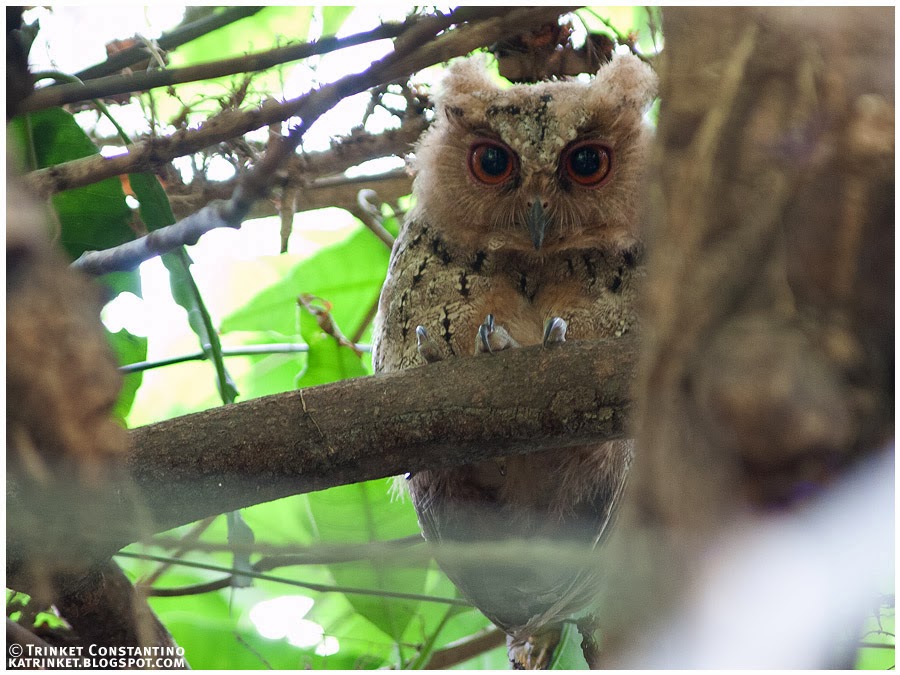
It took quite a while for us to find the Philippine Scops Owl in the complicated mass of vines and branches. I was about ready to give up when Adri finally spotted it!  Of course it had already spotted us by then, the crunch of dried leaves under our feet giving us away.  Viewed at night, the owl can look very stern, but in the daytime, it looked... cute!  It had twisted its head at a right angle to get a better view of us between the tangles, giving it a slightly comical appearance.  I'm sure Adri and I were also in some yoga-worthy poses as we tried to get an unimpeded view of it.

I can see you!


I am still in awe of all these owls in the city.  This one was sleeping right next to our old hangout when I was still an undergraduate student! The old structure had already been torn down and replaced with new buildings that were an extension of the neighboring research institute (it actually smelled like an animal house, the familiar smell of mice from grad school, maybe an additional bonus for the owl).  Did these owls live here so many years ago when these were all tambayans for our student orgs? Probably!

The owl eventually got comfortable to our presence, and after one last wide-eyed glare, slowly closed it eyes to catch up on some sleep.

The Philippine Scops Owl giving us a stern look
before catching up on some shut eye.

Our owl search-and-find took a little longer than we had anticipated, which left us no time for the nightjar for that morning.  So we checked on it a few days later.

Even though the mango tree it slept in was quite small, we still had a hard time spotting it.  Again, we were almost resigned to the fact that it had found another roost when I finally spotted an out-of place broken branch.  Looking through my binoculars, I confirmed that it was the Philippine Nightjar!  Despite the live and loud kulintang music coming from the arts building beside the mango tree, it seemed fast asleep.  

A nicely camouflaged Philippine Nightjar.

A curious security guard approached us, and although he already knew we were looking at a sleeping bird, he still engaged us in conversation and took a look through the scope.  He shared his amazement at the regularity of the roost of the bird, and how it seemed unfazed by the hustle and bustle of the university during the day. Adri and I both nodded in agreement, although, we pointed out to the mango blooms which would soon give way to fruit by the end of the summer.  Harvesting the fruit would surely drive the bird to find another perch in a few months.

A slight breeze blew, and the nightjar gave a little shake, as if to sway with the branches and the leaves.  All the time, it kept its eyes closed.  Sleep well, sweet dreams little nightjar!

A slight breeze blows the leaves obstructing our view,
giving us a good look at its white tail patch.