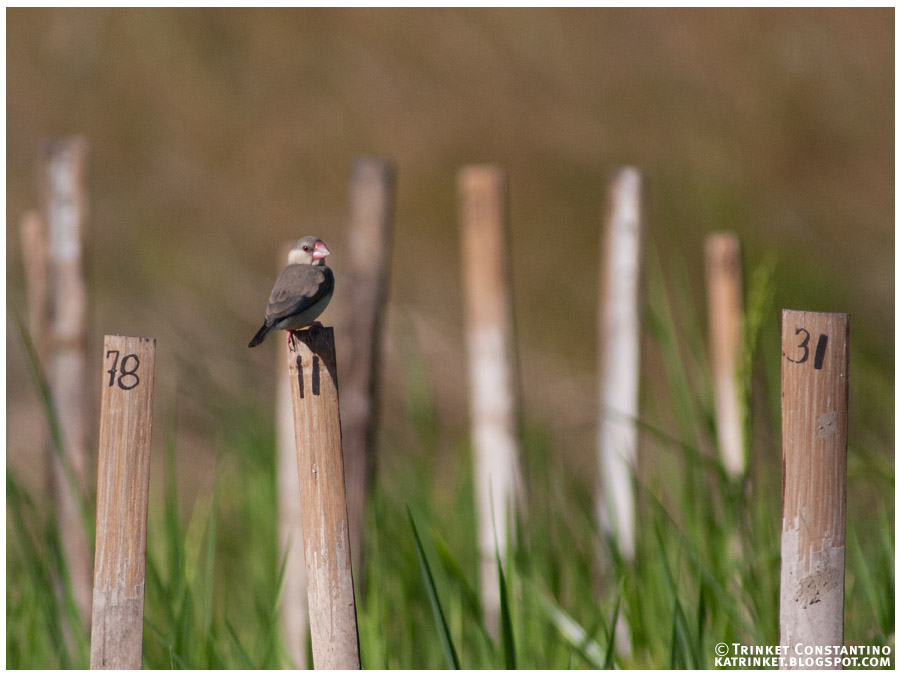
I was happy to see large flocks (around 50 birds) of Java Sparrows in the fields. Introduced in the country as caged birds, feral populations have established themselves all over, although I have not observed them in numbers as large as the native Chestnut, Scaly-breasted and White-bellied Munias.
The introduced Java Sparrow has such a smart plumage pattern.
I love the distinctive markings of these birds, no doubt it's what makes them popular in the pet trade. There were several juvenile birds flocking together in the fields, and a few adults mixed in with the Chestnut Munias.
Contestant # 11: a bit under age?
Young Java Sparrows flocking together.
The rice planted in the fields was very young and green, and a lot of the muddy ground was still exposed. We also saw a lot of waders - mostly migrant Wood Sandpipers and resident Little Ringed Plovers. We observed a resident Collared Kingfisher pick up what looked like a mole cricket nypmh from the muddy ground. It flew up to the eelctrical wires and proceeded to swallow, regurgitate, re-position and then swallow again, the unfortunate prey.
The resident Collared Kingfisher enjoying a tasty meal.
It was cool to see the nictitating membrane cover its eye anytime it attempted to swallow its food. The translucent "third eyelid" gave it a creepy zombie-bird look. At the dairy farms, we wanted to check out the endemic Spotted Buttonquails. At the end of the day, the foot (and pedicab) traffic on the dirt roads was quite heavy, so we weren't sure if we would see any ground birds. Still, we set-up the scope and proceeded to greet everyone passing us on the trail. And then, just as the last light of day began to fade, we noticed 2 buttonquails taking dust bath quite a distance away. A look through the scope confirmed that they were indeed the target endemics!
An endemic Spotted Buttonquail enjoying a dustbath. (Quite a distance away even through the scope, watch in HD)
They quickly scurried off the path though, to make way for two exuberant young boys, running home from school. As the sun set on a full day of forest and field birding, we decided we best be on our way home as well.
After an unremarkable morning up the forest trail (hornbills, yellow-bellied whistler, several white-eared brown doves, malkohas, rhabdornises, minivets, monarchs, black-chinned fruit doves, serpent eagle, a few flowerpeckers, flameback, etc. plus LOTS of people!) and spotting 4 tourist buses and 3 jeepneys parked at the botanical garden entrance, Adri and I decided to stake out the dirt roads at the dairy for some quail action. It was still early in the afternoon and the sun was quite high in the sky when we parked our car and ourselves by one of the dirt roads. Summer was beginning to creep in and everything was dry, even the slight breeze that blew every now and again.
Buttonquail Crossing
Hardly had we brought down our gear from the car when Adri exclaimed: mayro'n ng tumatawid! (there're birds crossing already!) Sure enough, several meters up the road in the direction we had come from, a pair of Barred Buttonquails were in the middle of the path, scratching at the dry dirt.
A pair of barred buttonquails crossing the dirt road.
We struggled to get our optics in place, but the duo was too far away from us, and the heat shimmering from the ground did not make for very good views or photos. After a minute or so, the 2 birds split up, one disappearing into the right side of the road and the other walking into the grass on the left. Wow, barely 5 minutes from parking we already had a sighting! We quickly settled down to wait again. Wait. Wait. Wait, wait, wait. "Maybe that was it for the afternoon," joked Adri. "Yes, that's their quota for crossing the road today, you think?" I reply. A slight movement up the road caught our attention. Another Barred Buttonquail. After a few minutes, it disappeared again into the grass. Wait. Wait. Wait some more.
My uber-patient partner.
Another unsatisfying appearance by an individual of the same species. Far away from us. Wait. Wait. Finally, some movement again in the grass bordering the road! Another Barred Buttonquail! It was again some distance from us, but this time it was making its way towards us. It would walk across the road and back, and then cross again. Sometimes it would disappear from view for a while at the edge of the road, only to reappear again, just a bit closer. And closer, and closer!
A buttonquail in the shadows.
It was very active, and so it was difficult to get a good shot. Adri and I were hardly moving. A few meters away from us, and something on the ground caught its interest.
Pecking at some fallen fruit
It picked at what looked like a ripe, red fruit on the ground. It became quite preoccupied with it, and stayed out in the open for a looooong time. Sometimes it moved away a bit, but then it came back to peck at the fruit. It even sat down for a while beside the fruit! After several minutes, it seemed to have its fill and waddled away.
Totally engrossed in the fruit for several minutes.
It was such a great close (well, close enough!) encounter with a usually shy ground bird! And Adri and I had that mysterious fruit to thank.
The aftermath: after the fruit was pecked at, it looked like this.
I quickly looked up and spotted the vine where the fruit came from. It was a familiar vine with conspicuous red-orange fruit, and though I have seen it many times before in various places, I did not pay it much mind before now.
This is what the ripe and unripe fruit looked like: is this from the cucumber family?
While watching the vine and waiting for more quails, a yellow vented bulbul flew in and perched on the vine right where the fruit was, and immediately began eating it! It is always interesting to know what the birds are eating.
Even the yellow-vented bulbul had a go at the fruit still on the vine.
A quick internet search led me to a vine native to the Philippines, Coccinia grandis, which is part of the cucumber family. Is this the mysterious vine which gives fruit that the quail (and the bulbul!) seemed to like so much? The description seems to fit perfectly. I'll be on closer lookout now for this plant and fruit. Adri and I wanted to wait for more quails crossing, but as the afternoon got cooler, foot and bicycle/motorcycle traffic on the path increased. After several minutes, we glimpsed another pair of quails far away from us, way back where we had the first sighting for the afternoon. Soon a group of kids decided to film a class project right behind us. What were they role-playing? Scenes from Ibong Adarna! The mythical bird who lured in princes with its song and finally transformed them into stone with a touch of its poop. We were amused at the apt-ness of their storyline, but decided that it was probably time to go.
Ibong Adarna by the neighborhood kids.
We doubted any quail crossing would beat our earlier encounter. Having achieved success, we no longer felt like waiting.
When I tell my mom I'm going birding, she never fails to ask me why we keep returning to the same place for birding. "Are there birds there you haven't seen yet? Don't you get tired of going to the same place?" Well... strictly speaking, the answers are always "Yes" and "No". In that order. But let's be clear. There are still many, many birds I haven't seen. Some of them are actually supposedly quite easy to see. Some of them have been regularly reported at the places I bird at... regularly. I cannot deny that even just the thought of a lifer excites me. But, most of the time, a new bird on my life list is not the driving force to go out and bird. After all, even with the same birds, each birding outing is different. But there is comfort to going to a favorite birding site. Birds can be quite predictable and, boring as it may sound, I like routine. Makiling and the UP Los Baños campus and its environs are regular birding go-to's for us. Quite near to the city, very accessible, forest plus grassland birding on the same day, what's not to like? I have heard many a local birder swear off Makiling as being difficult and un-birdy, but so far, Mariang Makiling has never let me down. And so to celebrate the end of a two-week break from school, we loaded up our car and headed south of Metro Manila. Of course one of the most reliable inhabitants of the forest in Makiling is Spotty, the spotted wood-kingfisher. There are few visits when he had let us down, and even then, he would give us a distant call, as if to assure us that he still occupied the same bend.
Makiling is also where I first spotted both species of malkohas. Ixi, Adri and I counted a family group of more than 20 red-crested malkohas traipsing through the trees! Up the trail near the buko stands, we had a close encounter with a pair of scale-feathered malkohas.
Philippine Serpent eagles are also quite easy to see at Makiling, giving away their presence with their sharp, piercing calls. One or two can often be glimpsed soaring against the blue skies, through breaks in the canopy.
The Philippine Hawk-Eagle our trio spotted was a delightful surprise. I think it was only the second or third time I had encountered this less common raptor at Makiling! With a bit of effort at dusk or dawn, Luzon Hawk-Owls are an almost sure thing. I remember quite recently how a pair of owls joined us for our al-fresco dinner, and how earlier this year campus residents had their dinners interrupted by a group of rowdy birders doing a paparazzi act on some neighborhood owls. But owls during the daytime? Ixi and I thought that Adri was kidding when, nearing noon, he (nonchalantly, as usual), motioned to a branch behind us saying, "uy, owl!" We had entered a narrow path of the main trail looking for an accipiter which was flushed by a passing motorcycle. Having lost it, we were taking our time looking around, admiring a coffee plant. When Adri mentioned the owl, we took our time turning around to look at the spot he was pointing at. Sure enough, out in the open, was the clear silhouette of an owl! It turned out to be a roosting Luzon Hawk-Owl! "Always take someone who is calm seriously," said Ixi when I repeated that I thought Adri was joking.
It slowly turned to face us, regarding us with an equal amount of curiosity. Stumbling upon an owl during the day! How cool was that?
We were back at the beginning of the forest trail in time for lunch, but unfortunately, Ixi couldn't join us for campus and grassland birding in the afternoon. Because it was a holiday, the Botanical Gardens were closed, so Adri and I decided to drive around the residential areas of the campus to kill a couple of hours of "dead" time. We almost ran over a grey wagtail walking by the sidewalk. It quickly flew up to the roof of a shed, and calmly walked away.
We dropped by the carabao and dairy center to get our chocolate milk (both those counters were open on a holiday!). A small flock of ashy minivets were taking cover at a nearby tree from the incoming rainshowers. In contrast, the scaly-breasted munias were oblivious to the precipitation.
We headed over to the agricultural fields. The rice paddies were in various stages of planting. One field was newly planted and we spotted several waders: kentish plovers, little ringed plovers, wood sandpipers, common sandpipers and long-toed stints scurried back and forth on the muddy ground. Yellow wagtails, crested mynas, striated grassbirds, common kingfishers and little egrets joined them while a few whiskered terns and barn swallows flew above the fields.
In the overgrown gullies between fields, white-breasted waterhens, barred rails, white-browed crakes, snipes, slaty-breasted rails and common moorhens walked cautiously.
In the fields where the rice plants were heavy with grain, not even a cheerful scarecrow could keep away the hundreds of munias! Chestnut munias rested on the blades of wild grass, on electric wires and even on the ground!
To my surprise, aside from the very common chestnut and scaly-breasted munias, there were flocks and flocks of white-bellied munias! They were much more retiring than their cousins, staying hidden in the ripening palay, and quickly taking to the air in the hundreds when disturbed.
And so we ended another birding day at Los Baños. No binocular-shattering moments, but still a few pleasant surprises. What else is there to expect?
as another semester winds down and comes to an end i finally am looking forward to more birding time in the next few days. all of a sudden migrants are everywhere and i wonder what happened to my september. my work took over the month, but i did get in a little birding time plus a lifer to make up for the lost birding hours. so before october takes over and i forget september ever actually happened, a quick recap of my short outdoor adventures during the last month. i did get to escape on a day of the work week to join a survey of kawayan cove in nasugbu, batangas. it was a lovely day trip to the seaside residential resort community. gracious hosts, good food, easy birding and a great group of birders. i finally got my first brown shrike of the season hunting by some lounging chairs beside the pool. after a relatively short birding day, we had come up with 42 species, highlighted by a pair of red-crested malkohas beeing fed by an adult, a dark-phase eastern reef egret hunting on the beach and a family of mangrove blue flycatchers quietly feeding near some houses.
a very quiet thursday morning at the beach
adri and i also spent a morning at westgrove heights in sta. rosa with leni s. for a change, this wasn't a birding trip but a butterfly walk! leni was interested to know more about butterflies and so we did a quick morning survey around the residential subdivision chasing butterflies under the hot morning sun. i'm looking forward to more "butterfly-ing" with leni at westgrove soon!
one of a pair of Papilio alphenor that caught our attention
most of the days of september flew by as things got busy for me in school and before i knew it, it was the last week of the month! thankfully, a short birding trip in irri at los baños was arranged in tandem with a welcome back get-together for ixi in calamba. the goal was to check out some reported super migrants: oriental plovers at the upland agricultural fields. prop tirso kindly obtained permission for our group to enter the restricted area. unfortunately, we were too late to catch these rarely spotted migrants, although the fields were full of munias, egrets, skylarks and an occasional rail. on top of the dip, adri and i got into car trouble! our radiator hose had sprung a leak which quickly drained all of the water causing our engine to overheat! but thanks to drew and his ever reliable duct tape, the problem was quickly remedied. we decided to cut our birding short to have a more permanent fix done at a repair shop while the rest of the group went on birding. after we had exited the irri grounds and were already at uplb campus football field, mel quickly texted: "red-necked phalarope"! a quick glance at our temp gauge showed that the duct tape was working fabulously, and so we speedily drove back and searched for our companions at the agricultural fields. sure enough, at some empty fields, together with several whiskered terns, cattle and small egrets and pratincoles, was a black and white bird that did not quite look like any of the others. it was very active, busy feeding in the watery mud, running around. and with that sighting, my lost september was suddenly found.
my september lifer: a red-necked phalarope at the irri agricultural fields
at the beginning of july i found myself on my favorite birding mountain. it was my long awaited reunion with mt. makiling - i hadn't gone birding its slopes and surrounding fields for more than half a year! adri and i, joined by alex and tere, had decided to spend the weekend on campus to check out our usual birding sites. after a bit of late morning birding in the botanical garden and afternoon birding at the agricultural fields, we celebrated our reunion with makiling by having our take out dinner al fresco just outside the building where we were staying overnight. on the menu was food we had brought along as well as food we had bought just outside the gates of the uplb campus: pancit, roast chicken, pork bbq, rice plus some wine, cheese and crackers. we grabbed some plastic chairs and tables from the seminar room and set up our dinner at the end of the driveway, lit by a single yellow lamp. the forest sounds of the night surrounded us, and beyond the driveway, the trees were enveloped in a blanket of inky darkness. above us shone a few stars, a rare sight for a rainy july evening and an occasional commercial plane passed over. as we were having dinner, we were surprised with a loud hooting! a very special guest had decided to join us for dinner! a quick search with a torch at the leaves of the caimito tree above us quickly revealed our unexpected company: a philippine hawk owl, looking down at us very calmly as we ate our roasted chicken with our fingers.
not wanting to scare away our guest, we hastily turned off the torch and proceeded to eat and exchange stories. but our guest was not to be ignored! it gave another loud series of hoots as if to say: is your take-out dinner more important than my visit?!? we trained our lights above us again, and sure enough, even closer, a pair of yellow eyes looked down on us. not needing to be asked thrice, alex, adri and i all rushed inside the building and ran up to the second floor to our rooms to grab our cameras. upon arriving back at the driveway, it seems we needn't have rushed as the owl was still at the exact same spot.
we clicked away happily. until something else caught the owl's attention and it quietly flew off. we went back to eating our after dinner cheese and crackers and our guest hung around eating with us. adri and i were awed to see it reach out its talons and grab a big moth in mid flight just behind alex and tere! every now and then it would call out, just to remind us that it was still somewhere nearby inthe dark. a philippine scops owl let out a loud growl every now and then too, but unlike its cousin, it didn't seem interested in coming to dinner. hmph. mr. sungit forever. just before we cleared our table, we decided to check in on our dinner companion one last time. he was quite easy to locate perched on the branches regularly calling out. suddenly he dropped his wings and changed his posture. oh no! had we offended our very obliging guest?
a series of hoots nearby answered our question, our guest had invited a friend! it flew in quietly to land beside the first owl, and after some head bumping, looked down at us with huge yellow eyes as well!
usually, it's the food that keeps me a loyal customer of a restaurant. but with dining companions like these, how can i not keep coming back to makiling?
makiling! it has been quite a while, too long, since i last went birding in makiling so adri and i decided last week at the very last minute that we go on a day trip. i had just submitted my students' final grades for the semester and i felt i needed to reward myself. i woke up at 330am and while i was getting ready to go, i heard something that i knew would be a portent of things to come for the day. just outside my window in the quiet of the morning, was a loud three syllable growl: uerk, uerk, err. we had a philippine scops owl in the neighborhood! i doubted that we would get to makiling early enough so i was thinking that it could count as our owling for the birding day! other of course than the happy thought: we have an owl! we have an owl! when we got to TREES the caretaker admonished us that we were twice late. late like, the sun's up late and late also because we had just missed the fruiting balite tree by a couple of weeks. we noticed though that the malapapaya tree was fruiting and sure enough, our first birds of the day were a pair of tarictic hornbills coming to the tree for a snack! aba, maswerte din pala kayo kahit late, said the caretaker. a lone grey streaked flycatcher was perched at the highest point of the dead tree. a glossy swiftlet still had a nest on the terrace ceiling.
i wonder if it's the same swiftlet year in and year out?
standing on a giant you are even bigger
the road up makiling was undergoing a major face lift. apparently, a pair of geothermal wellheads which were placed 35 or so years ago were being removed because there was not enough steam for them to generate any power. to accomplish that goal, the road had to be fixed all the way up to the sari-sari stores. to accompany us up the trail, a cat loader chugged its way past us even before we reached malkoha lane, and soon to follow was a cat roller, which would back-up every now and then (complete with backing up alarm beep beep beeps) upon encountering a bump on the flattened trail. every now and then a truck would pass us going up full of gravel, and then going down empty and later up again endlessly. *sigh*
still mariang makiling did not fail us! a white-browed shama singing cheerfully met us early on.
can you guess what bird this is hiding in the dark? by the way this is going to be the post with blurry bird pictures.
a pair of spotted wood kingfishers soon followed, with the female quietly perched in full view, despite of the truck driving by.
mrs. spotty
in the distance a philippine falconet perched haughtily on a dead tree branch against the sky while on an opposite branch a striped flowerpecker wagged its tail restlessly from side to side.
very still and...
... very flighty
while resting near spotty's bend, we came across a mixed flock as we rested by the side of the road. plain throated and flaming sunbirds, pygmy and buzzing flowerpeckers, stripe-headed rhabdornises, black naped monarchs, a yellow bellied whistler and even a philippine bulbul and a balicassiao all grabbed our attention and drowned out the sounds of heavy machinery operating farther up the trail. and suddenly there was a flash of orangey-red. a pair of rufous paradise flycatchers! finally, we see this species in makiling! in the meantime we witnessed the drama of a small, squeaky frog escaping from a hunting skink.
this frog barely escaped being eaten by a skink
as we were calming down after the rapture of a mixed flock, we noticed a huge nest just by the side of the trail. too bad it was already abondoned, we wondered what bird could have made it.
a huge nest by the road. are those decoy entrances?
we continued up, passing by the roller and the loader, with the workers gathered together having lunch, inviting us to join them. up at the buko and sari sari stores, some of the workers looked through our scope to take a closer look at a red-crested malkoha, a bird one of them knew to be the manuk-manok.
a manuk- manok
we snacked, rested and chatted a bit with the store owner, ate glo, about the roadworks before we decided to continue a bit on. it was already noon and the bird activity was dying down. up the road past the picnic grounds, we passed adri's regular driver during the tours. he had just come from harvesting dalanghita down the mountain and gave us a few to take home.
beautiful jade vines in bloom in the nursery
an additional load of a kilo or so, but one we were happy to carry. as we had predicted, there were a few birds about, but i was happy to see several butterflies on the trail.
a very pretty caleta roxus
as we walked down, a bit of rain caught up with us. unfortunately, only adri had an umbrella, which he very sweetly offered to me and the camera. i had lost my umbrella in subic a few months ago and had not remembered to replace it. a pechora pipit was walking very quietly by the side of the road and flew off as the truck carrying gravel passed it.
a lone pechora pipit in the rain
in the rain, we debated on what we would do for the rest of the afternoon. it was past 3pm and the botanic gardens were only open til 4pm. should we just skip it and do our regular rounds around campus to check on some regulars before finishing the day at the agricultural fields? it turns out our decision to spend half an hour at the botanic gardens led to my lifer for the day, one i had at the back of my mind, but which i had already crossed out since we didn't see it on the forest trail. the botanic gardens were already empty on a weekday at 3pm. grey wagtails walked ahead of us on the road. we stopped by the bridge over molawin creek, more wagtails but none of the butterflies i had hoped to see puddling. perhaps it was too late in the day already.
a migrant grey wagtail at the botanical garden
we decided to walk on a bit before heading back to the gate, we still had ten minutes before somebody would come to usher us out of the park. adri spotted some movement in the leaf litter near some benches. it was quite dark already, but there in front of us, moving quickly around the leaf litter were 2 forest wagtails! they moved about the dried leaves on the ground very quickly, well camouflaged by their pale olive brown backs and bibbed white breasts. as we watched them, a gust of wind blew suddenly, and off they flew into the vegetation back across the creek.
and with that wonderful sighting, i caught up with adri and closed the book on the four reported wagtail species in the philippines: the common yellow and grey wagtails, and the two rarer species- white wagtails from lmep earlier this year and finally the forest wagtails. i gave a little joyful dance (more like a wiggle really) and high five-d adri as thanks for the good spotting. just in time for the closing of the park. the rest of the afternoon was filled with the usual suspects. an indigo-banded kingfisher was busy catching crabs and fish from the creek while several house swifts and striated swallows flew overhead.
bombs away!
a drive through the agricultural fields which were golden and ready for the harvest added a few more species to our day's bird list including greater painted snipes, grassbirds, long tailed shrikes, whiskered terns and several cattle egrets.
an intense cattle egret a-hunting for insects
even nearing evening the grassbirds continue to vocalize. loudly.
more than a dozen brown shrikes patrolled the fields and we even spotted a skylark taking a dustbath on the dirt road. we tried in vain to look for rails or common kingfishers or even richard's pipits, but near biotech we came across a huge flock of lowland white-eyes and as we were driving out a cat by the side of the road flushed a button-quail across the road. we pulled over to fix our things in the waning light before heading home. a yellow bittern was standing in a paddy ditch across the road from us. we could almost hear it thinking: if i don't move they won't see me.
last bird for the day: a bittern at dusk
not the best of days on makiling, but the rufous paradise flycatchers and the forest wagtails were enough proof to me that mariang makiling still had many treats to offer.