Showing posts with label stilt. Show all posts

Thursday, September 6

Mekeni, mamilang tamung ayup!

("Come, let's count birds!" in Pampangueño)

Migratory birds are currently on the move for Autumn migration, and I look back to last February where we joined the indefatigable Arne J to check out the environs of Manila Bay to survey the waterbird population. Our group was composed of myself, Adri, Tinggay, Angelo and Arne. We were ready to count birds!

Manila Bay is a significant feeding and staging area for migratory waterbirds, and needless to say, the changes around its shores in the name of development and progress may be to the detriment of our feathered world travelling friends. It is important that regular surveys are performed, especially during peak migration to keep records which may be useful for future decisions. Arne has extensive experience with the Manila Bay area and has worked with Wetlands International, providing valuable data. Of course we were thrilled at the chance to join him on a survey!

Our initial plan was to explore a few mudflats along the coastlines accessible by boat at the northern part of Manila Bay where the Pampanga River meets the sea. A few Kentish Plovers were scuttling on the beach, while Whiskered Terns flew above us. There were also large numbers of black-headed gulls were flying overhead towards the sea, so we were excited to get going. We also got a single Caspian Tern flying overhead! It was a lifer for me! 

Because of the low tide, we had a difficult time getting to the bangka, having to balance and strategically step through the thick mud. We finally got to the bangka, but then, we couldn't move! We were stuck in the mud! The water was too low and we were grounded! Our bangka got stuck in the mud and we weren't getting anywhere. It looked as if our initial plans could not push through.  So we got out again and walked back through the mud back to the beach. After washing off the mud from our legs, it was decided that we just explore the banks of the Pampanga River.

We started off walking along the road on the west bank of the Pampanga river. 

Wow!  There were a lot of Black-headed Gulls. A LOT! They looked like little white islands from the distance, sparkling in the hot sun.  But a look through the scope revealed them to be flocks of gulls and terns! Most of them were preening, but some seemed to be resting or asleep.


There a several waders as well: egrets, sandpipers, stints, plovers, greenshanks - mixed in with the large flocks. We also spotted several more Caspian Terns mixed in with the flock, their larger size orange bills making them easy to spot.


We spent the entire morning counting on the west bank of the river, breaking for lunch at midday.  Tinggay provided us with a wonderful meal, which we enjoyed by the roadside under the shade of a tree.

We got back on the highway and crossed a bridge over the river and then proceeded to find our way to the opposite side of the river.

This time, in the afternoon, it was mostly resting Whiskered Terns which we counted!


The heat was stifling under that hot sun, and the east river bank provided even less shade than the sparsely tree- and bamboo-lined west bank.  We took refuge in the shade of the tall grass when we could.


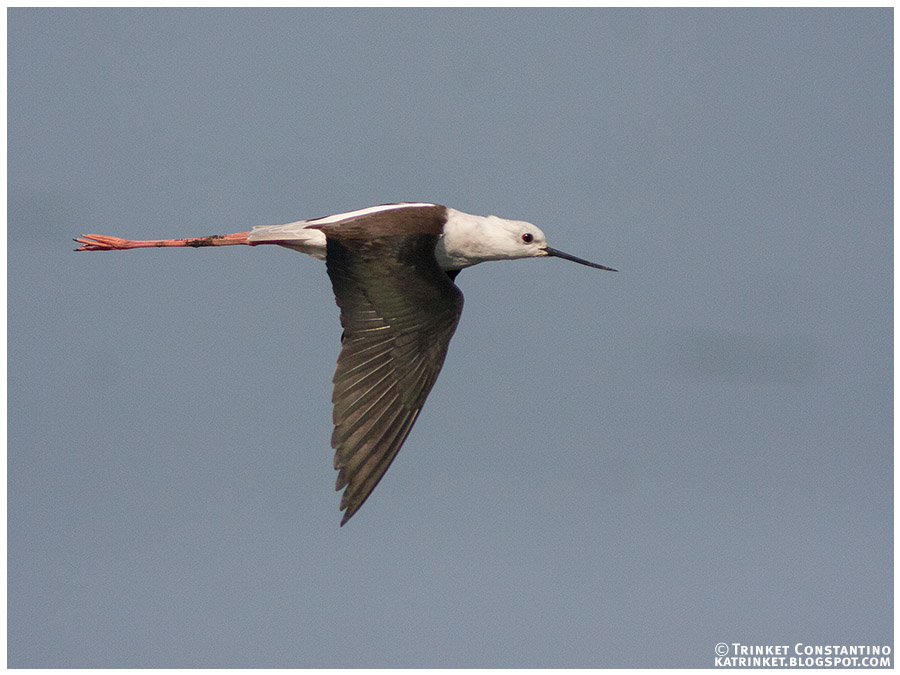
There were also several Black-winged Stilts feeding in the shallow waters, accompanied by a few Common Greenshanks.  Always elegant, whether standing on the impossibly long pink legs, or flying above the water, Black-winged Stilts are among my favorite waders.


Every now and then Adri would spot a large flock of incoming waders: sometimes terms, sometimes plovers or sandpipers.  They were flying so high up in the air!


Most of the east bank nearest to the sea was occupied with large fishponds.


Their fences provided perches for many of the terns.  This guard dog didn't mind the birds but it sure made quite a racket barking at us walking on the dirt path several meters away!


Arne and Angelo made it all the way to the shores of Manila Bay, I think!  We ran into them already walking back and so we made a u-turn as well.


It was getting late in the afternoon and the shadows getting longer.  The earth was cooling down a bit and the scenery was very tranquil.


We thought we were already done with our counts, but wait! There was more!  We spotted a few more waders at the beginning of the asphalted road on our way back.  There was even a Peregrine Falcon patrolling the fields at sunset, perched on a low dike!


In the end we came up with a count of more than 30,000 waders and wetland-associated birds!  Spending an entire day counting on the survey was exhausting and so I appreciated Arne's enthusiasm and professionalism even more after the experience.  At the end of the day as we drove off with the sun setting behind us we were in the good company of passionate birders, the total numbers were amazing and it was all well worth the back breaking and eye-crossing job of counting waders for almost 12 hours.


In the morning after our retreat from the original plan!


Thursday, May 4

Stilts at LPPCHEAA

On the 1st of April, a few WBCP-ers (led by Mike L. and Arne J.) attended the groundbreaking for a wetland park at the LPPCHEA (Las Piñas-Parañaque Critical Habitat and Ecotourism Area). Finally!  Hopefully, this project, led by Sen. Cynthia Villar, will focus on the importance of the mudflats as a wetland (it is a declared RAMSAR site!) and as a green space in a city choked by urban developments lacking environmental planning.

Adri and I were there but unwittingly skipped the ceremonies as we were captivated by several Black-winged Stilts foraging along a relatively clean beach.  We had lost track of the time and got caught up documenting the graceful stilts as they were feeding along the waterline.

When we arrived at sunrise, I was delighted to see that much of the trash along the coastline had been cleared (still a lot left of course, I would think it almost impossible to clean all of it up, with more trash coming in daily with the tide).  The beautiful shell beach was exposed - revealing a diversity of gastropods and bivalves, together with a bit of plant litter: seeds, twigs (and sadly some plastic knick knacks).  It was definitely a bit of beauty one seldom would expect to find along the Manila beaches of the bay.


I could only imagine all the possibilities of having a clean beach in Metro Manila for the city-dwellers to enjoy.


A lone Common Sandpiper was busy preening in the golden monring light, stanind on a bit of muddy, discarded rubber/canvas/plastic.


A few stilts were on the beach at first, some resting and preening, others busy foraging for food. Many of them were quite vocal, twittering loudly.


There were few other migrants at the beach, although in the distance at the river mouth we could see several egrets, some herons and quite a number of waders.

A few Common Greenshanks flew past us, twittering loudly.


It was not only the birds out foraging, a man and his two young boys were also busy looking for shellfish in the shallow waters.


As the shadows receded with the rising sun, more and more stilts began flying in.  It was nice to see varying plumage, from the usual greyish markings of younger birds to elegant black and white plumage of the full adults.


Adri and I found a nice large log to sit on, under the shade of the mangroves.  The birds soon got used to our presence and began to get comfortable.

We practice in-flight shots with two Whiskered Terns.


And got a good laugh trying to outdo each other with stilts-in-flight shots.


Some of the stilts were flying back and forth right in front of us!  Sometimes they were too close!


We were not the only humans on the beach, several meters away was a man busy with his boat, being ignored by most of the birds.


A few greenshanks decided to join the stilts.


And one of the beach dogs also came out to inspect the debris that had been carried in by the tide.


Soon the tide began to turn and we could tell the ground breaking event had finished, because we could see large groups of people descending on the beach.  In the distance, a large group in orange jackets were busy cleaning up the coast.


Nearby, a group decided to take the DENR trash boat (it had a huge net to catch floating trash out at sea) for a quick spin.  The Black-winged Stilts paid no attention to the people (probably because the people were not paying any attention to them either!)


The tide was eating up the thin stretch of beach so we decided to start heading back.  We ran into some of the participants and volunteers who were with Rey Aguinaldo (DENR Region IV and LPPCEHA Project Manager).  We were happy to show them some of the stilts through the scope.  They expressed their surprise at the number of birds along the beach, even commenting that they were happy that the event (with its many people and loud sound system) did not flush or scare them away.


As we walked back to the car along the more shaded inland trail, we spotted other migrants: a noisy Brown Shrike and a confiding Arctic Warbler.


We also ran into several groups of Barred Rails and Common Moorhens foraging under the mangroves.

At the end of the beach near the car, we saw a small group of three enjoying a swim in the water.  It was not something I would recommend!  I am still hopeful though, that one day, Manila Bay will be clean enough for more recreational activities.  With the threat of reclamation looming, perhaps a wetland park is just what LPPCHEA needs. Not just for humans, but for all the other wild ones that need it too.


Keeping my fingers crossed.


Saturday, January 30

Twitching the Candaba teals

As I mentioned in my previous post on Candaba, a couple of days after Adri and I did our ocular, Rob and Irene and Mel spotted a new country record: a Baikal Teal.  After a few days, a duck which was spotted earlier by Kevin Artiaga (one of Lala's students), was identified as a Falcated Duck (also known as Falcated Teal), another country record!

Exciting times again for Candaba, after last year's Baer's Pochard.

With Adri out on tour, I was happy to tag along with Tere, Alex and Drew to twitch the country rarity.  Meeting us there were Tina and Neon ready with their bazooka lenses. Mads and Jude were also following.  A daily stream of visitors kept us up to date on the sightings, it was obviously a big deal to the local birding community to have two new country records at a very accessible location.

When we arrived, the plains and ponds were just being lit up by the golden morning light.  In front of us was the remaining pond, filled with thousands of ducks: mostly the endemic Philippine Ducks, some resident Wandering Whistling Ducks, and the migrants of course: Garganey, Northern Shovellers, Northern Pintails, Eurasian Wigeons, Green-winged Teal, Tufted Ducks.  The challenge was on to find a single Baikal Teal and a single Falcated Duck.


This pond is where we had to find the ducks.

As we surveyed the ponds, every now and then a flock of Black-winged Stilts would take to the air, elegant and graceful as ever.


Black-winged stilts in flight.


The skittish Philippine Ducks would also suddenly lift off noisily from the water's surface, joined by a few migrants.  They would circle the ponds and land again, with just as much splash as they made taking off.


A frenzy of Philippine ducks.


A Eurasian Coot swam quietly near us.


This coot was quite close.


We were all quietly concentrating on looking at each and every duck (something we really should do, even without specific target in mind: that's how unusual sightings are made!).

And then, in a sea of fl0ating kangkong leaves and blossoms, a brilliant emerald green suddenly popped out.  It was the Baikal Teal!


Can you spot the Baikal Teal in this photo? (See the close-up below)


A beautifully plumaged duck: the Baikal Teal in the floating vegetation.


It was quite a distance away, thankfully it was in the vicinity of a small bahay kubo in the middle of the pond, which made it easier to point out to the others.


The teal was somewhere here.


Yay!


Watch this short video in HD (click play then the gear on the bottom to change quality to HD).  Thanks to Alex for sharing this i-phone-scoped video!


It was busy preening itself, so every now and then its head would disappear into the kangkong.  Later it would even go to sleep, its head tucked under its wings.


It became even harder to spot when it tucked its head in to sleep.


It's a good thing it had a very distinct head pattern and color, which made it easier to spot once you knew its general location.


Here it is!


Later it would move around, never flying up but paddling across the pond or flying low short distances. As long as we kept our eye on it from time to time, it was easy to keep track of it or even to find it again.


It moved about in the kangkong, mostly half hidden with only its head sticking out (thanks to Drew for the enhanced i-phone-scoped photo on the corner!)


High fives and thumbs up all around!


Birders and photographers enjoying the Teal, even if it was quite a distance away.


As we were observing the Teal, suddenly an Eastern Marsh Harrier showed up, spooking most of the ducks into the air (but thankfully not the teal).  


A majestic aerial display by an Eastern Marsh Harrier.


While we were watching the aerial display, Mads suddenly exclaimed: "Nakita ko na sya!" ("I've spotted it!") referring to the Falcated Duck.

Scopes, cameras and bins suddenly zoomed in on to the general location Mads was pointing to, which was even further than the location of the Teal!


The Falcated Duck is somewhere here, with some Philippine Ducks and Northern Pintail.


Sure enough, swimming with several Philippine Ducks was the target. It was a handsome duck, with a deep chocolate, head which glossed a bright green under the sun. It had a white throat and spot at the base of its beak.


The Falcated Duck was busy preening, it's green glossy head shimmering in the sunlight.


Like the Teal, it was busy preening itself, and every know and then we could see the curved feathers on its side and back after which it was named.

Yay again!


A short video of the Falcated Duck, thanks to Tere for sharing this i-phone scoped video! (Remember to watch it in HD)

It's great to have had the chance to observe these new country records.  We couldn't use our normal Kennedy field guide as it didn't have these species' descriptions, so we had to refer to other field guides.


No Kennedy guides were used that morning!

These sightings once again highlighted the need to preserve the remaining wetlands of Candaba which have all but been converted to great swathes of rice fields to feed the burgeoning population. The earth that feeds and shelters us needs to feed and shelter those we share it with too.


Mads writes about the latest Candaba sightings and a new initiative to save its remaining wetlands here: http://www.gmanetwork.com/news/story/551976/scitech/science/various-rare-birds-spotted-in-candaba.