Showing posts with label lamesa. Show all posts
Tuesday, December 6
We meet again
I've missed you Ashy Thrush!
It's been a long time. It was great to see you again. Good of you to stop and say hi.
Don't be a stranger!
On the other hand, you, Yellow-vented Bulbul, I hardly miss. I see you everyday.
And you, Common Kingfisher, you're only here half the year, so I don't mind seeing you often when you are here.
Wednesday, November 30
Squirrels in the City
A couple of Saturdays ago, I met up briefly with Adri and his group of Japanese birders at nearby La Mesa Eco Park (LMEP). One of the first creatures we spotted, right there at the parking lot, was a squirrel! It was high up in the narra trees, busy gnawing at something on the branches.
There are no squirrels native to Luzon island, but sightings have been more and more frequent in the past few years, especially in Metro Manila.
Finlayson's squirrels (Callosciurus finalysonii) are originally from Thailand, Cambodia, Laos and Vietnam, and are thought to have been introduced locally through the pet trade.
I first saw them as a new birdwatcher at the American War Cemetery in Taguig. It was a common experience then to be distracted from birding by the sight of a furry creature with a long bushy tail scampering across the manicured lawns and rows of white crosses at the cemetery. Since then, I've seen them at the Ninoy Aquino Parks and Wildlife in Quezon City and at Avilon Zoo (outside the cages!) in Rodriguez. My brother, who lives in Alabang, has often complained about them raiding bird's nests and chewing on electric and communications cables in their neighborhood. Fellow birders have spotted them at the University of the Philippines in Diliman, the residential areas of Dasmariñas and Forbes Park in Makati, and more recently at the Baclaran Church compound!
Having been born and raised in Metro Manila by parents who are also from Luzon, I was only familiar with squirrels from story books when I was very young (yes, Beatrix Potter's Squirrel Nutkin!) and picture books which showed mostly North American fauna. I was thrilled to learn (quite late I admit) that there were squirrels native to the Philippines. I always love seeing the red, noisy tree squirrels on Palawan the locals call bising (and AT LEAST once I saw a squirrel in Mindanao).
I find squirrels quite cute (note, they ARE rodents like the more often detested mice and rats, but I'm sure I'm not the only one who finds them cute). They scamper about the trees, moving up and down almost non stop, waving their bushy tails in the air. The Finlayson's is definitely no less cute in my book.
The problem is that the Finlayson's is not a native and it seems to be spreading quite quickly. It's already known to cause damage to man-made structures, especially electric wires, and is really becoming a pest. How else will it affect the environments (and the native species that live there) it is rapidly invading?
The Finlayson's squirrel is already an entry in a wonderfully informative book which came out this year "The Mammals of Luzon Island: Biogeography and Natural History of a Philippine Fauna" by Heaney, Balete and Rickart. It looks like this mammalian "foreigner" is here to stay in Luzon, much like the more familiar Long-tailed Macaques and Civet Cats which are also thought to have been introduced to Luzon long, long ago, and which have now been "naturalized". Here to stay, for better or (more likely) for worse.
So keep an eye out for these little mammals in your backyard Metro Manilans! Who would've thought, squirrels in the city.
There are no squirrels native to Luzon island, but sightings have been more and more frequent in the past few years, especially in Metro Manila.
![]() |
| A Finlayson's squirrel (Callosciurus finalysonii) in La Mesa Eco Park |
Finlayson's squirrels (Callosciurus finalysonii) are originally from Thailand, Cambodia, Laos and Vietnam, and are thought to have been introduced locally through the pet trade.
I first saw them as a new birdwatcher at the American War Cemetery in Taguig. It was a common experience then to be distracted from birding by the sight of a furry creature with a long bushy tail scampering across the manicured lawns and rows of white crosses at the cemetery. Since then, I've seen them at the Ninoy Aquino Parks and Wildlife in Quezon City and at Avilon Zoo (outside the cages!) in Rodriguez. My brother, who lives in Alabang, has often complained about them raiding bird's nests and chewing on electric and communications cables in their neighborhood. Fellow birders have spotted them at the University of the Philippines in Diliman, the residential areas of Dasmariñas and Forbes Park in Makati, and more recently at the Baclaran Church compound!
Having been born and raised in Metro Manila by parents who are also from Luzon, I was only familiar with squirrels from story books when I was very young (yes, Beatrix Potter's Squirrel Nutkin!) and picture books which showed mostly North American fauna. I was thrilled to learn (quite late I admit) that there were squirrels native to the Philippines. I always love seeing the red, noisy tree squirrels on Palawan the locals call bising (and AT LEAST once I saw a squirrel in Mindanao).
![]() |
| A Palawan Tree Squirrel (Sundasciurus juvencus) in Puerto Princesa |
![]() |
| A Mindanao Squirrel (Sundasciurus mindanensis) from Mt. Talomo in Davao. Photo c/o Adri |
I find squirrels quite cute (note, they ARE rodents like the more often detested mice and rats, but I'm sure I'm not the only one who finds them cute). They scamper about the trees, moving up and down almost non stop, waving their bushy tails in the air. The Finlayson's is definitely no less cute in my book.
The problem is that the Finlayson's is not a native and it seems to be spreading quite quickly. It's already known to cause damage to man-made structures, especially electric wires, and is really becoming a pest. How else will it affect the environments (and the native species that live there) it is rapidly invading?
The Finlayson's squirrel is already an entry in a wonderfully informative book which came out this year "The Mammals of Luzon Island: Biogeography and Natural History of a Philippine Fauna" by Heaney, Balete and Rickart. It looks like this mammalian "foreigner" is here to stay in Luzon, much like the more familiar Long-tailed Macaques and Civet Cats which are also thought to have been introduced to Luzon long, long ago, and which have now been "naturalized". Here to stay, for better or (more likely) for worse.
So keep an eye out for these little mammals in your backyard Metro Manilans! Who would've thought, squirrels in the city.
Labels:
books,
lamesa,
metromanila,
squirrel
Wednesday, February 26
Once more with feeling
And I was back at the La Mesa EcoPark! For the school holiday, Adri and I decided to have a relaxed morning birding. The park was quite busy, a school was holding its family day at the amphitheater and loud music, prayer and cheering reverberated through the mini forest. Fortunately, it was still a good day for us, birding and photography-wise, as the birds didn't seem to mind the noise.
Barely had we entered the trail, when we quickly spotted a red-bellied pitta, very shy and retiring, it quickly disappeared fast as its little legs could run. We also ran into LMEP regular, Anthony B., who informed us that WBCP-ers Linda G. and Jo S. were also there. Walking onward, we came across Peter T., who was with an eager group of Hong Kong birder/photographers, stalking a hooded pitta with huge lenses. Not wanting to get in their way, we proceeded on.
Enticed by the loud calling of a grey-backed tailorbird, we almost missed a flock of eye-browed thrushes! There were five or six of them flying around, and one of them perched for quite a while, busy preening itself. Was I glad I had a camera with me this time!
As we enjoyed close views of the thrushes, the resident ashy thrush scuttled quickly across the trail, while above us a Philippine coucal moved cautiously in the tangles. Guaiaberos, arctic warblers, gerygones, lowland white-eyes, olive-backed sunbirds, red-keeled flowerpeckers, magpie-robins and pied fantails moved noisily about the foliage, bird songs competing with pop music amplified by a sound system.
We moved on and to our surprise, we ran into the eye-browed thrushes again! Just like my last visit, they took quick trips to the palm trees by the trail to grab some of the bright red fruit.
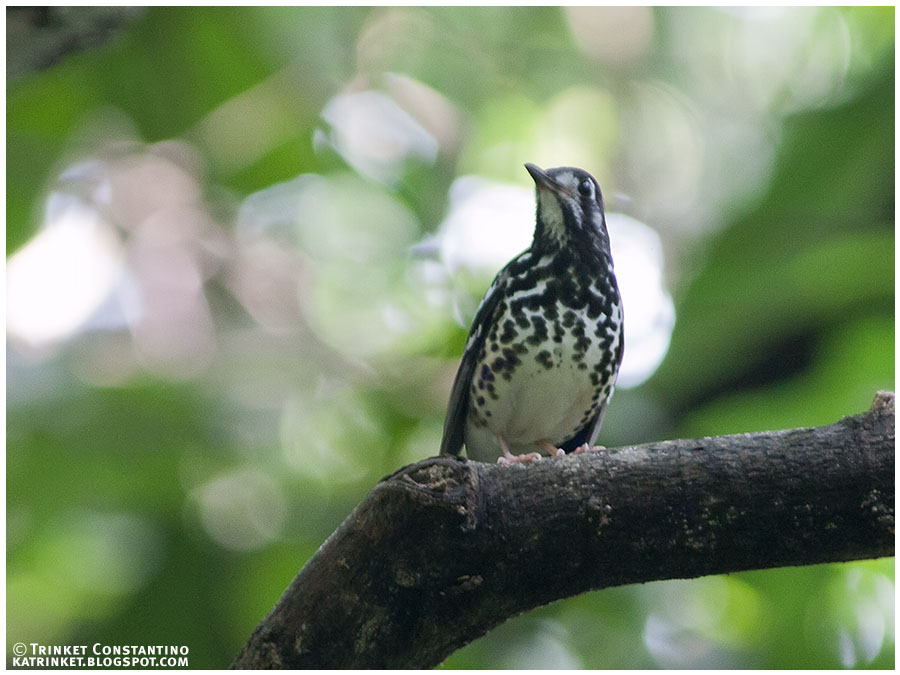
Not to be outdone by its migrant cousins, a very photogenic ashy thrush was sitting on an acacia buttress. It was a shady perch, but it sat just where a shaft of sunlight broke through the leaves, making a beautifully dramatic photo.
It stood quite still for a good half an hour, trilling ever so softly. Linda and Jo found us standing there in the middle of the path, admiring it.
A group of high school students from nearby Diliman Preparatory School (looking like they were filming a school project) regarded us curiously, and we pointed out the thrush. It was great to hear and see them get all excited (complete with exaggerated arm movements and jumping up and down!) as they successfully spotted the bird which was well inside the small forest patch.
Linda and Jo had just seen the mangrove blue flycatcher, a bird which had been conspicuously hard to find at the park recently. So we all moved on, Adri and I out to look for the flycatcher and the hooded pitta, and Linda and Jo to look for the red-bellied pitta we had seen earlier.
While looking for the pitta, we did spot the mangrove blue flycatcher, but it only afforded us a brief view, before flying into the undergrowth.
We settled ourselves down and decided to wait for the pitta to come out, as it was hopping behind the branches and leaves, barely in our view.
And come out it finally did! Just like the thrushes, it was very cooperative, coming out in the open to forage for food, scurrying back into hiding as people passed behind us on the trail, only to come out as their voices faded away when they moved on.
After watching it for several minutes, Adri and I were both satisfied with our shots and decided that it was time to head back.
Just as we were about to leave the mini forest, we again spotted the red-bellied pitta! It was also scrounging the ground for food. Like its hooded cousin, it would scurry out of sight when people passed by the trail. It would stay very still behind some plants for several minutes, but eventually would come out into the open again.
Adri and I again settled down and lay in wait. A slight movement on our left revealed an emerald dove likewise walking on the ground.
The pitta had probably decided we weren't a threat, so it came out in the open for quite some time. The high school students we had talked to earlier passed by us once more and asked (in hushed voices now) if we were again looking at a bird. I quietly pointed to my camera's LCD display and then to where the bird was standing. It was much easier to spot of course than the ashy thrush, a bright red belly pretty much stands out against the dried leaves!
The students could hardly contain their excitement. Even toned down, their repressed squeals of delight and hurried whispers surprised the pitta and it ran for cover. But Adri and I didn't mind so much as we had already been observing the pitta for some time.
Actually, I don't know if I was more pleased with our pitta sighting or with these excitable kids finding the birds, in their words, "Cool!"
Barely had we entered the trail, when we quickly spotted a red-bellied pitta, very shy and retiring, it quickly disappeared fast as its little legs could run. We also ran into LMEP regular, Anthony B., who informed us that WBCP-ers Linda G. and Jo S. were also there. Walking onward, we came across Peter T., who was with an eager group of Hong Kong birder/photographers, stalking a hooded pitta with huge lenses. Not wanting to get in their way, we proceeded on.
Enticed by the loud calling of a grey-backed tailorbird, we almost missed a flock of eye-browed thrushes! There were five or six of them flying around, and one of them perched for quite a while, busy preening itself. Was I glad I had a camera with me this time!
![]() |
| The eye-browed thrush is quite a handsome bird. |
As we enjoyed close views of the thrushes, the resident ashy thrush scuttled quickly across the trail, while above us a Philippine coucal moved cautiously in the tangles. Guaiaberos, arctic warblers, gerygones, lowland white-eyes, olive-backed sunbirds, red-keeled flowerpeckers, magpie-robins and pied fantails moved noisily about the foliage, bird songs competing with pop music amplified by a sound system.
We moved on and to our surprise, we ran into the eye-browed thrushes again! Just like my last visit, they took quick trips to the palm trees by the trail to grab some of the bright red fruit.
![]() |
| Another look at the eye-browed thrush. |
Not to be outdone by its migrant cousins, a very photogenic ashy thrush was sitting on an acacia buttress. It was a shady perch, but it sat just where a shaft of sunlight broke through the leaves, making a beautifully dramatic photo.
![]() |
| I don;t think I shall tire of seeing this endemic. |
It stood quite still for a good half an hour, trilling ever so softly. Linda and Jo found us standing there in the middle of the path, admiring it.
![]() |
| The thrush makes such lovely pictures |
A group of high school students from nearby Diliman Preparatory School (looking like they were filming a school project) regarded us curiously, and we pointed out the thrush. It was great to hear and see them get all excited (complete with exaggerated arm movements and jumping up and down!) as they successfully spotted the bird which was well inside the small forest patch.
| Curious kids are always a delight. |
Linda and Jo had just seen the mangrove blue flycatcher, a bird which had been conspicuously hard to find at the park recently. So we all moved on, Adri and I out to look for the flycatcher and the hooded pitta, and Linda and Jo to look for the red-bellied pitta we had seen earlier.
While looking for the pitta, we did spot the mangrove blue flycatcher, but it only afforded us a brief view, before flying into the undergrowth.
![]() |
| A very shy mangrove blue flycatcher |
We settled ourselves down and decided to wait for the pitta to come out, as it was hopping behind the branches and leaves, barely in our view.
And come out it finally did! Just like the thrushes, it was very cooperative, coming out in the open to forage for food, scurrying back into hiding as people passed behind us on the trail, only to come out as their voices faded away when they moved on.
![]() |
| A very pitta pose for the hooded. |
After watching it for several minutes, Adri and I were both satisfied with our shots and decided that it was time to head back.
![]() |
| And another view of the hooded pitta |
Just as we were about to leave the mini forest, we again spotted the red-bellied pitta! It was also scrounging the ground for food. Like its hooded cousin, it would scurry out of sight when people passed by the trail. It would stay very still behind some plants for several minutes, but eventually would come out into the open again.
![]() |
| The red-bellied pitta busy with a worm (even if it wasn't so early) |
![]() |
| The pitta trying to hide behind some leaves. |
Adri and I again settled down and lay in wait. A slight movement on our left revealed an emerald dove likewise walking on the ground.
![]() |
| An emerald dove attempting to distract us. |
The pitta had probably decided we weren't a threat, so it came out in the open for quite some time. The high school students we had talked to earlier passed by us once more and asked (in hushed voices now) if we were again looking at a bird. I quietly pointed to my camera's LCD display and then to where the bird was standing. It was much easier to spot of course than the ashy thrush, a bright red belly pretty much stands out against the dried leaves!
![]() |
| And the red-bellied pitta yet again. |
The students could hardly contain their excitement. Even toned down, their repressed squeals of delight and hurried whispers surprised the pitta and it ran for cover. But Adri and I didn't mind so much as we had already been observing the pitta for some time.
Actually, I don't know if I was more pleased with our pitta sighting or with these excitable kids finding the birds, in their words, "Cool!"
Labels:
birding,
dove,
endemic,
flycatcher,
lamesa,
migrants,
pitta,
quezoncity,
thrush
Monday, February 3
The one with just us girls and I had no camera*
* Yes, I was a Friends (1994 - 2004) fan, and I can't believe it's been 10 years since the series ended!
With Adri away on tour for a month, and Jops likewise on a guiding trip, Maia and I decided to have a girls-only birding morning at La Mesa Ecopark.
I was so excited to go birding, Maia had told me that they had seen the White's (Scaly ground) Thrush during the weekend. It was a lifer for me the previous new year and I wanted a better look at it.
I arrived ahead of Maia by just a few minutes so I waited for her at the path by the entrance, entertained by a hungry Brush Cuckoo which was picking out some caterpillars inside the tangles of a Thumbergia vine.
It was great to get to LMEP on a weekday morning as the usual weekend crowds were absent and we shared the park with only the regular joggers. As we entered the mini-forest, a small movement in the undergrowth caught Maia's attention. It was a Pechora Pipit running around looking for food.
We immediately headed for the fruiting palm trees and within a few minutes, our target arrived! In flight the White's Thrush's large size was obvious. It perched right on a clump of bright red palm fruit and began eating. This was a much better view than my fleeting glance from last year! Unfortunately, I didn't have a camera with me, but you can check out Maia's pictures on her blog here.
We watched the thrush for some time, until suddenly an Ashy (Ashy Ground) Thrush flew in and chase away the bigger thrush. How strange for these ground birds to be up in trees for extended periods!
We tried to find the Spotted Wood Kingfisher, but we didn't find it, so I still had not seen this popularly photographed bird in this park. The usual park residents: Large billed crows, Red-keeled Flowerpeckers, Philippine Magpie-Robins, the Phlippine Pied Fantail (recently promoted to an endemic!), Colasisis, Guaiaberos, Arctic Warblers, Olive-backed Sunbirds, called incessantly around us.
We walked back to the palm trees, where the Yellow-vented Bulbuls were taking their turn at the ripe fruit.
Maia decided to wait for the thrushes for a better photo, and I went in search for a second target: a would-be lifer which was often seen and photographed at the park but which I had yet to see clearly. All my previous sightings were of a bird scurrying into the undergrowth in my peripheral vision. As I walked quietly on the trail, a movement on my right revealed the Pechora Pipit again, looking comical as it jumped up and down from the ground to reach a caterpillar on some high leaves.
As I rounded the turn, there it was! On the middle of the path, as clear a view as I could wish for, was the Slaty-legged Crake! It was nicely framed by the greenery on the side of the path (this was where the path was narrowest for the entire trail). It stood still for several seconds so I could drink in all the wonderful details: its bright red-orange head and breast, distinct black and white barring on its belly, its bright red eyes delicately ringed with the thinnest yellow line. (Really, with all those distinctive features jumping out at you, it had to be named after its grey legs?!?!?)
Woohoo! Without a camera in hand, I committed to memory the picture.
"Alam mo bakit mo nakita?"
"Kasi wala kang camera!"
("Do you know why you saw it? Because you didn't have a camera with you!")
Those were my husband's words to me when I had immediately texted him of my victory.
I gleefully returned to Maia at the palm trees and reported my lifer to her. As we fell in to random chitchat, the bulbuls and both thrushes continued to return to the red fruit. It was funny watching both the Ashy Thrush and the Yellow-vented Bulbuls dive-bombing the much larger white's Thrush when it landed on the red fruit. Those fruits must have a high commodity value! We got to talking about the other thrushes we had seen at the exact same place the year before. And, as if in response to our reminiscing, what would perch on the red fruit but an Eye-browed Thrush! It was much more reticent than its cousins, and just grabbed a few fruit and immediately left.
After a few more minutes, some school kids on a field trip came walking up the trail, engaged in loud chatter. With that, Maia and I decided to end our girls'-morning-out. And what a very productive morning it was!
Second lifer for 2014: Slaty-legged Crake (hmmm... still no photo!)
With Adri away on tour for a month, and Jops likewise on a guiding trip, Maia and I decided to have a girls-only birding morning at La Mesa Ecopark.
I was so excited to go birding, Maia had told me that they had seen the White's (Scaly ground) Thrush during the weekend. It was a lifer for me the previous new year and I wanted a better look at it.
I arrived ahead of Maia by just a few minutes so I waited for her at the path by the entrance, entertained by a hungry Brush Cuckoo which was picking out some caterpillars inside the tangles of a Thumbergia vine.
It was great to get to LMEP on a weekday morning as the usual weekend crowds were absent and we shared the park with only the regular joggers. As we entered the mini-forest, a small movement in the undergrowth caught Maia's attention. It was a Pechora Pipit running around looking for food.
We immediately headed for the fruiting palm trees and within a few minutes, our target arrived! In flight the White's Thrush's large size was obvious. It perched right on a clump of bright red palm fruit and began eating. This was a much better view than my fleeting glance from last year! Unfortunately, I didn't have a camera with me, but you can check out Maia's pictures on her blog here.
We watched the thrush for some time, until suddenly an Ashy (Ashy Ground) Thrush flew in and chase away the bigger thrush. How strange for these ground birds to be up in trees for extended periods!
![]() |
| The bright red fruit of the McArthur palms |
We tried to find the Spotted Wood Kingfisher, but we didn't find it, so I still had not seen this popularly photographed bird in this park. The usual park residents: Large billed crows, Red-keeled Flowerpeckers, Philippine Magpie-Robins, the Phlippine Pied Fantail (recently promoted to an endemic!), Colasisis, Guaiaberos, Arctic Warblers, Olive-backed Sunbirds, called incessantly around us.
We walked back to the palm trees, where the Yellow-vented Bulbuls were taking their turn at the ripe fruit.
Maia decided to wait for the thrushes for a better photo, and I went in search for a second target: a would-be lifer which was often seen and photographed at the park but which I had yet to see clearly. All my previous sightings were of a bird scurrying into the undergrowth in my peripheral vision. As I walked quietly on the trail, a movement on my right revealed the Pechora Pipit again, looking comical as it jumped up and down from the ground to reach a caterpillar on some high leaves.
As I rounded the turn, there it was! On the middle of the path, as clear a view as I could wish for, was the Slaty-legged Crake! It was nicely framed by the greenery on the side of the path (this was where the path was narrowest for the entire trail). It stood still for several seconds so I could drink in all the wonderful details: its bright red-orange head and breast, distinct black and white barring on its belly, its bright red eyes delicately ringed with the thinnest yellow line. (Really, with all those distinctive features jumping out at you, it had to be named after its grey legs?!?!?)
Woohoo! Without a camera in hand, I committed to memory the picture.
"Alam mo bakit mo nakita?"
"Kasi wala kang camera!"
("Do you know why you saw it? Because you didn't have a camera with you!")
Those were my husband's words to me when I had immediately texted him of my victory.
![]() |
| Without a camera, i was forced to sketch! |
I gleefully returned to Maia at the palm trees and reported my lifer to her. As we fell in to random chitchat, the bulbuls and both thrushes continued to return to the red fruit. It was funny watching both the Ashy Thrush and the Yellow-vented Bulbuls dive-bombing the much larger white's Thrush when it landed on the red fruit. Those fruits must have a high commodity value! We got to talking about the other thrushes we had seen at the exact same place the year before. And, as if in response to our reminiscing, what would perch on the red fruit but an Eye-browed Thrush! It was much more reticent than its cousins, and just grabbed a few fruit and immediately left.
After a few more minutes, some school kids on a field trip came walking up the trail, engaged in loud chatter. With that, Maia and I decided to end our girls'-morning-out. And what a very productive morning it was!
Second lifer for 2014: Slaty-legged Crake (hmmm... still no photo!)
Monday, August 5
getting re-acquainted
it was a school holiday and i got the chance to join adri and visiting birder rob for a short birding jaunt to nearby la mesa eco park. it was a re-acquaintance with the regular birds of the park mini-forest: the ashy ground thrushes were busy, busy, busy. another active nest was a good sign of their continuing success.
the red-bellied pitta was also present, having been a-miss the past few times we had visited the park. the mangrove blue-flycatchers were busy feeding a brood of 3 demanding fledglings. grey-backed tailorbirds sang noisily from the tangles. common emerald doves and white-eared brown doves flew across the paths. flocks of white-eyes twitted above, moving in large flocks through the canopy.
we were on our way out when a heavy rain poured and we sought shelter at the refreshment and first aid stand where we ran into lmep regular anthony who brought more good news. the red-bellied pittas were also busy with a family of 3 young birds! it looked like the park birds were having a good breeding season!
we decided to take a peek at the spillway and check for rails. the rain had slowed to a light shower and although barred rails called loudly, all we could spot was a single white-breasted waterhen which quickly disappeared into the grass.
as we were watching the bulbuls bathing in the rain, another bird caught our attention. it was sitting quietly with its back to us in a thorny bush, and we had a very bad view. but it would turn its head every now and then and adri was quick to call it. a plaintive cuckoo! it was a great sighting for all of us, a lifer for rob and a bird i could not even remember when i last saw.
it finally moved, affording us a better view of its orange-ish eyes and cross-thatch patterned tail. it didn't seem to mind the many bulbuls it was sharing the bush with but got quite excited when a pair of golden-bellied fly-eaters arrived. foster parents? or possible victims for this nest parasite?
after almost half an hour, it finally moved into the bush out of sight. it was great for me to see this bird again after a long time, it almost felt like a lifer all over again!
![]() |
| another busy day collecting worms for one ashy thrush... |
![]() |
| ... sitting on a nest for another |
the red-bellied pitta was also present, having been a-miss the past few times we had visited the park. the mangrove blue-flycatchers were busy feeding a brood of 3 demanding fledglings. grey-backed tailorbirds sang noisily from the tangles. common emerald doves and white-eared brown doves flew across the paths. flocks of white-eyes twitted above, moving in large flocks through the canopy.
we were on our way out when a heavy rain poured and we sought shelter at the refreshment and first aid stand where we ran into lmep regular anthony who brought more good news. the red-bellied pittas were also busy with a family of 3 young birds! it looked like the park birds were having a good breeding season!
we decided to take a peek at the spillway and check for rails. the rain had slowed to a light shower and although barred rails called loudly, all we could spot was a single white-breasted waterhen which quickly disappeared into the grass.
as we were watching the bulbuls bathing in the rain, another bird caught our attention. it was sitting quietly with its back to us in a thorny bush, and we had a very bad view. but it would turn its head every now and then and adri was quick to call it. a plaintive cuckoo! it was a great sighting for all of us, a lifer for rob and a bird i could not even remember when i last saw.
![]() |
| a very wet plaintive cuckoo sitting quietly in the rain |
it finally moved, affording us a better view of its orange-ish eyes and cross-thatch patterned tail. it didn't seem to mind the many bulbuls it was sharing the bush with but got quite excited when a pair of golden-bellied fly-eaters arrived. foster parents? or possible victims for this nest parasite?
![]() |
| a front view of the plaintive cuckoo... better but still not ideal |
after almost half an hour, it finally moved into the bush out of sight. it was great for me to see this bird again after a long time, it almost felt like a lifer all over again!
Tuesday, April 30
target qc birding
it was another target birding trip, but this time we were not working on our own targets, but stuart m.'s target birds. and we didn't have to travel far as these targets were found around quezon city.
fresh from giving a workshop at the recently concluded 6th international hornbill conference in makati, stuart was eye-ing to see philippine endemics found at the nearby la mesa reservoir area. he had heard about these endmic superstars from his student, wbcp-er lala e., who had just very recently finished her ph.d. (congratulations dr. lala!!!).
not surprisingly, number one on our target list for the day was the ever popular ashy ground thrush of the la mesa eco park. however, a recently reported philippine frogmouth on a nest at the la mesa nature reserve was our first agenda for the morning.
so stuart, adri and myself met up with wbcp-er and bird photographer neon at 630am at the la mesa nature reserve. it was our first time to visit the nature reserve, but i was happy to be met by kuya efren, who remembered me from a birdwatching workshop jops, maia, jon j, drew and myself had facilitated at the lmep last year! it was he who had found the frogmouth nest, on the day that his wife had just given birth to twins!
neon was already on site when we arrived and was busy documenting a nearby guaiabero nest. at a nearby tree, the two parents were busy with a young bird who had apparently just fledged. another young bird was still peeking out of the nest! instead of the black beak of the adult, it still sported a yellow orange beak, which was more hook-shaped, more like a colasisi's than a guaiabero's!
![]() |
| a juvenile guaiabero peeks out of its nest, ready to fledge soon |
kuya efren approached us, in complete birding attire (he change his bright yellow uniform for a dull colored long sleeved shirt... according to him he was afraid that i would scold him for not remembering the lessons from our workshop!) and gear: a pair of binoculars and even a scope donated by wbcp-er propjerry!
we set out for our target, and of course birded along the way. guaiaberos, collared kingfishers, white-eared brown doves, yellow vented bulbuls, black naped orioles and white-breasted wood-swallows were a-plenty. a hooded pitta even called from one of the gullys we crossed.
as we neared the site for the frogmouth nest, kuya efren gave us a few very sensible reminders. they had cordoned off the nest area to prevent people from approaching the nest too closely. no going past the marked area, no noise, no sudden movements and no actions to disturb the nesting bird.
and so he led us off the trail and sure enough, there was target bird number 1: a philippine frogmouth sitting very quietly and perfectly camouflaged on its nest.
![]() |
| the strange looking philippine frogmouth incubating an egg on its nest |
although not a lifer for me (i had added it to my lifelist in bohol 3 years ago), it was the first time i for me to see the luzon subspecies fo this bizarre looking bird. again, i had flashbacks of the australian picture books i had read when i was younger, about the tawny frogmouth, which would sit perfectly still, bill pointed to the sky, its feathers blending perfectly with the tree bark color and texture. and here it was, even better. the philippine version, posed exactly like it did in the picture books, huge mouth and all.
it was still sitting on a white egg... fingers crossed that it's a successful endeavor!
kuya efren had one more nest to show us, this time a nightjar nest. so we doubled back to head over to the second location. as we walked single file on the path, we passed a collared kingfisher nest, and another guaiabero nest. a loud melodious call filled the air: "ashy ground thrush singing!" adri exclaimed. as we caught glimpses of this handsome bird, kuya efren (who had gone ahead of the group) came back with sad news. the nightjar nest had been raided. he showed us bits of eggshell in his hand. the perils of ground nesting birds.
before we left, we thanked kuya efren for helping us out and for his responsible nest discoveries. it looks like there are many more discoveries awaiting birders at the lmnr.
our second target was already anti-climactic, since we had already seen an ashy ground-thrush at the nature reserve. still, the la mesa ecopark is hassle free birding and promised better views of this once super elusive endemic.
true enough, upon entering the gate to the park, we immediately heard another ashy ground thrush singing! we set up the scope across the road and as people flowed into the park, it was stuart who quickly found the bird. it was just behind the plants lining the main walkway, singing loudly from its perch.
as we entered the mini-forest trail, we bumped into birder/photographers bob, cynthia and peter, who had been staking out the red-bellied pitta all morning in vain. the good news they had for us that all the other expected birds were just around and we quickly found them: more ashy ground thrushes busy turning over leaves on the ground, very loud grey-backed tailorbirds, several vocal hooded pittas, busy lowland white-eyes still nesting.
![]() |
| the always handsome ashy ground thrush |
![]() |
| close encounters with a grey-backed tailorbird |
![]() |
| one of several hooded pittas calling loudly |
![]() |
| busy as bees, the lowland white-eyes were still gathering nesting material |
there were barred rails, mangrove blue flycatchers, colasisis, arctic warblers and even a pechora pipit among the usual oriental magpie robins, philippine pygmy woodpeckers, black-naped orioles, collared kingfishers and more. pretty good birds for a handful of forest. soon the heat was building up as noon approached and we decided to move on.
while having a quick snack, we called wbcp-er jops to ask if his neighborhood scops owl family was still at their day roost. this was target number four. (unfortunately, target number 3, the philippine nightjar at up diliman, was not to be found at its usual mango tree roost since the tree was fruiting and the fruit being harvested). a sudden summer downpour had us trapped at the restaurant. we spent a very pleasant hour exchanging birding stories and talking philippine pop culture and politics while waiting for the rain to let up.
it was mid afternoon when we arrived at the philippine scops owl site. we were quite nervous as the young scops owls were several weeks old now and we were not sure if they would still be in the same roost. jops said that he had last seen them a week before, when he and maia had checked on them after receiving the news that one of the three fledglings had been found dead. without jops or the neighborhood security guards with us, we weren't sure if we could find the owls.
fortunately, we spotted the two young owls huddled together in the same tree, a little wet from the afternoon rain. they had spotted us first from their high perch aand by the time we had them on the scope, they were glaring at us with their large orange eyes!
after a few minutes though they went back to sleep, catching up on a few more hours of rest before night fell. the adult owls were nowhere to be seen, but with the two juvenile scops olws, our final target was achieved!
![]() |
| the young philippine scops owls glare at us with huge orange eyes |
we dropped off a very happy and fulfilled stuart in makati, with an hour to spare before the conference final dinner. target birding in quezon city was a success!
Labels:
birding,
frogmouth,
lamesa,
owl,
parrot,
pitta,
quezoncity,
tailorbird,
thrush,
whiteeye
Friday, March 15
3 thrushes in 3 hours
having recently broken my work imposed birding mini-hiatus (see my latest backyard lifer here), it seemed inevitable that my resolve not to bird until the second semester grades were submitted would melt away.
i joined adri and visiting singaporean birder albert l. on thursday afternoon to take a look at a new family of philippine scops-owls at the parish church grounds. these owls were recently "discovered" by jops who, just last year, had his own nightly scops-owl visitors to his backyard. we met up with maia and jops (and several curious homeowners) and very quickly found the owls which the subdivision security guards were keeping a close eye on. 2 adults and 3 very fluffy fledglings hunted actively in a very small area in the early evening, their high pitched calls sounding surreal with the evening mass music being played in the background.
![]() |
| an adult philippine scops-owl, busy hunting in the night to feed a brood of 3. |
over dinner, adri and albert casually mentioned their plans to bird at the la mesa ecopark the next day, with the ever popular endemic ashy ground-thrush on top of albert's checklist. when jops asked me if i was going, i said i was really tempted to take the morning off to join them, especially with the recent reports of migratory thrushes being spotted in the area.
eventually we all decided to take the morning off and join adri and albert. what twitchers we were!
and so at 630am, we all met up at the lmep, ready for anything!
our first bird on the trail was a very plump red-bellied pitta, busy trying to get a big & fat earthworm down its throat.
![]() |
| a red bellied pitta caught a bit more than it could swallow. |
we ran into bram, who was busy stalking the ashy ground thrush. we went our separate ways, adri and albert in search of the ashy ground thrush, and the rest of us looking our for our target: the migratory brown-headed thrush, photographed a few days earlier eating ripe and red palm tree fruit.
after a few minutes, i decided to leave jops, maia and bram in front of the palm trees to look for the ashy ground thrush. it was very dark in the inner trails, and i came across a very quiet hooded pitta hopping in the undergrowth. adri and albert were still busy looking for the ground thrush so i decided to walk the whole loop which led me back to jops, maia and bram.
![]() |
| an awful picture of a hooded pitta in the dark; but if you squint your eyes at the screen it comes into focus :) |
maia was a bit agitated as a whole flock of thrushes had flown in and left, leaving her with barely a glimpse, "madami sila pero hindi ko nakita!" she complained to me as i rounded the corner into their view.
argh. did i miss them too?
it must have been several minutes that we stood at the same spot when bram suddenly straightened up, alert at a sharp zeeet-ing call.
above us on a mango tree, very quickly, was a brown-headed thrush, belly view. it quickly flew to a nearby defoliated gmelina, giving a lovely profile view. in a few seconds, it was gone again. a lifer for all 4 of us! we quickly re-hashed our whole experience, describing the birds to each other.
within a few minutes, the thrushes were back! a few of them began feeding at the red palm fruit, giving us opportunities for photos. i quickly messaged adri to come, because i knew that it would be a lifer for both him and albert.
![]() |
| a brown-headed thrush daintily eating some red palm fruit |
soon, both of them appeared on the path, having finally bagged the ashy ground thrush. unfortunately, the brown headed thrushes had once again disappeared. we waited patiently, as they had appeared now 3 times before, we hoped it was just a matter of time before they circled back again.
and they did! a single thrush alighted on the palm tree fruit and we all trained our binoculars on it.
"but that's an eye-browed thrush!" a disappointed tone obvious in adri's voice as he id'd the more common thrush he had seen several times before in kitanglad.
![]() |
| and an eye-browed thrush mixed in with the brown-headed thrushes! |
whaaaaaaat?!? jops, maia and i were confused. sure, eye-browed thrush was a lifer for us also... but...
bram and albert, definitely more seasoned birders than the 3 of us, agreed it was an eye browed thrush.
"but the one before was definitely a brown-headed thrush," bram quickly said.
"it must be a mixed flock," adri reassured us. (we must have looked very confused)
"yes, these turdus species tend to mix together," agreed albert.(we must have looked very confused AND bewildered)
a quick look at the field guide confirmed our confusion. the two species looked very much alike!
we needn't had worried: like clockwork, they were back a second time, and on the same palm tree we had both thrushes: an eye-browed thrush and a brown-headed thrush! the side by side comparison had us celebrating 2 lifers!
being very greedy for good views and photo opportunities, we waited for several more minutes as they came back and back again.
we were finally satiated and decided to go back for the ashy ground-thrush, and maybe a better view of the hooded pitta and the slaty-legged crake (spotted by adri and albert earlier).
we got separated again, when maia pointed out to me a lowland white-eye nest, cleverly camouflaged under the large palo santo leaves. in a few minutes adri came hurrying down the path. the ashy ground-thrush was out in the open! he led us back to albert who was happily clicking away at the endemic thrush perched on an open branch.
![]() |
| the ever handsome endemic ashy ground-thrush |
even if i had only skipped half a day of work i knew i would hardly have my mind on it in the afternoon as a re-lived 3 thrushes in 3 hours in my head over and over again. i wonder if any of the others got any work done?
Tuesday, January 15
new year birding!
happy new year!
no, i haven't been not birding! it's been a long hiatus from blogging because of major life projects in the works but it's back to the (new) normal for me!
my birding year began on the 2nd day of the new year with a lifer! following last years' tradition of a twitchy new year, adri and i met up with felix and mel (and ixi and mikeli and gina and irene and bob and cynthia and jo and doc charo) at the LMEP and quickly spotted the newest LMEP sensation: a very quiet and exceedingly shy scaly ground thrush!
(sorry folks, no picture - a frustratingly difficult to photograph bird! but here's a blurry pic of a close cousin, the once hard to find but now very confiding ashy ground thrush)
![]() |
| the super popular ashy ground thrush of the lmep |
on our way out of the park, adri and i spotted a pair of crested mynas busy cleaning out a tree hollow for their nest.
![]() |
| a crested myna busy cleaning: a new home for the new year |
but my new year's birding didn't end with a twitch, it ended with a non-twitch.
on the 3rd day of the new year...
adri and i decided to take some of my nieces and my nephew out to candaba.
![]() |
| still waters at candaba |
hmmm... small warbler = lbj.
we doubted the kids birding for the first time would appreciate that. so we decided to pass on it. and that was our non-twitch.
so we took the kids (plus my brother george) around the ponds. the planting season was early this year, in anticipation of the early summer/early rains, and we saw very few waders. there were less ducks too, or maybe they were just well hidden. we were able to show some philippine ducks, wandering whistling ducks and tufted ducks clearly. strangely, we saw a wild philippine duck in flock of domestic ducks in the duck pens!
![]() |
| philippine ducks in flight |
there was a flock of over 50 turtle-doves flying around perched on the trees and equally many common moorhens walking around the pond vegetation. as usual, the tiny but impressive common kingfisher was a favorite as was the graceful blue-tailed bee-eater.
![]() |
| a white-browed crake busy preening |
the grey and purple herons were like sentinels standing in the middle of the main pond, together with some egrets and black-crowned night-herons. we were busy birding from the back of a pick-up truck when adri (who was following the pick up in another vehicle with my brother) suddenly jumped down and yelled "raptor!". we looked in the direction he was pointing and glimpsed an eastern marsh harrier taking to the air after surprising a purple heron. as he flew further away, he was mobbed by a flock of white-shouldered starlings.
![]() |
| birding! |
we stayed until sunset, with all it's pink splendor reflected on the waters. in the waning light, a purple swamphen caught everyone's attention as it walked on the water hyacinth nearby, flicking its white tail in the air. "it's a dinosaur!" said one of the kids.
purple swamphen showing its huge feet
![]() |
| another dramatic sunset at candaba |
it was good to start the birding year at a relaxed pace. twitch or non-twitch.
Subscribe to:
Posts (Atom)


