Showing posts with label nuthatch. Show all posts

Monday, July 31

A birdy morning at Irawan

*Watch out! Series of late posts coming up!  With the rainy season comes time to write about the past summer's adventures!

On our first full day in Puerto Princesa, we had a full day ahead.  For our morning, we planned on an early start by birding at Irawan Eco Park.  The last time I had attempted birding there was waaaaaaay back in 2009 during the bird festival! It wasn't a place I was familiar with, but Adri had been there several times.  

As we parked our car on a clearing by the side of the road, the musical calls of a White-vented Shama and a Melodious Babbler greeted us, as well as the low hoots of a Greater Coucal.  Ah Palawan!  Your birds so different from Luzon!   Ashy-headed Babblers called loudly from the undergrowth just at our feet, rustling leaves giving clue to their whereabouts.  The noisy bising (Palawan Tree Squirrels) were busy scurrying up and down trunks and from branch to branch.

While Dollarbirds and Slender-billed Crows took their place on obvious perches above the canopy, a very vocal Asian Koel was harder to spot, even for a large-ish bird moving about in the foliage. We finally spotted it in a small clearing, behind some branches.


We came upon a huge rain tree beside a stream, and there was a steady flow of small birds moving around.  Several Pale Spiderhunters were  very active, proving a difficult target to catch on camera.  Their long, thin and curved beaks seemed out of proportion with their tiny bodies.


A migrant Grey-streaked Flycatcher was also flying around and back as it caught flying insects.


Sunbirds, flowerpeckers, Phylloscopus warblers, Black-naped Monarchs and Black-headed Bulbuls flew in an out of our view.  

I was pleasantly surprised with a lifer: a trio of Velvet-fronted Nuthatches came in and crept around and about the high branches.  Their bright orange beaks clearly differentiating them from the Sulphur-billed Nuthatches so common in high elevation Luzon.


A Hooded Pitta surprised us by flying right in front of us and landing beside the stream, quickly disappearing into the brush. Our binoculars revealed Pin-striped Babblers and several Ashy-headed Babblers moving around the vegetation in the distance.

As we walked further on, we ran into a few locals about their daily routine.  We were recognized as birders right away and they greeted us with a silent nod and, sometimes, with a few suggestions on where to find birds.  As we were in such a conversation with a local woman, a Spot-throated Flameback landed on a tree high above us.  Try as we did to get a good view though, the thick leaves and branches confounded us!


It was the same case with a White-bellied Woodpecker we ran into a little later on (this time at eye level, but still behind the leaves and branches)!


Thankfully, we did get excellent views of other birds.

A Palawan Tit was busy preening and paid no attention to us observing  it.


We came across several Rufous-tailed Tailorbirds on the trail.  Of all tailorbirds in the Philippines, these must be the easiest to spot and photograph!


A pair of Blue Paradise Flycatchers were busy catching food - probably to take to a nest nearby. I love the blue beak and blue eye ring on this bird!


Several Ashy Drongos were also flying around and perching on branches like they were swings.


The loud calls of several Hair-crested Drongos  would break the otherwise serene forest sounds, they would come flying through in groups chasing one another like a riotous group of teenagers.  This one had a juicy bug to eat quickly before its mates interrupted it.


Every now and then a Striped Flowerpecker or a Pygmy Flowerpecker would fly in, look around a bit, and then fly off.


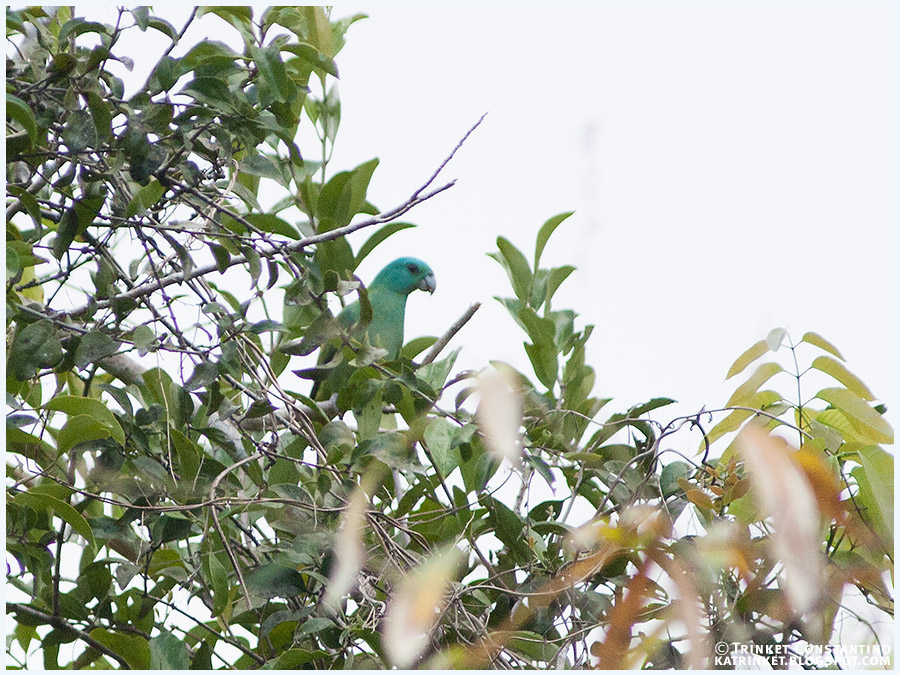
Un-naturally quiet, we were surprised to see a Blue-headed Racket-tail fly in and land on a tree nearby.


I love parrots.  They walk gingerly along the branches, twisting their head and torso around as they use both their feet and their beaks.  This one was sooo quiet, that we were surprised to see it still around after having been distracted by other birds for several minutes.


As it was already approaching lunch time (you tend to lose track of time when there are a lot of birds around, no?), we decided to it was time to head back to the car.  We ran into several more birds going back, including a Chestnut-breasted Malkoha, several Yellow-throated Leafbirds, and an Oriental Dwarf Kingfisher that appeared as an orange bullet whizzing by with a high pitched call.

At the car, the Hill Mynas we had spotted when we arrived were still busy eating.


Our morning birding had churned out 53 species, and after lunch we were off to visit the Katala Foundation's Katala Institute for Ecology and Biodiversity Conservation (KIEBC) at Narra. (I had already written about that trip previously here.)

What a wonderful way to start our impromptu Palawan trip! 

Thursday, September 29

Off to see the Bundoks


In Filipino "Bundok" literally means "mountain", and definitely one of the most popular mountain getaways for Metro Manila folks is Baguio, in Benguet province.

Last July, towards the end of my long intersession holiday, Adri and I were able to fit in a quick trip to Baguio.  The goal? To see the recently promoted Bundok Flycatcher.  Previously considered as a set of endemic subspecies of the resident Snowy-browed Flycatcher, it has been recently upgraded to full species status.


The now endemic Bundok Flycatcher, split from the Snowy-browed Flycatcher

And so, hoping for good weather in rainy July, we were off to see the Bundok (the bird, not the mountain though).


At the bus terminal in Dau, Pampanga

We boarded our bus early in the morning, planning to arrive in Baguio by noon.  The recent upgrading and construction of expressways leading north of Manila had made the trip very convenient, even by public transport.  We planned to stay the entire of our three days at Camp John Hay, away from the city traffic and congestion.

The cool Baguio weather to me is sleep-in-all-day weather, and it was still the case as the mid afternoons to early evenings were marked by heavy downpour and dropping of temperatures several degrees below the usual Manila heat.  We were lucky though to have wonderfully sunny mornings which allowed us to bird without worrying about rain. 


Sunny mornings on the Camp John Hay Eco Trail

The Camp John Hay Eco Trail was just a 15 minute walk from the Igorot Lodge where we were staying. Breakfast was not a problem since the lodge was also right beside a Starbucks and so we stocked up on sandwiches for our short birding hike.

The familiar birds of the Cordillera highlands greeted us as we walked.  Cheerful mixed flocks of  Mountain White-eyes, Elegant Tits, and Sulphur-billed Nuthatches wove in and out of the canopy.

Cheerful Mountain White-eyes

Even more cheerful Elegant Tits

Always busy Sulphur-billed Nuthatches

It is always a challenge photographing these tiny, active birds.  But with patience and luck, coupled with the sheer number of them encountered, success is almost assured.

Midway into the Eco Trail, from its start behind a paintball arena across the Le Monet Hotel, we crossed a picturesque bridge over a small stream.  


A bridge across a stream

Butterflies flitted around us in the morning sunlight.


A graceful Count (Tanaecia calliphorus) fluttering around.
Dark-colored Bushbrowns on the path.

A smaller bushbrown showing its upper side as it suns.

A graceful sailor soaking up some sun.

Nearby, an Elegant Tit was making a meal out of a not-yet-a-butterfly caterpillar.


Breakfast hiding under a leaf.

Citrine Canary Flycatchers were busy flying from perch to perch and back, hawking for little insects.  A Scale-feathered Malkoha gracefully flew above us, gliding from pine tree to pine tree.


A quiet Scale-feathered Malkoha

Ahead, a very noisy Tawny Grassbird was carefully inspecting the path and the foliage, moving in and out of our view.


A Tawny Grassbird in an acrobatic pose, now you see me...

...Now you don't!

A little Draco lizard caught our attention, crawling up the trunk of a nearby pine tree.


Little Lizzie up a tree

A praying mantis stood still as a statue, its front legs folded together in the usual worshiping pose.


Praying mantis in the morning sunshine

It was a beautiful morning, the sky above us blue and the faint scent of pine in the air. 


Pine trees and blue skies

Looking closer around me, I saw several daddy long legs on the tree trunks, their bodies shiny emerald green orbs.


Shiny Daddy Long Legs


A lovely moss carpeted the ground and most of the tree trunks too, a fairy land in miniature.  I've learned recently that "Baguio" was actually derived from "bigyiw" which is Ibaloi for moss! 


A mossy carpet

The flocks of Elegant Tits were mostly made of young birds, the distinctive black markings still greyish.  They moved energetically around the trees, playfully swinging upside down from pine needles and leaves as they searched for food.


Young Elegant Tits

In mid-flight catching a... feather?

Sulfur billed Nuthatches crept up and down and around the trunks and branches, moving forwards and backwards in a never ending inspection of the bark.


Nuthatches always on the move

As I was admiring all these creatures around me, I heard a familiar call of an arch nemesis bird and noticed Adri standing very still in some tall grass, camera in hand.

I joined him and kept my eye on the little brown birds giving off loud explosive and melodious calls. It was the first time I had seen many of them together, 4 of them moved deftly and quickly through the grass.  As usual, these Philippine Bush Warblers teased me with short glimpses, moving out of the cameras view just as the focus kicked in. Definitely still no improvement to the arch nemesis status after this trip.


Still in the most-hated bird list: Philippine (formerly Luzon) Bush Warbler
This is Adri's photo.
Obviously the bird loves Adri who harbors none of my ill feelings towards it at all.

Finally at mid-morning, we stopped by a small watering hole by the side of the trail.  A small movement behind us caught our attention, and there was our target.

A beautiful male Bundok Flycatcher, snowy brow and all, sitting quietly in the shadows (and look a small orchid in bloom right beside it)!


Bundok Flycatcher in the shadows (look, an orchid too!)

It stayed in that general area for the rest of the time we were there, sometimes perching quite near, other times farther away.  Sometimes in the light, and sometimes in the shade. 

We also caught a glimpse of its partner, a much drabber-colored female.  The female was more skittish than the male, moving around much more quickly.


The female Bundok Fly refusing to pose well for a photo.

It was great to watch them behaving as flycatchers do, flying to and from the perch as they caught insects on the wing. Standing very still on the perch and sometimes singing very softly. They were really neat and handsome birds. (I like flycatchers.) 

Light on the handsome Bundok Flycatcher.

So it was mission accomplished for us,  getting the Bundok flycatcher on my life list, In Baguio City, up in the bundoks of the Cordilleras.


Tuesday, August 16

More Negros lifers at Gawahon!

From Danjugan Island, Adri and I hopped on a bus back to Kabankalan and then transferred to another bus that would take us up north to Bacolod City. An hour's taxi ride later, we were in Victorias City even further north of Bacolod, at our final Negros island destination: Gawahon Eco Park.

Gawahon is a Hiligaynon for "overlooking", providing a panoramic view of the plains of Victorias and Silay. It lies on the northwestern edge of the Northern Negros Natural Park (NNNP).  It showcases mid- to high-elevation forest with several natural pools and waterfalls making it a popular weekend destination for the locals. Recently, it is quickly gaining popularity as a birding destination as well.


A view of the Northern Negros forest

Adri and I checked in to the guesthouse with a view of the entrance of the park (which was clean but a little run down and definitely very big for just the 2 of us!) and met up with our guides Ricky and Lory. A quick walk behind the guest house revealed several Yellowish White-eyes, Visayan Bulbuls, Pied Trillers and a pair of Plaintive Cuckoos.  Walking further we passed by a marshy area where we saw Mangrove Blue Flycatchers, Elegant Tits and Black-naped Monarchs. Nightfall found us checking out the trail where we would be birding the following day.

After making arrangements for food and finalizing our birding plans, Adri and I had our dinner on the veranda, joined by several noisy geckos on the ceiling.


Geckos on the ceiling!

The next morning we took a 5 minute motorcycle ride to the start of the birding trail.  It was refreshing to see relevant signage along the roads.


We were immediately greeted by Visayan Flowerpeckers and Orange -bellied Flowerpeckers. A flowering vine, locally called anukol, which was the favorite of the Flame-templed Babbler was in bloom, unfortunately there was no sighting of this beautiful endemic.


Anukol: just add the Flame-templed Babbler

At the first set of bathing pools and falls, a pair of Citrine Canary Flycatchers were feeding. 


A pair of Citrine Canary Flycatchers.
They had a small, well-concealed nest above one of the pools!  It was built within easy reach so I crossed my fingers and hoped that it was inconspicuous enough to escape the notice of curious park-goers!


Can you see me snug in my nest?

At the end of June, the rainy season was fast on the heels of summer so the day was turning out to be quite gloomy and overcast and everything wet and damp from the previous evening's downpour. Despite the noise of the waterfalls, Adri quickly picked up on a loud bird song.  It was one of our targets: the White-throated Jungle-flycatcher, a Negros-Panay-Guimaras island endemic!  

Our group of four walked up and down the steps trying to locate the bird across the stream.  It was a good thing that it kept singing loudly for several minutes.  Finally, Lory picked up on some movement and we finally spotted it! Another lifer for me on this trip!


Lifer: White-throated Jungle Flycatcher
It was perched behind many branches and leaves, oblivious to our scrambling for a better view. It very obligingly stayed in place, singing loudly, for almost half an hour.

Singing in the rain

While watching it, Ricky commented on his amazement that such a plain-looking brown bird could be so sought after by birdwatchers! Ah the allure of island endemics!


Lory, Ricky and Adri with eyes on the prize

As we proceeded on, a mixed flock of Citrine Canary Flycatchers, Yellowish White-eyes and Lemon-throated Leaf-Warblers passed through, cheerful and busy.


More Citrine Canary Flycatchers!
Yellowish White-eye

While walking by the water, we kept our eyes open for another of our targets, the Southern Indigo Banded Kingfisher.  This was a lifer also for both Adri and myself, being recently split from what was now the Northern Indigo Banded Kingfisher found on the Luzon and Luzon region islands.


Waterfalls, steps and pools all around

Ricky and Lory led us to a spot where we could stake out the kingfisher.  It was a scramble down a narrow trail ending in a rocky river bed.  On our way down we passed another mixed flock which now included a White-vented Whistler, Sulphur-billed Nuthatches, Visayan Fantails and several Elegant Tits.


White-vented Whistler
An ever-cheerful Elegant Tit

As we each were sitting on a chosen rock, hoping that the kingfisher would appear and exchanging birding stories, I passed the time watching water striders on the surface of a puddle, black and blue butterflies flying around (the same ones we saw a week earlier at Twin Lakes) and a flowering shrub nearby. 


A very ragged butterfly

Staring at pink flowers to pass the time
After several minutes of waiting, Adri suddenly exclaimed quite calmly (in true Adri fashion) "It's perched right there behind you!"

Thinking he was joking, the three of us turned towards where he was looking. Sure enough, the bird was just a few meters away, very quietly hiding behind a large plant! As I tried to maneuver my way to better positions to view it, it flew out and perched in front of us!


Panic picture: forgot to check the aperture again!
In my panic I got a lousy photo, but good thing Adri did a better job when he first sighted it!  It is most distinguishable from the the Northern species by the all black bill and a thinner breast band (and in my opinion a deeper indigo color).


Lifer again! A male Southern Indigo Banded Kingfisher

Yay!  Targets secured and mission accomplished. We decided to take the afternoon off and flagged down a tricycle to take us back to the guesthouse. (I was doubly grateful as I was suffering from a bum stomach and did not enjoy all that walking!). 


Eco-Park Ranger hitching a ride on the trike

It turned out to be a good decision as the heavens came pouring down in the mid-afternoon and the rains lasted all the way til the evening.

The next morning, with the pressure of our targets off (plus my bum stomach), we decided to take it easy.  We went back to the trail to the higher falls.  It was quite birdy and we enjoyed several mixed flocks of Black-naped Monarchs, Visayan Fantails, Sulphur-billed Nuthatches, Visayan Bulbuls, Orange-bellied and Visayan Flowerpeckers and Balicassiaos. We even had a lightning quick glimpse of a Flame-templed Babbler!


Black-naped Monarch

Visayan Fantail

Sulphur-billed Nuthatch

The trail was very nice and easy (and wet!), revealing the beautiful forest along the way.  


The trail up to the higher falls

This little puddle frog (Occidozyga) was doing an excellent job of camouflaging itself.


Spot the frog!


On the other hand, this brightly colored caterpillar seemed frightening in its flamboyance.

A hairy caterpillar

We  ran into an active White-bellied Munia nest just by the side of the trail and we even picked up a used nest that had fallen along the trail.


Nests along the trail

On our way back to the guest house, we spotted a Buff-eared Brown Dove (already split from White-eared Brown Dove  by Birdlife and HBW) sitting quietly on its flimsy nest of twigs. So many nests must be a good sign!


A nesting brown dove

Gawahon Eco Park is surely going to gain even more popularity as a birding destination in the next few months.  Easy access, good trails, endemic targets.  This year's Philippine Bird Festival, (the 11th!) is going to be held in Bacolod City and will feature the amazing biodiversity of the Negros Island Region.  

From the Balinsasayao Twin Lakes Natural Park down south on the Oriental side to Gawahon Eco Park up north on the Occidental side, I'm glad to have gotten a chance to revisit the established and try out the new.

I'll be seeing you again soon Negros!


(graphic featuring the endemic and critically endangered Walden's Hornbill  

by uber-talented WBCP-er Arnel T.)