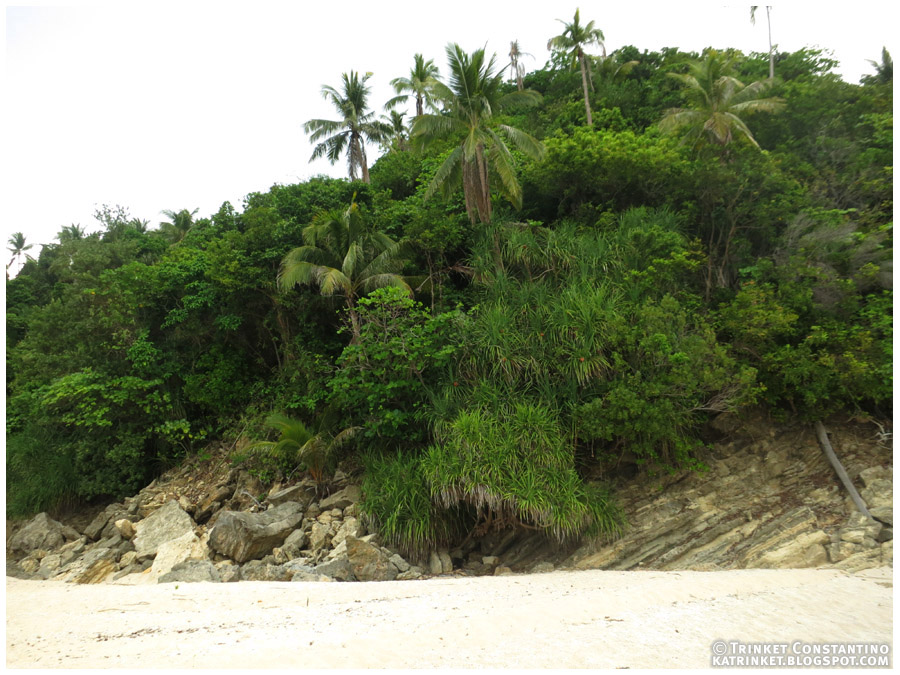
Our Danjugan island adventure continues...
Happy to have observed the Beach Thick-knee so early in the day, we headed back to Moray Lagoon on the other side of the island where breakfast was waiting for us.
We took our time enjoying the huge breakfast with an idyllic view of the lagoon.
 |
| A humongous home-cooked breakfast with a great view! |
Across the waters, several Black-chinned Fruit Doves and Pink-necked Green Pigeons were also congregating for a meal at a fruiting tree.
 |
| Black-chinned Fruit Doves enjoying breakfast also. |
In the mangroves beside the dining area, several moray eels were hiding in the prop roots, as well as under the pilings of the cabana. No questions as to how Moray Lagoon got its name!


Several moray eels from which the lagoon got its name. They were as large as my arm!
While having our meal with Robin, the rest of the staff of Danjugan had also arrived by outrigger. One of the managers, Andrew, came up to greet us a good morning and to commment on our optics. We also met our guide for the day, Tikyo, who asked us about the thick-knee, having been tipped off by Ramram (who had the day off), that we were birders. We happily announced that we had already seen it (showing him the photos) and that we were ready for other island adventures. It was quickly decided that we take the boat with the rest of the staff to Typhoon beach on the the Western side of the island.
The boat ride again took us through the clear waters around Danjugan, giving us great views of the island geological formations and flora.


Fantastic rock formations and coastal plant life around the island.
Typhoon Beach offered alternative accommodations to Moray Lagoon, with its own common dining area and bar.
 |
| Typhoon Beach facing the Sulu Sea on the western side of the island |


Alternative accommodations to Moray Lagoon Camp on Typhoon Beach.
We took a short walk up to a high point on the island where there was a view deck perfect for hanging out. We had a good view of the forest and of Turtle and Tabon Beach.
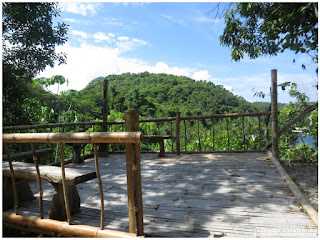

Views of Turtle and Tabon Beach and the Sea-eagle nest.
We could clearly see the the rocky outcrop and the beach where we sighted the thick-knee that morning. The Black-naped Terns were still flying around.
 |
| Can we see the Beach Thick-Knee from here? :-) |
Using the scope, we could see the sea-eagle's nest in the distance. Tikyo even scoped a few young black-tipped reef sharks near turtle beach! Around us, Pied Trillers, Olive-backed Sunbirds and Golden-bellied Gerygones (flyeaters) were very active.
 |
| Olive-backed Sunbirds and Gerygones |
Butterflies fluttered about all around us, enjoying the sunshine and the flowers.
 |
| Many butterflies too! |
From here we went snorkeling. Several meters off the shore of typhoon beach was a snorkeling area with huge table corals. We enjoyed almost an hour of watching reef fish, giant clams, colorful coral and other invertebrates. I especially enjoyed a school of large batfish which Tikyo pointed out to me. On top of the table coral, a pair of cleaner wrasse would offer their services to larger fish passing through. (Sorry, no photos!)
Noon was fast approaching so we headed back to shore to trek back to the eastern side of the island. The hike was a pleasant one, passing through view decks, beaches, limestone and coral trails and bamboo bridges.


Scenic view along the trail
 |
| Tiny ponds filled up with the high tide |
We stopped along the way to admire several plants in bloom. A vine which had heavily scented clusters of white flowers was growing all over the island. We also spotted several epiphytes like hoya and dischidia in bloom. A lot of the trees were also flowering.
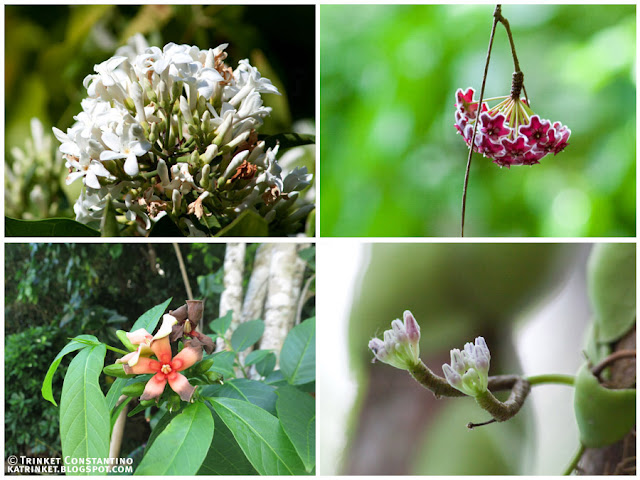 |
White, scented flowers of a vine, a maroon Hoya, the orange flowers of a Wrightia tree,
and the dainty white flowers of a Dischidia. |
 |
| The strange flowers of Palm-leaved Tacca plants growing on the ground. |
As we approached Moray Lagoon, we took a short detour to the bat cave which hosted several hundreds of Geoffroy's Rousette Fruit Bats. As we approached the cave, the noise of the bats (as well as the smell of guano!) became more conspicuous.
 |
| The Bat Cave and hundreds of cute Geoffroy's Rousette Fruit Bats! |
Water filled the bottom of the cave where the bats roosted and the little sunlight that pierced the darkness reflected back on the walls. Most of the bats were asleep but many were fidgeting, flying around and cleaning themselves as they hung by their hind legs and stretched their bat wings.
 |
| Hanging around (literally!): Bats are important pollinators! |
As we walked on, we continued to enjoy the diversity all around us: long spined Diadema sea urchins on the side of the lagoon...
 |
| Scary long-spined Diadema sea urchins |
... a tree with dainty purple flower clusters...
 |
| Pretty purple flowers. Is this Memecyon edule? |
... the rustle of Tabon Scrubfowl scratching on the ground...
 |
| Always shy: Tabon Scrubfowl |
... the weather-beaten and winding branches of Bantigue trees...
 |
| Beautiful Bantigue trees growing with other mangrove species around the lagoon. |
... Little Herons hunting in the mangroves...
 |
| Busy Little Herons waiting patiently for fish |
There was soooo much to see on this little island!
Even while having our lunch we would watch all sorts of fish and crabs (and of course the moray eels!) around the dining area.
 |
| Different fish under the dining area |
 |
| Colorful fiddler crabs defending their holes |


Huge moray eels looking very intimidating.
Pacific Swallows flew gracefully around the lagoon, perching on the outrigger boat anchored nearby.
 |
| Pacific Swallows gliding above the waters. |
On a little mangrove island just off the dining area, a pair of Philippine Pied Fantails were aggressively defending their nest, continuously chasing off a Collared Kingfisher and several Little Herons!
 |
| Pied Fantail versus Collared Kingfisher (and all other birds!) |
Later we took the kayaks out for some more nature tripping. The waters on the east side of the island was so clear! We could see the various brown algae and corals and sea grass beds beneath us!


Clear waters under the kayak.
Tikyo led us to the East Beach which changed positions depending on the seasons and prevailing winds. The small beach was perfect for swimming as it had a little clear area from the sands shifting around.
 |
| The moveable East Beach. |
Tikyo spotted a lone bat, probably an Island Flying Fox, which he pointed out to us.
 |
| Shhh... A sleeping Flying Fox. |
As we headed back towards the lagoon, Tikyo left us to continue our exploration on kayak. We circled Moray Lagoon, getting great views of the camp and of the trails from the water.
 |
| A view of the dining area at Moray Lagoon. |
 |
| The bamboo boardwalk beneath the Bat Cave |
There were several fish in both the shallows and deeps of the lagoon. Several anemone fish were guarding their homes and fiercely approached our kayak as we passed over them.
 |
"It's an an-anemone!"
Anemone fish and their anemone |
Just as we were about to pull our kayak ashore, we were surprised by a flash of blue and white flying across the lagoon entrance. It was the Stork-billed Kingfisher! We had seen glimpses of it all day, and it was sort of a lifer for us. It was of the subspecies gigantea, and unlike the Stork-billeds we had seen in other places in the Philippines, this one had a creamy white head.
 |
| Stork-billed Kingfisher gigantea! Not bad for a photo from a kayak. |
We paddled furiously to get good glimpses of it as it perched just outside the lagoon. Birding by kayak: a first for us!
It was truly a fun-filled and busy day exploring the island! I can imagine spending hours taking in all the little bits of natural history of Danjugan, whether over land, over water or under water!
After a restful night's sleep, we woke up the next morning, packed our bags and said goodbye to our neat little open cabana.
 |
| Our bags are packed, but we're not ready to go! |
On the little stone breakwater, a Pacific Reef Heron was hunting in the golden morning light and the Stork-billed Kingfisher again flew by.
 |
| A Pacific Reef Heron bidding us goodbye. |
"We saved a Philippine island. Now we invite you to explore it." These words greet you when you discover the gem that is Danjugan. Truly, there is something new to see everyday for nature-lovers: both sea- and land-lubbers, like us.
Danjugan Island a protected marine reserve and wildlife sanctuary, managed by the Philippine Reef and Rainforest Conservation Foundation, Inc. located on the occidental side of the Negros Island region. To learn more about Danjugan island, visit: www.danjuganisland.ph