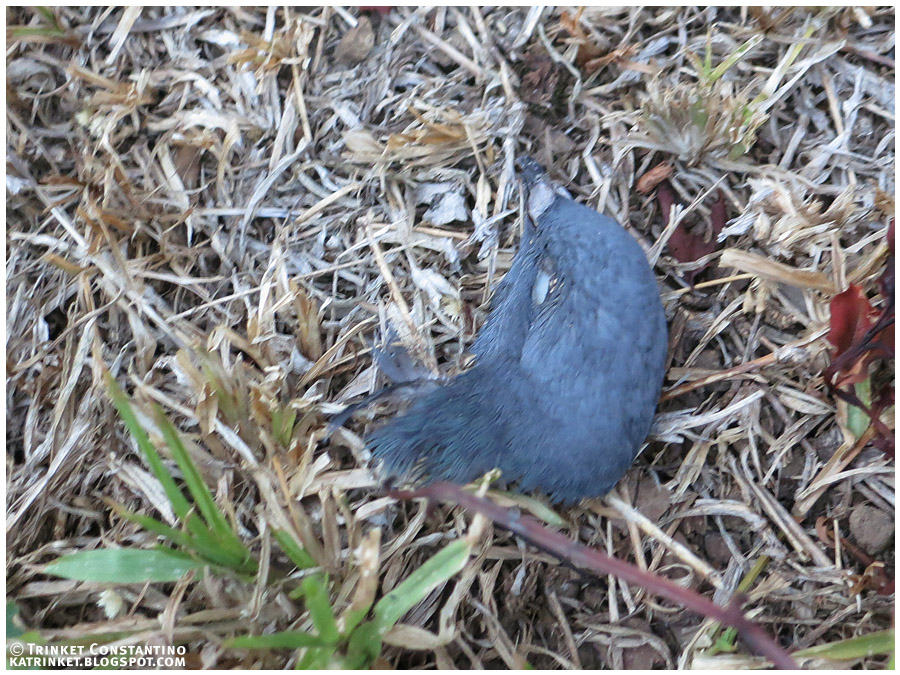
Showing posts with label ateneo. Show all posts

Saturday, May 6

The pigeon hunter

For the 6th straight year, we have observed that the grounds of the Ateneo was home to a magnificent hunter: a migrant Peregrine Falcon!

During the migratory season, I look forward to Abby F's announcement that the groundskeepers have spotted the falcon and that he has started his annual pigeon hunt.

In February, Adri and I dropped by the communications towers which serve as his resting, lookout and eating area.  Rock pigeon carcasses littered the ground!  There were also several remains caught up in the beams and platforms of the communications towers.

A few of several pigeon carcasses on the ground - mostly just the wings left behind.

Several more pigeon carcasses caught in the communications tower (including a head!)

On one of the small trees under the tower hung a pair of wings that belonged to a racing pigeon.  On its legs was a green numbered band - a sure sign that some human owner had lost a prized possession to nature's swiftest hunter.

And a few caught in the trees below the tower.

I hope that the falcon's taste for pigeon flesh will not put it in a bad light with pigeon fanciers. This is not an exclusively local problem, and I hope it will not escalate to a point that these beautiful raptors will be put in danger. 

That afternoon though, despite the clear evidence of its arrival, we failed to see the falcon.  He (it could be a she) was probably off chasing pigeons... literally.

After having secured permission from the administration to regularly check on that particular field to document the falcon, Adri and I decided to try one Saturday morning.

Adri quickly spotted him on one of the towers.  As a pair of security personnel passed beneath, the falcon flew to another tower on the further edge of the field.  At first we had a difficult time finding a good angle to observe him. He was wisely staying close to the network of beams and cables, which not only hid him from sight, but also shaded him from the bright morning sun.


Sometimes awake...
We watched him for over an hour, hoping he would come out and hunt.  But no, all he did was preen and nap!

Once in a while a single or flock of pigeons would fly overhead, getting Adri and I excited in anticipation of some action.  But all Mr. Falcon would do was gaze at the passing pigeons as they flew by, and go back to sleep!


But mostly asleep! 


We thought that he probably already had his fill, and hunted during the cooler hours of dusk and dawn. They have even been reported to hunt in the evening!

The groundskeepers and gardeners were all familiar with the falcon,
but Adri's scope gave them close-up views!

He was also woken up by a pair of resident White-breasted Woodswallows who couldn't help but check him out with a close flyby.  They probably were getting ready for their annual tower nesting - maybe not a good idea with a migrant raptor still hanging around!

Resident White-breasted Woodswallows sharing their field.

Whether it was the pesky woodswallows or the moving sunlight, the Peregrine finally moved out of the shadows of the steel maze and gave us a clearer view.

A beautiful digiscoped photo of a beautiful raptor.

What a handsome bird!

After a couple of hours, it still looked that he had no plans of moving and so we packed up our optics and bid the raptor goodbye.

See you again next season Mr. Falcon! May the University grounds provide you with a safe haven every year!


Monday, July 4

Dainty blooms of the strong narra and molave

Early in June, just as summer faded into the humid air of the upcoming rainy season, I received a text from Abby F. about a late-blooming narra in its full yellow glory.  The next day, I decided to take a peek and hopefully some photographs, but unfortunately, the afternoon rains previously had all but brought down the golden yellow flowers!


Sprays of yellow narra flowers


As I looked down at the yellow confetti flowers at my feet, I noticed that they were mixed in with lavender!  The molave trees, much less showy than the narra trees, were also in bloom!


Lavender blooms mixed with yellow:  Molave with a splash of narra.


The dainty cornflower blue blooms on the trees were attracting several bees and other insects, although I could not catch a scent.  


Pale blue-lavender blooms of the molave,


Popular as a hardwood used in furniture and to literary analogies of strength and resiliency, I only recently found out what this native tree actually looks like. 

I am glad to have several molave trees planted around the university campus where I can admire them everyday, in bloom or not.


Happy to see rows of molave around the Loyola Heights campus.


Side by side with the narra trees, the yellow and pale blues contrast quite well, although it is easy to miss the muted molave blooms beside the much more cheerful narra flowers.


Molave and narra: native trees you can get to know.

Wednesday, May 11

Wings of the fallen


Summer time on campus usual means less schoolwork and more time for guided bird walks.  This year, summer falls at the tail end of the new school year, but we still got to fit in 3 bird walks at the and of March until mid-April!

At this time of the year,a  bird walk yields a very active resident bird population: long-tailed shrikes, collared kingfishers, black-naped orioles, barred rails, Philippine magpie-robins, Philippine pied fantails, pied trillers, coppersmith barbets, lowland white-eyes, golden-bellied gerygones, white-breasted woodswallows, yellow-vented bulbuls and zebra doves are part of the typical bird list. An overstaying brown shrike or two give a great example of a common migrant.

Strangely though, the highlight of the recent bird walks is not the flash of blue as a kingfisher flies by, or a pair of bright yellow orioles calling loudly from an acacia tree.  It isn't even a pair of hard-working shrikes feeding their young on a nest in the parking lot.

The highlight comes towards the end of the walk. And it isn't exactly a pretty sight. Or even a live bird. 


(Pretty gruesome sight is more like it!) On our first walk we discovered that the back of the observatory was littered with rock (racing) pigeon wings!


The students ran around counting more than 15 pairs of wings on the ground!  Some with the tail still attached, or part of the breastbone.

We knew at once of course what these were: the remains of the prey of our annual visitor: Peregrine falcon food!

It was amazing to see how much he had caught. He must be a pretty efficient hunter! I had actually spotted him in the middle of March hovering over the parking lot with a pigeon (almost as big as him!) gripped in his talons.

One of the students even found a one and only pigeon head:


When we looked up at the tower, we saw more carcasses on the platform.  This was one big time hunter!


Unfortunately, it was only the first group of the three who had the privilege of actually seeing the falcon.  He was up on the tower, being mobbed by the woodswallows. 


Still, even in his absence, the last two groups were able to appreciate the presence of a raptor on campus.  

The prey he left behind spoke on his behalf.

Monday, August 31

Unusual at the usual

It was great to have met new birding buddies on campus!

Fr. Vic is a budding birder and bird photographer and had taken great documentation of two cuckoo species on campus: the Philippine Hawk Cuckoo and the Philippine Drongo Cuckoo (a new record for the campus).  Alex had crossed paths with him in the virtual world of social media and we set up a Saturday afternoon birdwalk to meet up.  We were happily joined by Temay and Joy who worked at the admin offices.

Our walk started out with the usual suspects: a Black-naped Oriole was calling loudly from a tree in front of the admin building.  Zebra Doves patrolled the grassy areas between the trees, almost oblivious to our presence.


Zebra or Peaceful, both these names fit this dove perfectly!


At the parking lot, a Coppersmith Barbet was calling loudly, but it took some effort to spot him.  There was also a younger barbet, with much less red on his head.  Neither would keep still enough for a clear enough photo though.


A partially hidden Coppersmith Barbet.


Suddenly Adri spotted a different bird shape up in the tree.  A Rusty- breasted Cuckoo (Brush Cuckoo)!  I had not seen this bird on campus in a looooooong time.  It was still a juvenile, the barring across its breast and underparts very distinctive.  It flew quietly and purposefully around the tree until we lost track of it.


Rusty-breasted Cuckoo!  You can just see the start of the "rusty breast" in this juvenile.


All this while, a Zebra Dove was lying, very relaxed I must say,  on the gravel behind us, probably wondering what the fuss was about.


I'm calm and relaxed...


In the shallow trough beside the parking lot, a White-breasted Waterhen was moving quietly behind the grass while invisible Barred Rails called loudly.  A Philippine Coucal made a surprise appearance as it flew low over the ground and disappeared behind the vegetation.  The cogon grass was left long enough to allow it to go flower and seed, and small flocks of Scaly-breasted Munias were enjoying a snack.


Munias in the grass


In the overgrown bamboo, a Philippine Magpie Robin and a Philippine Pied Fantail played hide-and-seek.  Changes in taxonomy had elevated these birds to endemics recently, nice for birds easily seen/heard on campus.


A Philippine Pied Fantail guarding his secret territory.

Yellow-vented Bulbuls flew around us, often perching for a bit of preening.


Yellow-vented Bulbul in mid-preen pose.

As the afternoon slipped to sunset, we hurried along towards where Fr. Vic had spotted the cuckoos, hoping for a glimpse or maybe to hear some calls.  

As we entered the back garden, a Long-tailed Shrike perched against the valley of Marikina, with the Sierra Madre mountains in the distance.  


A not-so-neat looking Long-tailed Shrike, maybe in mid-molt.

As we approached the slope for a better view of the valley, we flushed a Common Emerald Dove from its tree on a low mango tree. We walked to the side and back around the parking lot.  On a bare-branched tree in the distance, another  Coppersmith Barbet was calling loudly.  Above us, a flock of Lowland White-eyes was moving through the canopy of the huge rain tree, maybe one last snack before roosting for the night.

Suddenly, Tere called out "Imperial Pigeon!"

Wow, that was unusual!  Green Imperial Pigeons were relatively common in forested areas but hardly sighted in the city. We all took a look, and sure enough, in place of the diminutive Coppersmith Barbet  was a large Pigeon, clearly silhouetted against the sky!


A surprise sighting in the distant tree.


And an even bigger surprise when Adri exclaimed "It's a Spotted Imperial Pigeon!", telling us to take a good look at its breast and underparts which, even in the dwindling light,  were clearly brownish!


Bird alert: SpImp on campus! SpImp on campus!


Imagine having a spotted a Spotted Imperial Pigeon, a hard to find endemic, right at one's workplace!  It was such a pleasant surprise!  We explained to our birding companions (who were probably initially surprised at OUR surprise!)  that our group had traveled all the way to Ilocos Norte to spot these elusive birds!

Local migration?  Lost in the city?  Whatever the reason that particular individual decided to stop and perch at that particular tree at that particular time - it was serendipitous for our little birding group. 

Happy to have more birding eyes now on campus! Since then, Fr. Vic has also documented an immature Black-chinned Fruit Dove, another new record for our "backyard"!  I'm hoping now our campus bird list will grow and there will be more exciting finds for us. 

Sunday, August 9

When school is out

With a new semester starting, the campus will be alive once more with the student population going about their daily routine. Having had an extended break because of the adjustment to a new school year (with the "summer" term moving to June - July and the first semester starting in August), the campus was pretty quiet for most of April and May with only the regular staff and the faculty coming to work.

With a few bird walks scheduled as a fun activity to fill in the student-free work load for the staff, we were quick to observe a few campus birds not regularly seen during the busy school year.

A family of Philippine Magpie Robins were regulars at an empty student parking lot near our office.  It was great to see this family of four every afternoon, with the young busy following their parents around.  They were an easy bird to point out to newbie birders, distinctive black and white birds flitting around actively the parking slots shaded by a couple of ficus trees.


Dad in a typical pose.

Mum in another typical pose.

One of the young ones looking at me curiously.

The young ones would often beg loudly for food.  When this was observed by one of my high school students on a summer internship, she exclaimed excitedly " It's shouting! It's shouting!"


"FEED MEEEEEEE!!!"


Their beautiful melodious call was clearly heard in the relatively silent campus.  The parking lot was adjacent to an overgrown area where they presumably stayed most of the year when they would be reported as "heard but not seen".

I'm glad to have verified that the campus Magpie Robin population seems to be doing well and growing in number.

Aside from the Magpie Robins, a short observation at the ficus trees also gave good sightings of White-eared Brown Doves.


A quiet pair of endemic White-eared Brown Doves.

These endemic doves are usually very shy and skittish.  They are not common in the city, except in pockets of greenery.  This pair was calmly preening at a talisay tree behind the ficus, after having enjoyed a snack of ficus fruit.

In the afternoon, several Barred Rails could often be called calling, hidden in the long grass. With a few people around, a few ventured out into the open areas.


With a bit of patience, a brief  Barred Rail sighting in the grassy fields.

It's good to document these not-so-often-seen-birds-on-campus.  While I expect them to fall back into the "heard only" category now that school has started, I look forward to catching even brief glimpses every now and then.

In the meantime it's back to the regular campus birds...


The very common Zebra Dove.


Saturday, February 14

a lesson in conservation at Candaba

Bringing another small group (separate from those who went to Bohol) of my Conservation Biology students to take a look at a classic example of wetlands conversion at Candaba allowed me an opportunity to twitch one of the rarest ducks in the world: the critically endangered Baer's Pochard.

The classification of critically endangered is not a very good category to be in, it means that this species is considered to be facing an extremely high risk of extinction in the wild. And with an estimated 150 - 700 mature individuals left in the wild, the Baer's Pochard sadly and definitely belongs in this category.

The key reasons for its rapid decline? Hunting and wetland destruction in both its breeding and wintering grounds.

When we arrived at the ponds, I quickly allowed a couple of hours for birding.  We were lucky to have a display of power by a pair of Eastern Marsh Harriers, who spooked the ducks into flying up into the air, to the delight of the group.


An Eastern Marsh Harrier preening in the morning light after flushing the ducks.
More than half of the main pond (the only remaining pond) had already been drained and converted to rice fields for the season, and so the ducks and other water birds were all crowded into a bit of water left on the side of the house and rundown DENR station.  It was ironic that, as the ponds were now being converted to rice fields, for the first time in several years we could see several species of ducks together in the pond.  I remember in the first couple of years that I started birding, the whole of the pond looked like that!  

There were the resident Philippine Ducks and Wandering Whistling Ducks. Joining them were the migrant Northern Pintails, Green-winged Teal, Garganey, Northern Shovellers, Tufted Duck and Eurasian Wigeon.  Then there were the not so common migrants: Gadwall, Common Pochard and of course the star: a lone Baer's Pochard.

Also included were several Purple Swamphens, Purple and Grey Herons, white egrets (Great, Intermediate and Little), White-breasted Waterhens, Common Moorhens, White-browed Crakes, Pheasant-tailed Jacanas, Little Grebes and even a Eurasian Coot!

I expected to run into a few birders and photographers on our trip, and sure enough we did.  While my students were doing their interviews of the locals and the recreational visitors (mostly bikers), Adri called me to tell me that they had spotted the Baer's Pochard.  I quickly walked over to where the birders and bird photographers were standing.

And there it was.  Well-hidden behind the floating kangkong was a dark head and a chestnut brown breast.  It was barely visible!  I was amazed they had even found it as it was quite far away towards the middle of the ponds.  What gave it away of course was the more distinctive Common Pochard beside it,  all previous reports the past week had these 2 ducks sighted together.


A well-hidden critically endangered Baer's Pochard
(had to use an arrow as it is almost impossible to find in the photo!)
On the right is the bright chestnut head and white back of a Common Pochard.
Hope as we did for it to come out for a better view, it remained concealed. No one wanted to take their eyes of it, in case it suddenly decided to expose itself.

Every now and then another duck would pass in front of it or behind it. We were hoping the jostling it got from a couple of Northern Shovellers and a Garganey would wake it up and force it to move out in the open, but we had no such luck.


We were hoping that the other ducks, like this pair of Northern Shovellers, 
bumping into the resting Baer's Pochard would jostle it into the open. No such luck though.

Once in a while a white eye would peek from behind the vegetation, causing a bit of excitement in the group.  But that was as good as it got that morning. 


A light-colored eye peeking from behind the kangkong.

Soon I had to go back to my students to process their interviews and their short morning experience. Later, we ran into Alex, Tere, Felix and Brian.  I urged my students to converse with the birders.  Alex gave a wonderful summary of the state of the Candaba wetlands which I am sure they enjoyed and appreciated.


Alex with my students

I am still not quite at ease having been assigned to co-teach the subject of Conservation Biology, having had no formal education or training of it.  Of course, my part had to do with genetics, which I was comfortable with.  But I am glad that I had the chance to share with my students whatever I had been learning vicariously about conservation from my passion for birding and my birding experiences.

(WBCPer Tonji writes about the sad state of the Candaba Migratory Bird Sanctuary and the Baer's Pochard on the club's monthly  newsletter here: https://ebonph.wordpress.com/2015/02/04/baers-pochard-in-the-last-pond-in-candaba-pampanga/)


Monday, February 9

Back in Pamilacan with the dolphins

Non-birding trip!

I joined my co-teacher Jom and some of our students on a Conservation Biology class fieldtrip (I was part of the team teaching it - in charge of the genetics part!) to Bohol.

I had been to Pamilacan Island twice before.  The islanders were traditionally whale hunters, hunting whales, whale sharks, dolphins and manta rays via harpoon ("pilak"). When their main source of income was banned in favor of protecting these marine animals, they were offered dolphin watching as an alternative livelihood. 


A shot of Pamilacan island from our 2010 trip
To make a long story short, it has been a rough road for conservationists and the islanders, and scars from the experience still have not fully healed.  And even today, the Pamilacan locals, who were trained in the proper dolphin-watching techniques, experience a lot of competition from non-trained guides and boatmen who pick up tourists at the popular Alona Beach on Panglao Island. (Note:  If you do go dolphin-watching in Bohol, try to find guides who are based in Pamilacan).

My first visit to Pamilacan was during the time of SARS in 2003 with Vir, Kutch, Adri and JenneR.  It was my first time to see dolphins in the wild and it was an unforgettable experience!  Seeing dolphins all around the bangka, swimming under us, riding on the bow, somersaulting in the air - I had to stop myself from jumping in the water to join them.


Check out my shot from 2003 - digital cameras were not yet the norm!

The second time was fairly recently, in 2010, when Adri, Mel and I planned a birding + beach trip to Bohol.


Adri's cool shot of spinner dolphins from our sunny 2013 trip.

Between my first wild dolphin close-encounter and this last one, I had seen dolphins a few other times.  While swimming with whale sharks in Donsol, a dolphin jumped on the horizon and was shrugged off by our boatman ("Dolphin lang un" "It's just dolphins") and on our return ferry from the Camotes Islands we were lucky to have encountered a huge pod.  I don't think I will ever tire of seeing dolphins in the wild!

This time it was far from the ideal weather to go dolphin watching.  The sky was overcast and there was a slight drizzle.  The sea was a somber steel grey and white caps formed on the tops of waves.


Waiting for our pick-up at Alona Beach
(which has changed considerably since I was here in 2003!)
on an overcast morning.
But we were all optimistic. Our guide, Turning, and boat crew were all experienced locals and we knew that they could find the dolphins.

As we headed from our pick-up point at Alona Beach on Panglao to Pamilacan Island, a lone Great Crested Tern checked out our boat, looking to see if we had any fish it could steal. Photography challange: close subject (couldn't fit in the frame!), bird-in-flight, low light, moving boat rocked by waves!
A Great Crested Tern checking out our bangka.
Soon there was a slight commotion as our boatmen, Turning and Jom spotted splashes on the horizon.  The dolphins were here!

It was a pod of spinner dolphins (Stenella longirostris).  They came up to the bangka to check us out and were soon swimming alongside and in front of us.  Every now and then, one would jump out of the water.  There was even a mom with its calf!


To count dolphins you multiply by 5 every dolphin you see on the surface.

The monochromatic hues reflect the somber weather that day.

Chuffing:  when dolphins surface they exhale forcefully from their blowhole to clear the area.  
Bubbles from chuffing are a good way to spot dolphins in the distance.
These spinner dolphins approached our bangka and
spent a few minutes with us before moving on.
Our students were so excited!  For many of them, it was there first wild-dolphin encounter. Their comments about wanting to jump in the water to join the dolphins reminded me of my first experience.


Our students rushing to the bow for a closer view of the dolphins.

Flukes in the air! Dolphins seem like such joyful animals.
Eventually, the pod left us and we continued on our way to Pamilacan where we would spend the night. The non-ideal weather added a little challenge to docking the boat on the beach.


Docking at Pamilacan island
The weather didn't improve during our stay, it was cold, wet and windy.  But I didn't mind (What is it with me and cold beaches? I had the same experience 2 weeks before at Pannzian!).  Having dolphins greet us was a warm enough welcome!


Low tide on a gloomy, cold and wet morning.