Showing posts with label concepcion. Show all posts

Sunday, September 14

the migrants are here!

While most Filipinos anticipate the coming of the -ber months (SeptemBER, OctoBER, NovemBER, DecemBER) to officially herald the beginning of Christmas season, birders have quite another thing in mind.

The cooling days and lengthening nights signal the beginning of autumn migration, and while shops begin to display Christmas ornaments and the radio begins to play Christmas carols, birders are on the lookout for their first migrants of the season, usually the ubiquitous brown shrike, its arrival alerted by sharp calls in the morning of newly arrived individuals jostling for territory.

I had my first taste of migrants in the most unexpected place. I usually enjoy a well-planned trip to the more conventional birding sites to welcome migrant waders: either the swamps of Candaba or the hidden city environs of the Coastal Lagoon.  But my first migrants were spotted a little bit closer to home. Literally. We were spending a weekend in our family house in Tarlac with some birder friends and to our delight, the rice fields just across our balcony were being plowed and flooded for the next round of planting.  Even from a distance we could make out the graceful pink legs of black-winged stilts walking on the mud.


Black-winged stilts are unmistakable with their long pink legs!

Terns flew around the water-logged fields, picking up food from the water, and they were joined by many oriental pratincoles. 


Terns flying over the fields

Oriental pratincoles have both a resident and migrant population:
it was my first time to see so many near our house!


A closer inspection with our binoculars and scopes revealed several little-ringed plovers, running across the drier mud.  Some of them still sported breeding plumage and their bright yellow eye rings stood out against the somber browns of the empty fields.


Little-ringed plovers could also be residents or migrants,
and seeing them in their bright plumage is always a delight.


A few Pacific golden plovers were also present, and it was great to catch them in their distinctive black plumage, a contrast to their non-breeding golden hues.


Not the usual look sported by golden plovers for the winter.


Blending into the background were several wood sandpipers, and a few common sandpipers (although I had already seen some common sands at the airport a few months back), busy walking back and forth.


A wood sandpiper and a common sandpiper: common migrants seen at rice fields

A quick scan of the surrounding grassy areas revealed my first brown shrike for the season.  It was spotted by Adri, who pointed it out to us and also noticed a second individual just beside the first one!  It was very unusual for them to be sharing a space without much hullaballoo, so they must have just arrived.


My first brown shrike for the season
(you can catch a glimpse of my second brown shrike hidden in the grass below it)

There was also a common kingfisher patrolling the pond, a regular visitor to the farm.  There are usually two or three of them, but it seems that only this one has arrived so far.


My favorite migrant on the farm: a common kingfisher perched on the mulberry bush.

 We also had good looks of the usual residents:  blue-tailed bee-eaters and pacific swallows flew gracefully over the waters.  White-breasted waterhens walked gingerly on the vegetation at the edge of the pond while collared kingfishers called loudly all around.  The white-throated kingfisher was also busy swooping down on the muddy fields for tasty snacks.  Zebra doves and red turtle doves perched on the kapok trees lining the pond.

A cool find was a male greater painted snipe, walking with the other waders with three young birds! Unlike most birds, the male painted snipe is the parent tasked with incubating the eggs and raising the young.  Its plumage is much more drab than the female.


Do you see the well-camouflaged male greater painted snipe and one of its chicks beside it?

A walk around the fields at sunset revealed a very interesting situation.  There were also several (human) children running around the fields, each clutching a soda PET bottle as a receptacle for something they were gathering from the muddy ground.  It turns out that the field in this condition were perfect for the breeding of camaro (mole crickets) which are a delicacy to Capampangans.  

Nearby, a yellow bittern picked up a mole cricket from the mud and quickly swallowed it.  It was unmindful of us as it continued to inspect the mud for more of the critters.


A yellow bittern on the hunt at sunset.

No wonder the waders were in such a frenzy!  I would've loved some adobong camaro myself!


Adobong camaro (mole cricket): yum!


Saturday, March 31

mistletoe + butterfly update

ever since discovering the mistletoe  (Amyema incarnatiflora) in the house in tarlac, adri and i've kept a close eye on it, each of us having been back on 2 separate occasions.

when adri went several weeks ago, he saw more flowers in full bloom, interspersed with the host tree's (duhat, Syzygium cumini) flowers:


i was back last week and there were only a few flowers left:


there were several butterflies, painted jezebels (Delias hyparete luzonensis) flitting around the mistletoe and there was one that started laying eggs on one of the fresh leaves of the mistletoe!


it laid its eggs in 2 neat rows!  


hopefully i get to go back soon and get to see the cats!


Wednesday, March 7

kissing under a mistletoe

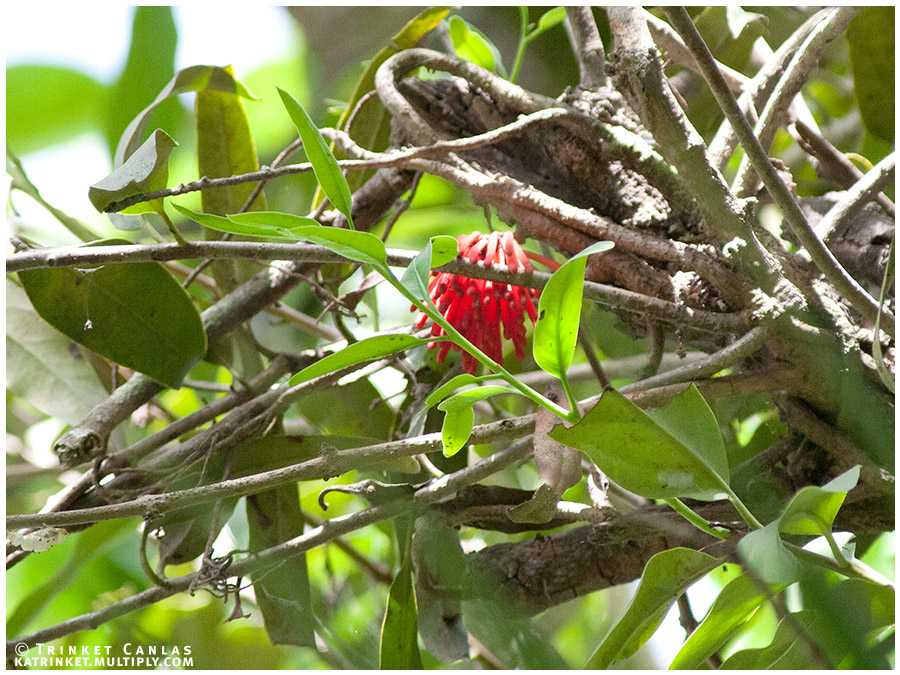
adri, myself and george went with mom when she last checked in on the renovations at the house in concep, and we discovered this growing on one of the duhat trees lining the pond:


i wouldn't have noticed it if it weren't for the beautiful red flowers which just didn't fit in as i was staring at a very old duhat tree.

it often comes as a surprise to people that mistletoe (yes, the popular kiss-under-a-sprig-of-mistletoe-at-christmas mistletoe) is native to the philippines.  i have also learned this only relatively recently... side information from birding of course.

flowerpeckers enjoy eating mistletoe fruit, and as they pass the seeds, they are so sticky they have to wipe them on a branch, securing a spot for the mistletoe to grow and flourish, its roots digging into the host plant for nutrients.  yes, mistletoe is a semi- parasitic plant.  and the literal translation of "mistletoe" is "dung on a twig," maybe because of the way it is propagated?  adri did a very nice video from some of nicky's recordings for bap which you can watch here, here and here.

i also learned that certain butterflies, the jezebels (delias sp.) use the mistletoe as a host plant (from lydia of course).

it took me some time to search the net (and it didn't help that justin bieber had a song with the title mistletoe! try googling it!), but i finally found a reference which led me to think this one with nice red flowers is Amyema incarnatiflora.  

my internet search even brought up a set of stamps issued by the philippine postal office in 2007. (it's the 3rd on the top row)


i'm hoping for confirmation of my id from experts.

in the meantime, i'm excited by this discovery, mistletoe in the garden! i had seen plenty of these parasitic plants while birding, although it's ironic that the first flowering specimen i would observe would be so close to home. another thing to look forward to when going home to tarlac (& i don't just mean the kissing)!  


Friday, January 6

the Concep house "downtown"


Young tricycle driver to Tita Mel (please excuse poor kapampangan spelling)

"Madam! Kasipag da naman ding bisita yu. Alas-4 ning abak atin ng atlung matwang mamalis ampong mipag-istorya king balkun yu!"  

          lola Noning 1901 - 1994
          lola Luming 1907 - 1999
          lola Pat 1913 - 2004


My mother's aunts who stayed in Concepcion (lola Embing moved to Manila and lola Madre stayed at the convent) lived in this house across the town plaza when her father, lolo Edong (the only brother in a family of 6), moved his family to the
house in the barrio.  My mom says it was built in the 1930's, one of the few residential houses designed by National Artist Juan Nakpil.


My mom's cousin, Tita Mel, now lives by herself at a second house behind the original house.  When I was small, I remember coming to Concepcion to these houses full of people: my grandmothers, cousins and aunts and uncles.  Marriage, family, career, migration, death has silenced the old house. Now, it still looks the same as all those years ago, still pretty but now showing its age and oh so much quieter.


Wednesday, May 23

concepcion

mom arranged Sunday lunch for the entire family at concepcion last sunday. the pond was full of big fat tilapia and the mangoes were dripping with the second harvest of the season. the house was in a sorry state, but clean enough. such a shame the house isn't livable anymore. 

the kids had fun running around the open space and teasing the cows and the goats. i hardly remember the few summers i spent in the farm. i was the youngest of the cousins and didn't get to spend too many vacations in the province. still, i have memories of giant hay stack slides, of little frogs in muddy carabao footprints, of a large bedroom filled with a row of beds, of hitting pili nuts with a stone, of hito harvest season and fruit laden duhat trees, of climbing up to the pigeon house to hear soft coos through the wall.

i definitely grew up a city kid, but i'm glad i have these memories.