the area looked quite promising, many parts looked like they were part of a well-forested area spanning several hillsides. we did see and hear several birds on the road. philippine coucals and blue-throated bee-eaters were quite common. several whiskered-treeswifts were perched on the trees by the road. there were philippine pygmy woodpeckers, colasisis, white-browed shamas, blue-headed fantails, elegant tits and black-naped monarchs. there were also white-throated, collared and spotted wood-kingfishers. hooded pitas were quite common too, we heard a different one calling at almost every turn. a small spotted buttonquail was seen twice at the same stretch of raod.
 |
| one of several whiskered tree-swifts |
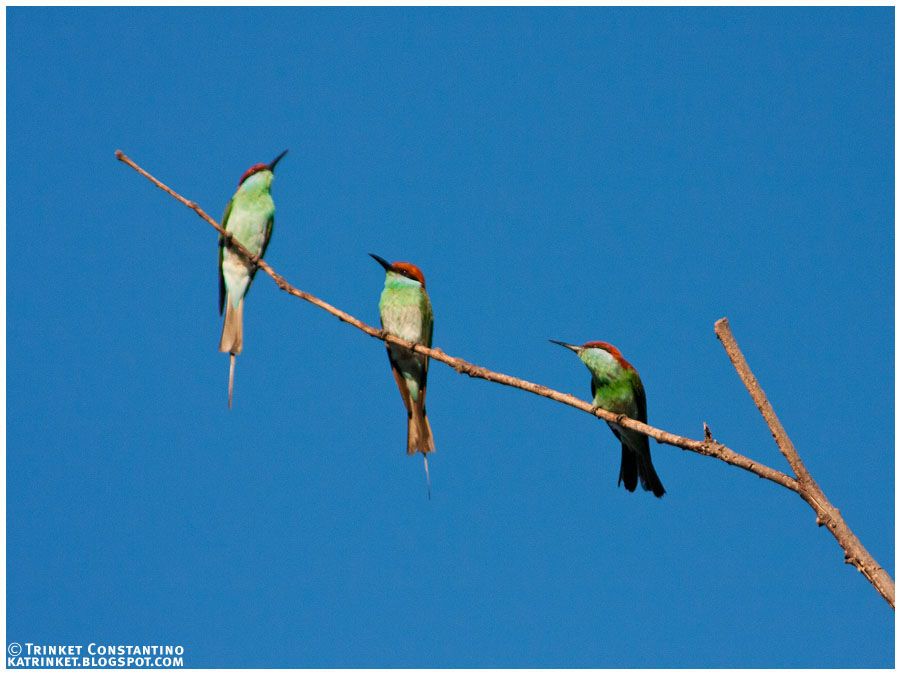 |
| a trio of bee-eaters in a row |
on a not-so-good note- there were only a few doves: pompadour green-pigeon, white-eared, yellow-breasted, black-chinned, reddish cuckoo-, and common emerald doves were all heard or seen. however, we had a feeling there must be some hunting going on as they were all extremely skittish, as were the other medium-sized birds like the blackish and bar-bellied cuckoo shrikes. we also observed a lot of old large woodpecker holes on the wooden posts along the road, however, we did not glimpse a single one!
we did observe at least one pair of birds who had successfully fledged their young: a pair of yellowish white-eyes were busy feeding 2 young birds perched below their nest, probably having just left the nest that day. (we also saw some lowland white-eyes, unusually overlapping in habitat with the yellowish!)
 |
| a yellowish white-eye busy looking for food |
 |
| a fluffy white-eye fldgeling under its nest (can you see the other fledgling and the nest near the top of the photo?) |
 |
| mom/dad with food! each fledgling had its turn getting fed, very efficient! |
we also observed a pair of scale-feathered malkohas who were just starting out: they were in the process of building a nest. definitely not nest parasites these relatives of the cuckoos.
 |
| one of a pair of scale-feathered malkohas building a nest |
as the others walked ahead of me, i got distracted by the many, many butterflies flying around!
we first noticed them puddling underneath a huge tree. fine drops were falling to the road, was it dripping tree sap that was gathering butterflies underneath its shade?
 |
| several of these papilios were puddling under a tree |
 |
| the papilios' wings showed varying degrees of wear and tear |
 |
| quite a beaten specimen of one of my favorite lycaenids: caleta roxus |
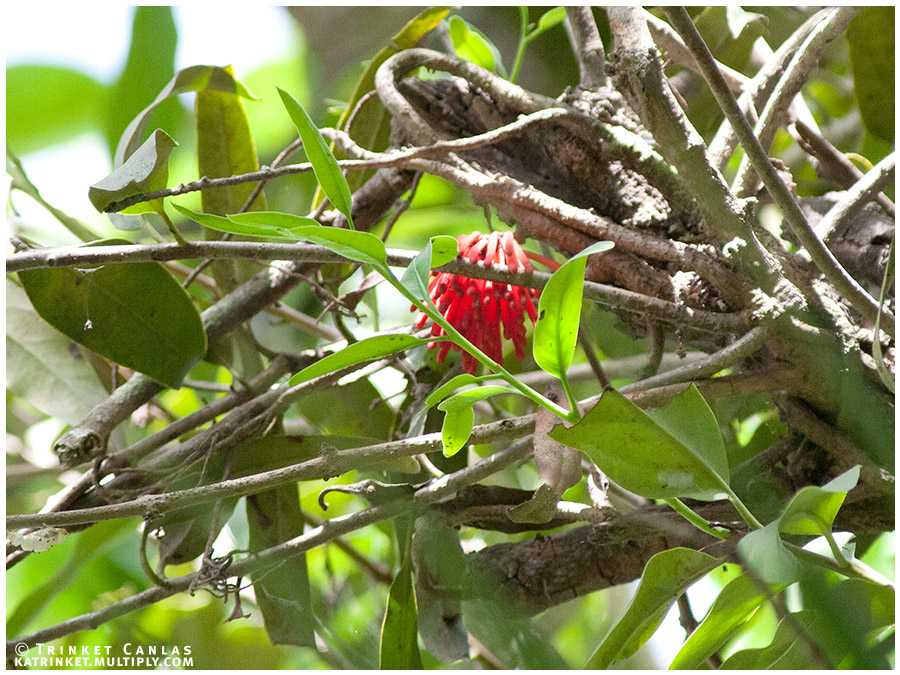
there were a lot of interesting looking plants as well. at one area, all the duhat trees were host to a now familiar mistletoe. the bright red flowers were a beautiful sight, and many of them invited olive-backed sunbirds to sip their nectar.
 |
| the trees were dripping with the red flowers of the mistletoe amyema incarnatiflora |
 |
| a female olive-backed sunbird taking a sip of nectar |
by the side of the road i saw at least two different kinds of vines, both with clusters of star-shaped flowers.
 |
| this reminded me of a hoya but the flowers and leaves weren't so succulent |
one of them grew profusely over the small trees, and its flowers attracted quite a few lycaenids and pierrids.
 |
| a lycaenid (one of those whose identity eludes me: it had a bright orange upper side) sipping nectar from the flowers of a very profuse vine. |
 |
| caleta roxus joining the lycaenid in the previous picture (do you see its false head?) |
some of the butterflies were attracted to less pleasant things: a pair of cruisers were joined by a skipper another nymphalid taking in minerals from the remains of a dead lizard.
 |
| a variety of butterflies attracted to a dead thing on the road! |
as i hurrried to catch up with the others, i saw that they were in the same predicament as i was. they were being distracted by the butterflies! how could they not be? several small lycaenids were perching on our shirts, bags, and even our hands and faces!
 |
| a fresher specimen of c. roxus on adri's bag |
 |
| another lycaenid stayed perched on my hand as i walked for several meters! |
some of the butterflies were perching on the road and the rocks by the side of the road, bathing in the hot mid-morning sun!
 |
| another cruiser on a lily flower planted near a grotto |
 |
| a common jester perched on the grotto walls |
 |
| how i wish i got a better photo of this skipper! |
 |
| i was not familiar with this sunning nymphalid so i took pictures of its underside... |
 |
| ... and its upperside! |
 |
| a tiger sipping from the rocks |
 |
| and a crow sipping from the concrete road! |
many of the them were chasing each other, perhaps guided by the scent of another chemical (not salts nor flowers nor decay but love!): pheromones!
 |
| the chase of ages |
 |
| guided by the scent of lurve! |
it's too bad that radar hill is quite far away from metro manila. it looks like such a promising place to watch both birds and butterflies!