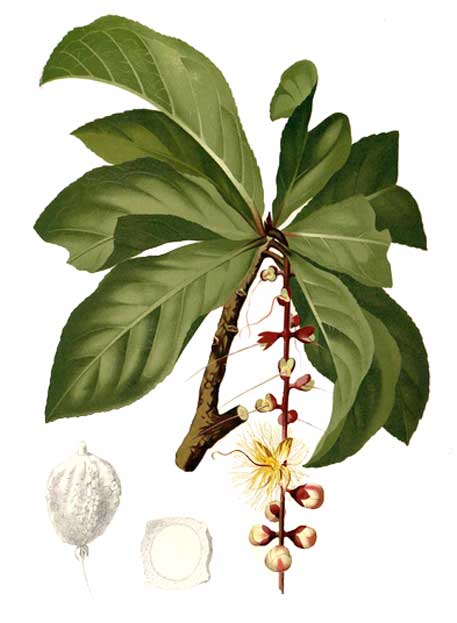
(please excuse the the title of this essay ) what i am referring to is a beautiful tree native to the philippines and many parts of SE asia, india and polynesia. it is common and grows in damp places along the seashore, rivers or creeks. however, with most of metro manila's waterways paved with concrete, very few of these trees can be found in the city.
the putat: read more about it at the very useful stuartxchange
one of these places is by the creek separating the ateneo de manila university and miriam college campuses. a fairly large (and probably old) putat grows by the culvert on the ateneo side, clearly visible from katipunan beside the pedestrian overpass crossing the road.
the putat (barringtonia racemosa) or fish poison wood (hinting at its traditional use to fisher folk) is small tree, somewhat "normal" looking. but when it flowers, its pink blooms can drip thickly from its branches and cover the ground in a carpet of pink. if only we had more waterways around the city to plant it! (too bad the mmda is no longer trying to paint the metro pink!)
i collected a few of the fallen seeds around the ateneo putat and at least three of them germinated. hopefully i can re-plant them where they can grow and bloom.
i would have never noticed this tree if it wasn't mentioned to me by fellow-birder/native plant enthusiast cel (of the pnpcsi) and co-teacher abby (of the ateneo aemc). unfortunately, this putat, rare-tree-in-the-city, is in danger of being cleared for future road widening. katipunan traffic is no joke and this threat is very real. hopefully it won't fall victim to the concretization of the city. the putat is one of the native trees that is not very popular, certainly not as popular as the non-native fruit trees from childhood: the duhat, atis, langka, santol and many other trees that were introduced from other parts of asia or the americas. recently, a book on native philippine trees: Philippine Native Trees 101: Up Close and Personal, was launched. cel was the chief photographer of the project so i was able to get advanced (and autographed! thanks cel!) copies before it comes out in the bookstores. it talks of the kamuning, kamagong, lumbang, ipil and other native trees now more associated with streets and places than with the tree! it's a great book, filled not only with information, but delightful anecdotes from people from all walks of life. to learn more about philippine native trees like the putat, go and grab your own copy!
after 5 consecutive guided birdwalks in school for ron's/mishi's/pau's ecology classes, i am officially guided trip-ed out!
one of the good things that came out of the trips is that adri and i (joined by jops and maia on friday afternoon and manny i, whose daughter was one of our students, on saturday morning: super thanks!), with the help of the others, were able to observe and document several nesting birds on campus! it was great because it made the back-to-back-to-back-to-back-to-back guided trips much easier! first, because it was almost as if we guaranteed sightings of the birds at specific places and second, even non-birders could not resist the wonder of an adult bird feeding its helpless young on a carefully constructed nest.
the first nest is a long-tailed shrike's nest which jops had spotted a week before on a bird & tree walk for the ateneo community. it was a walk jointly facilitated by the wbcp and the pnpcsi. the shrike's nest was very well hidden behind the leaves of a mahogany tree, right by the sidewalk of a very busy road! the nest was cup-shaped made of loosely woven grassy material. it was easy to point out because the shrikes also made use of a long piece of plastic straw, and it hung from the branches making a convenient marker. the nest base looked like it made use of other discarded plastic packaging also.
the young shrike looked like it was ready to fledge any day. its parents patrolled the nearby field, returning regularly to the nest to feed the lone chick. on another nearby mahogany, we spotted another nest several meters up which looked like an old shrike nest.
a few meters away across the field, another long-tailed shrike pair was busy feeding an older shrike, already fledged from the nest. the shrikes in my office parking lot had also just recently successfully fledged. needless to say, the long-tailed shrike is a guarantee on campus. they're literally EVERYWHERE.
the second nest is a black-naped oriole nest, a wonderful find because the bright yellow oriole never fails to elicit the oohs and aahs (plus the "may ganyan palang ibon dito?" comment) from the participants. this one was waaaaaay high up in a rain tree.
it's a fairly largish nest, and with bright yellow birds returning to it every few minutes, it's hard to miss once you know it's there and what to look fro (and if you look up of course). the parents were busy feeding two young birds. the birds still had a lot of their feathers sheathed and their heads were still featherless, but once we observed one of them perched confidently on a branch above the nest, preening itself for several minutes in-between feedings.
the nest was made of leaves and twigs and other plant material. long strips of dried material was used to weave the nest on to the supporting branch, making it very sturdy despite its height up the tree and the wind blowing the branches violently from time to time.
the parents left the area for only a few minutes at a time, and it was interesting to note that they were especially aggressive to a collared kingfisher which would come and call loudly from time to time. they would arrive on the scene as soon as the kingfisher would start calling and upon locating it, would chase it away (listen for this at around 2:10)!
the students were also amused to observe the confrontation between the orioles and a pair of pied fantails. the birds chased and dove at each other in the high canopy with much energy and display of maneuverability. david versus goliath one student mentioned.
at a much smaller tree beside the the huge one with the oriole's nest, we also spotted an old, used nest, placed in a pretty open spot. by the looks and material of it (notice the plastic again), it must be a recent long-tailed shrike's nest. there were at least two adults in the vicinity. (need i emphasize again that these shrikes are everywhere on campus?)
saturday morning was our 5th and last trip. the birdwalks were getting shorter and shorter as we now knew where the birds would be. on our way to the oriole's nest, manny made another nest discovery! just by the driveway, on a small tree (this time i'm not sure what species of tree this was), he had spotted a golden-bellied fly-eater coming out of a bunch of dried leaves. it turned out to be a nest which was still being built!
this nest was a hanging nest, built very close to the ground. it was made of softer plant material, what looked like a lot of moss. the adult was still checking the nest out, coming back with new nesting material. despite its (human) accessibility, it was easy to miss, it blended so well with the foliage and didn't look like what you would think a nest looks like. the adult was entertaining to observe, leaving and coming back to the nest in almost exactly the same pattern every time.
it even led us to see another fly-eater nest, this time way up another rain tree. the nest was already elongated and dry, probably used already. it was taking nesting material from that nest and using to to bulk up the new one.
strangely enough, a male pied triller was also taking material from that same fly-eater nest!
we had spotted the pied triller the day before, on a nearly bare narra tree, in the same area. adri had spotted it because it was also sitting on a tiny nest strategically placed at the base where a larger branch forked out into three smaller branches (covered by a leaf in the photo below). we couldn't figure out if it was an old nest or it was just being built, it looked very flimsy and thin. we did see it (the male) sitting on it on the 2 consecutive days, i suppose i'll have to check on it again if i want to know what stage that nest is at. the female pied triller was also always in the area.
we saw many other pairs of birds during the birdwalks. aside from the pied fantails harassing the orioles, there was a pair of collared kingfishers always at the same site, and we also spotted a pair of lowland white-eyes moving about a tree, gleaning for insects. we also saw a white-breasted wood-swallow which seemed to have a well concealed nest on the corner of the steel bars of a communications antennae ("isn't it hot up there?", one of the students asked, more of a comment than a question).
our walk covered only a very limited area of the campus, i'd love to think that all this nesting activity is happening all over the university grounds!
i was excited to receive a text message from cel t. inviting me to join a pnpcsi (philippine native plants conservation society, inc) tree walk at the up diliman campus on sunday morning.
i met up with a small group at the admin building behind the oblation and we got up and started soon enough at a very familiar corner: university avenue cor. jacinto st, right near albert hall (my second home for oh so many years).
our guide, arch. patrick gozon (http://pinoytrees.blogspot.com/) began with a short introduction on the definitions of native, indigenous, endemic and introduced (so similar to how we start our bird walks!), pointing to several palm trees right there at the outpost, beside the lady bathing. obviously, aside from the huge palm oil palms and coconuts, i had never noticed these other palms!
it was a very educational and interesting morning. we walked from university avenue to the up lagoon area (horrors, the lagoon had been half filled in and overlaid with concrete!) on the side of vargas museum, to the back of the main library by the beach house, to engineering and beta way, back to the as building and the faculty center to nsri and msi.
it was a good time to go around, several of the trees were in bloom.
pili (Canarium ovatum) trees in bloom and fruiting on university avenue! imagine that!
a lifer tree: the salingbobog (Crateva religiosa) by the lagoon had such pretty flowers! they must be pretty sweet too, several pierid butterflies were drinking their fill.
the kalumpit (Terminalia microcarpa) tree in by the library in front of phan was still blooming. i know the fruit but i've never seen the flowers (or knew what the tree looked like!)
katmon (Dillenia philippinensis) in up! i know katmon because i kept on seeing its lovely flowers in the forest while birding, and the first time in palaypalay. i learned in agusan that the fruit was used as a souring agent.
this is a botong/putat (Barringtonia asiatica) flower and dried fruit. i've seen this at the cbd at subic and even in ateneo! i didn't even notice the one at the msi!
(this isn't a tree but how can i resist the msi blue rock thrush when it lands right beside me and picks up a huge juicy caterpillar?silent note: when my main agenda ISN'T birding! it may be my last sighting of this handsome fellow for the season. )
i'd best be joining more of the tree walks and hitting the books and the internet... i definitely have a LOT more to learn about our native trees... even in up where i stayed for more than 10 years! i'm definitely looking forward to learning more!
since feb 7 was a school holiday, i volunteered to drive mom to the manila seedling bank for the last day of the horticulture show.
there was not much truly exciting at the sale booths, but at the exhibit area i loved the display of the philippine native plants conservation society. aside from the beautiful plant display (native philippine plants i presume!), they had wonderful posters of philippine hoyas, pitcher plants and mistletoe plus a fibreglass rafflesia. and of course a lovely tribute to the late prof leonard co.
another booth which caught my attention had a wall garden of succulents. it looked like a pretty hard maintenance job to have one in real life but i loved all the kalanchoe colors they displayed.