On my last post, I wrote about the Ashy-fronted Bulbul outside Mel's and my shared bedroom window. So why were we in Puerto Princesa in March? Well, Mel was invited by the Katala Foundation to share her craft with some of their local partners in conservation. Mel designs and sews beautiful mini felt charms of Philippine endemic wildlife, among them the Philippine cockatoo (katala) and the Palawan hornbill (talusi). I was happy to tag along and volunteered to be her assistant. On our first day, we worked with some of the women from Brgy. Luzviminda of Puerto Princesa and from the town of Narra. Narra is the site for one of the most successful conservation programs of the Katala Foundation so far, and the skills training could provide an additional source of income plus an avenue for educational campaigns.
It was great working with the women the whole day. In the beginning they had a lot to say about the tiny patterns and how cutting the felt almost left them cross-eyed. But as the day wore on, they became obsessed in their hand work and engrossed in their sewing. There was even a bit of competition on who could sew the best looking and the most number of charms for the day!
It was good to be in the company of women with a good sense of humor and who worked well with their hands. At the end of the day-long training, everyone was proud of their work and excited to go full force in producing the charms.
On the succeeding two days, we moved to Iwahig and worked with the medium-security inmates of the Penal Farm. Although the group was very different from the women we had worked with the previous day, there was a similar level of skill, enthusiasm and competitiveness!
Everyone was hunched over their classroom desks, hands busy, caught up in their work. Everyone also was in good humor, stories of all sorts were exchanged while working. Despite having been deprived of liberty, the men were very open in sharing their stories of their lives and giving commentaries on a wide variety of topics.
Upon learning that Mel had yet to see a Philippine Cockatoo in the wild, the inmates began to offer all sorts of suggestions on how she could accomplish getting it on her life list. The Penal Farm after all was one of the sites where the Katala population was re-establishing itself. Almost everyone (not only the inmates, but the guards as well!) had a recommendation: from a specific tree to a specific time! Thankfully, one of the local expert guides, Mang Arding, who worked at the penal farm and with the Katala Foundation, kept an eye out for any katala while we were there. Upon spotting a lone cockatoo feeding at the manggahan area, he quickly fetched Melanie and me and drove us to the site! (We were not allowed our cameras and optics in the facility, so all we had as evidence is the story and a few blurry digiscoped photos using Kuya Arding's binoculars!).
While not officially a birding trip, we (myself, the Katala staff, the prisoners, the guards, Mang Arding and Mel of course!) were all happy to that Mel got her katala lifer! It is always great when different lives intersect and align towards a common goal. Cheers and hugs to Mel for being so generous with her time and talents. It was truly an enriching and unforgettable experience. Read more about this skills training program by clicking this link: https://bit.ly/2MrKWrf
The Philippine Cockatoo (or Red-vented Cockatoo) is classified as Critically Endangered, which means that the risk for its becoming extinct in the wild is very high! Once fairly common throughout its range, it has suffered greatly in the past decades from habitat loss and the pet trade.
The critically endangered endemic Philippine Cockatoo.
In fact, I have to admit that as a child, we did have a Philippine Cockatoo in the family named Pablito. Creamy white with the distinctive orange and yellow feathers on his (we never did find out if he was a he or a she) undertail, Pablito was a delight. We grew fond of him, despite the chewed down wood furniture and the constant ruckus and squawking. Sadly, he met an untimely end with one of our dogs when he was accidentally let out of the house. Before that, I had no idea that we had cockatoos in the Philippines, as I associated parrots with the exotic wilds of the South American jungles or the dry landscapes of Australia down under. As a novice birdwatcher two and a half decades later, I was finally given the chance to see Philippine Cockatoos, where they belong: in the wild lowland forests! In 2005, less than a year into birding, Tere had invited Adri and myself on an impromptu Palawan birding trip. It would be the first time I would ever visit Palawan as a birder! We were all so excited! On top of the usual birding itinerary at Puerto Princesa, she had also arranged a trip to Rasa Island in Narra with the Katala Foundation, specifically to see the cockatoos. And see them we did! I will never forget the afternoon van commute to Narra, arriving in time for dinner and being met by Debbie and given direction on what to do the next day. Before sunrise, we walked to the beach at low tide in the dark, to be transferred to a larger outrigger boat which would bring us off shore to the roosting site of the Philippine Cockatoos at Rasa Island. As we approached we could already hear the loud, noisy calls of the parrots, even in the dark. Our guide, Fred, was explaining to us how the population had quickly grown from around 20 individuals in the late 1990s to over a hundred, thanks to the efforts of the Katala Foundation in protecting Rasa Island and in engaging the former poachers, now turned wildlife wardens. Rasa Island was known as the last stronghold of the Philippine Cockatoo. Against the lightening sky, we could see the silhouettes of the birds busy with their morning rituals: preening, stretching, playing, squabbling. The still sea, the pinks and periwinkles of sunrise, the island jungle: it was all beautiful.
The cockatoo roosting sight on Rasa Island in 2005
Clockwise from top left: Fred explaining to us the history of Rasa Island, Dusk lightening the skies, silhouettes of the cockatoos (we had no long lenses in 2005!), Adri and Tere birding on the boat.
That morning, we counted 92 individual cockatoos at the roost site, before they flew off towards the center of the island or to the mainland to feed. Ninety two critically endangered Philippine Cockatoos in the wild!
A rainbow over Nara (2005)
On our way back to the mainland, a rainbow touched the sea in front of Narra, a clear sign of hope. Fast forward to 2017, I had never set my eyes on a wild Philippine Cockatoo again since that encounter a dozen years before. I had visited Palawan several more times, having fallen in love with the easy birding. But I had never gone back to Narra. Peter and Indira Widmann, the passionate and energetic leaders of the Katala Foundation, were now our good friends with whom we had shared several meals and adventures (read about our Siargao trip here!). I suppose it was finally time for me to see the Katala again. In April, during the Holy Week break, Adri and I once again found ourselves in Puerto Princesa on an impromptu visit. Peter and Indira were generous and gracious hosts, arranging again for us to visit Narra. This time, we were off to visit the Katala Institute for Ecology and Biodiversity Conservation (KIEBC). The KIEBC serves as venue for research, conservation education, rescue and rehabilitation and habitat restoration. Currently, the center is still undergoing major works and not yet fully operational It can only be visited by appointment. It was a quick, 2 hour drive now to Narra, the road network having been vastly improved over the past several years. We had coordinated with the Katala staff, and Anna, the education officer gave us great directions and we found the KIEBC with no problems at all. As we got down from our car, the joyful song of a Common Iora welcomed us.
A cheerful Common Iora welcomes us to the KIEBC.
We met Anna, and the rest of the cheerful staff who were there: Angel (who was in charge of the animal husbandry) and Yud (who was in charge of the rescued turtle's care). We were given a brief presentation on the KIEBC and its goals, as well as the current and future plans for the site. And then we got a very special tour!
Yud talked to us about the Philippine Freshwater Turtle Conservation Project. She showed us the 3 different species of turtles which had been rescued and were currently being rehabilitated at the center: the Asian Box Turtle, the Asian Leaf Turtle, and the elusive (And also critically endangered!) Philippine Forest Turtle (which is endemic to Palawan).
Signage at the KIEBC and Yud showing us the "leaf" design of the plastron of the Asian Leaf Turtle
The girls explained how the turtles were being taken care of and the intricacies of the rehabilitation. It was great to hear them so passionate about their work!
We were shown around the various parts of the center, with the girls carefully explaining each part and casually telling stories of their on site experiences. There were 3 rescued Katalas from Balabac (who obviously associated people with food), and 2 more from Narra: a male named Silver and a female named Violet. Sadly, they could no longer be returned to the wild, but I think they were doing very well at the center.
There were also two very shy Palawan Porcupines who gamely came out of hiding in their spacious enclosure after a fair amount of coaxing by Angel.
The spacious enclosure of the Palawan Porcupines provided them with a lot of hiding places!
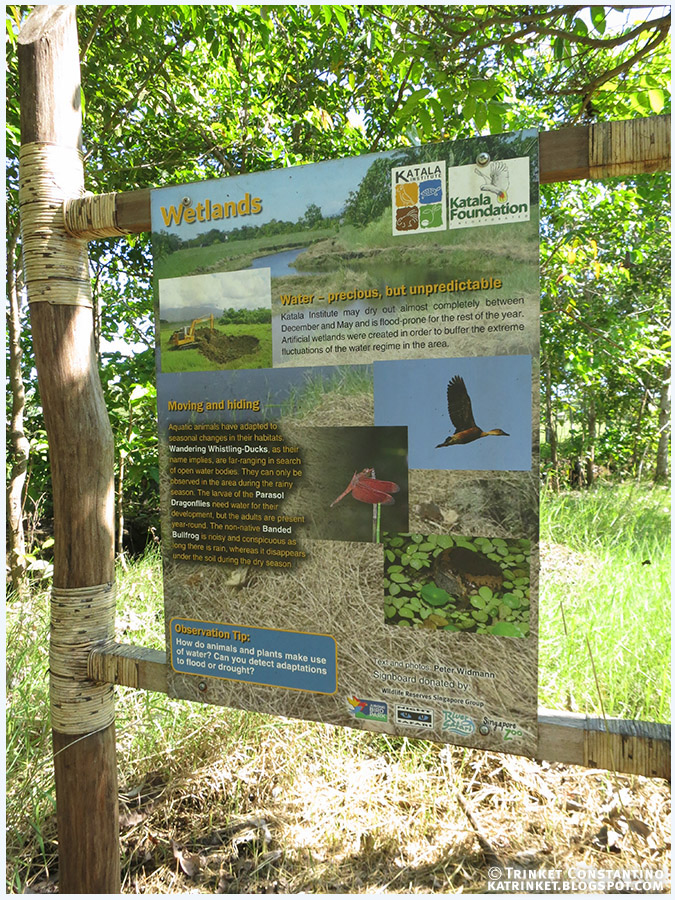
Many wild birds and herps also enjoyed the center, and one of the showcases was a mini-wetland area. Dragonflies were flying all around, and sometimes, the girls said, Wandering Whistling Ducks would come to rest in the grassy water.
A wild skink sunning in the leaf litter at the tree nursery.
Valuing wetlands at the KIEBC: pond dipping anyone?
With a lot of work still being done at the KIEBC, and with staff as enthusiastic and impassioned as the girls, I am excited for all current and future projects.
With the enthusiastic staff at the KIEBC
So the original plan was just to drive to Narra in the afternoon and be back by sundown at Puerto. However, Anna had mentioned that, since it was nearing late afternoon anyway, would we not like to take a chance and see the cockatoos roosting in town? How can one say no to that?!? So Anna led us into town, to a known roosting site. Apparently, the cockatoo population on Rasa Island was growing so big that some of the younger generation was expanding their territory! Some were reported to no longer return to the island to roost in the evenings, but stay in some parts of the mainland! (Isn't this a great testimony to the success of the Katala Foundation's work on Rasa Island?) I turned out that the roosting tree was across the street from a small sari-sari store. So we set-up our optics and began the wait. It was only 4:00 pm, and the cockatoos were reported to come at sunset. Wait, wait, wait. People began to get curious of our presence (non-local alert!), but we were obviously there for the cockatoos, so they began to reassure us in their own unique ways. "Ah, are the cockatoos there," said a passerby with a look at the roosting tree. "No, it's too early yet," as he glanced at his wrist watch. "Just wait," said the sari sari store seller. "They'll come maybe at 5:00." "They'll arrive soon," said a woman sweeping the street. "They'll be there," said a grandmother tending to her potted plants. As the minutes wore on, the comments got longer. Questions flew left and right from each person passing the street or buying something from the store: where we were from, how we heard of Narra, were we really there just to see the cockatoos. Kids playing would glance at us, and then at the roosting tree, shake their heads and then be on their way. At past 5:00 pm, people were becoming quite concerned for us. "It's still bright, they usually come near sunset." "Are they not yet there?" "What bird is that on the tree? Oh it's only a kingfisher." "They're coming." Adri spotted a single white Katala flying across the sky! One cockatoo! We didn't even have time to lift our bins or our cameras. At 5:30 pm, we were already causing a major commotion on the quiet street. "Still not there?" "Maybe they're on the beach. Did you check on the beach?" "Sometimes, they roost out on a tree at the back of the house," said a man while pointing to a tree barely seen behind a two storey cottage. "But they don't seem to be there either. I'll check and come back." Even Anna was beginning to get anxious and began to call all the local volunteers to check. And the best comment yet was from a man on a bike who stopped in front of the small crowd we'd created: "You know, when you wait for them they don't come!" (To everyone's credit, this comment was boo-ed loudly, but not after hard laughter). The owner of the house we were standing in front of assured us that the cockatoos were coming, and proceeded to show us a daily log of photos taken with his smart phone and began to detail when the cockatoos started roosting on the street.
A daily log on his phone: this was taken a few weeks before.
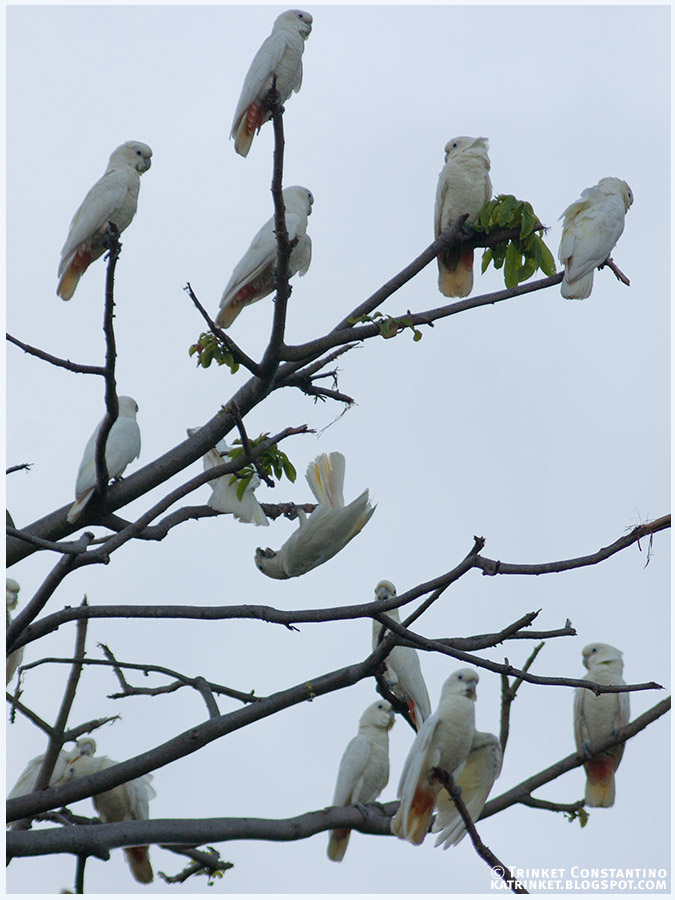
Two houses down, a group of balikbayans were curious about our presence and everyone tried to explain at once why we are there. Ok, now, even Adri and I were getting antsy at the non-arrivals. We were already comforting ourselves with the single sighting of the flyby. And then, at 6:00pm, the welcome sound of loud calls and squawking. Five perfectly white cockatoos land on the kapok tree (locally called duldul) in an awkward frenzy! "See? They're here. Just like we said." And just like that everyone is relaxed and excited at the same time. Later more cockatoos join in. We let everyone peek through the scope and our binoculars, even the balikbayans were excited. And even more cockatoos come.
Enjoying with us and some balikbayans what to them is a daily sight.
And more cockatoos fly in. And more.
Count the cockatoos on the kapok (dulul) tree at sunset! How many can you see?
Soon the kapok tree is a noisy, crazy, beautiful ruckus.
Adri and I couldn't quite decide which cockatoos to focus on.
Later, the cockatoos came even lower, landing on some fruiting malunggay (moringa) plants in someone's backyard. The owner, Mang Danny, turned out to be one of the Katala Foundation's boatmen, and he invited us to take a better look.
Cockatoos feeding on moringa fruit.
All households in Narra are required by ordinance to plant malunggay trees in their backyard: for the nutrition of both human and bird!
Hanging out: literally.
I could clearly see that most birds were ringed, and Mang Danny explained that the birds fledged each year were ringed with a specific color of band. He mentioned that all these birds expanding territory were mostly young birds, of the generations produced since Rasa Island became protected.
We left when it was too dark too see properly, almost 7:00 in the evening, with a smiling Anna walking beside us. In the end we counted 54 Philippine Cockatoos. Fifty four noisy, white birds. Fifty four beacons of hope.
Where there is passion, where there is the will to work hard and to fight hard and to persevere together, there is hope. Hope for the Katala and the every creature that they share their place on earth to live. This past May, Indira Dayang Lacerna Widmann won the prestigious 2017 Whitley Award (Whitley Fund for Nature) for her work with the Philippine Cockatoo. Congratulations to her and the entire Katala Foundation! whitleyaward.org/winners/partnering-prisoners-safeguard-critically-endangered-philippine-cockatoo/ On June 30, 2017, Narra will celebrate its annual Katala Festival. It's a chance for everyone to support the Katala Foundation and people of Narra in their conservation efforts.