Showing posts with label munia. Show all posts

Saturday, August 25

Birding Bandilaan

Predictably,  our tricycle driver Manong Glen seemed quite surprised that we didn't want to go the usual tourist route.

Cambugahay Falls?  The old, enchanted balete tree?  The springs?  Cantabon Cave? The Lazi convent and Church? Salagdoong Beach?  He offered all of them in succession.

We said no to all of the above!  We loved our memories of Siquijor from more than a decade past, and we were happy to keep them as they were.  Our top priority was the Bandilaan National Park, we were there to see the endemic Siquijor subspecies of the Streak-breasted Bulbul!

Manong Glen was familiar of course with the bulbul, locally called tagmaya. He agreed that it would be easiest to see in the forest. With a scratch of his head, he offered to pick us up at 6am the next day. From his own lips came the suggestion that it would be good to start early.  Perfect! We made a compromise with Manong Glen though, in case we didn't spot it at Bandilaan, we would gladly go to Salagdoong (the forest not the beach!) where we knew it was also easily sighted.

Right on the dot, he was outside our resort.  We sped off in a comfortable modernized tuk-tuk (better than a tricycle for the uphill drive he said!). But first, a quick stop at a neighborhood panaderia for some hot pan de sal and an irresistible loaf of cinnamon rolls!

On the way up the mountain, we could already hear some bulbuls calling. We drove thru good roads, passing several houses with signs offering  hilot (traditional massage) services.

When we arrived near a tourist spot where an uphill path to the view point split from the road,  Manong Glen parked the tuk-tuk and pointed up the overgrown, dark and wet (looked slippery too!) path.  The open road actually looked more promising and so we told him we would just walk along it.  We ate a pan de sal each, offered the rest to our driver, and went on our way.  Our driver told us he would park a few meters back at a flatter area and would wait for us there.


Bandilaan National Park on the slopes of Mt. Malabahoc

The forest looked much thicker than we remembered, certainly a good sign.  Although it could have just been greener because it was the rainy season.

Very quickly, we spotted the noisy bulbuls moving around the canopy.  Wonderful!

Getting photos though was another matter.  It was still a grey morning, and the little morning light available was filtered by the  forest.  On top of that, a beautiful light mist surrounded us!  The air was fresh and cool, the forest alive with sound... but still, photography would surely be a challenge.

Hooded Pittas were singing loudly, the wet ground and leaf litter was perfect for their foraging.  Every now and then when we turned a bend we would flush one from the road.


From above,the large hibiscus-like flowers from the native Vidal's Lanutan trees were dropping to the ground.  They would land with a soft plunk (one time hitting my head!) and covered the road in an almost festive feel.


The Streak-breasted Bulbuls (if split in the future, this endemic subspecies siquijorensis may be known as the Siquijor Bulbul) were very active!  It turns out that many were still feeding their young, who followed them around begging noisily.

One such parent-offspring pair were feeding at what seemed like a rattan vine, moving actively about the abundant fruit.


Many of the bulbuls were also in moult.  Not a very handsome bird to begin with (in my opinion, that is!), they looked all the more awkward with missing feathers.


The bulbuls were not the only ones busy with their young.  We encountered several Mangrove Blue Flycatcher families as well.  They sang melodiously throughout the morning.


The damp forest was also excellent for fungi spotting. Tiny and huge, dull and colorful - all sorts grew on the branches and ground.


Of course there were also my favorite epiphytes in abundance - ant plants (Myrmecodia)! They grew thickly on the trees, together with moss, ferns, orchids and others. Their bulbous caudices hanging on to their hosts' branches while their green leaves sprouted at the opposite end of the plant.


Begonias grew in great bunches on the ground, their bright orange flowers adding bursts of color on the ground.  There were several other flowering plants also, attracting all sorts of insects.


It was too early and too cold though for butterflies, we spotted this Red Helen Menalaides helenus hystaspes, immobile, busy sunning itself on a leaf.


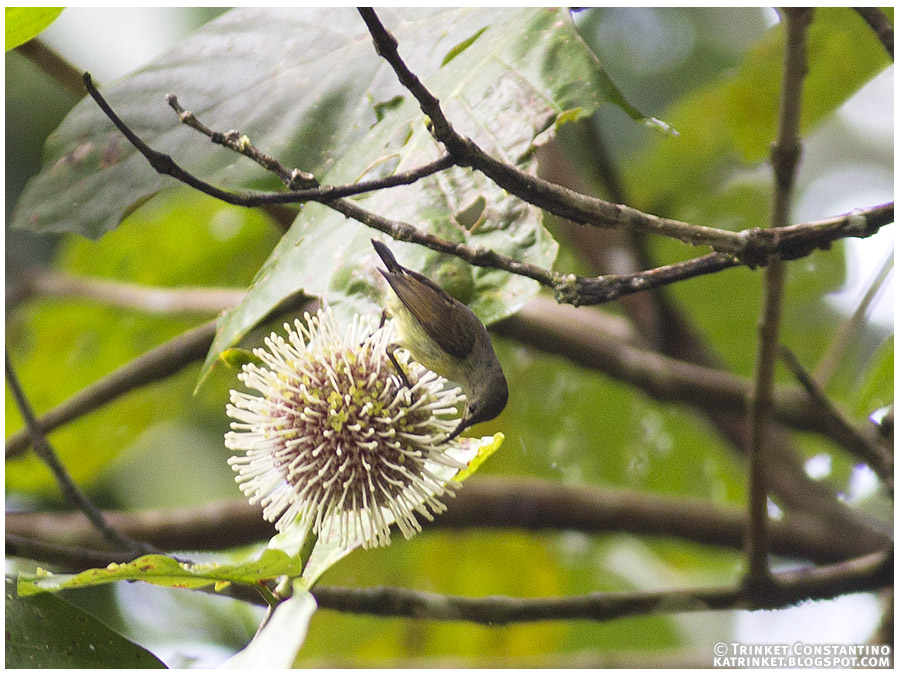
The sunbirds preferred the trees though, this female Purple-throated Sunbird was preoccupied with sipping nectar from the flowers of a bangkal tree.


A pair of White-bellied Munias were busy picking up long leaves to weave into their nest which they were building just off the side of the road.


A lot of other small birds were also very active.  I was a bit confused by this one, which turned out to be an island endemic subspecies siquijorensis of Yellow-bellied Whistler.  It looked just a bit smaller compared to the ones I've seen in Luzon and Mindanao.


Orange-bellied Flowerpeckers and Black-naped Monarchs also joined small mixed-species flocks.


As the morning wore on, the sun began shining more brightly, dissipating most of the mist.  We came across a pair of very friendly Black-chinned Fruit Doves, one of whom posed for our cameras for several minutes.  It was unusual behavior for them not to be afraid, since they are often the targets of hunters.


As birders know, a kilometer length of road can stretch on forever when you are looking out for birds and other creatures.  We finally reached another sign (newer and better maintained and beside a picnic area, this was probably a more popular entry point), and so we decided to turn back.


By the time we got back to our tuk-tuk, 3 hours had elapsed. Manong Glen, not familiar with birders' lack of time perception, was relieved to see us.  I guess he did not expect to wait so long, and he was actually thinking we might be lost!  After all, who would spend so much time looking at birds?!?

We showed him photos of the bulbul, and he could not believe it when we said that it was only found in Siquijor island.  "Nakapagtataka!"  (loosely, "magical" or "amazing") he kept on saying over and over again in wonder. (Of course he was also in maybe equal disbelief that we came just to see the bird.)


Streak-breasted Bulbul, Hypsipetes siquijorensis, endemic to the Philippines and only found on Siquijor, Cebu, Romblon and Tablas islands. 
With our target accomplished, we quickly downed the cinnamon rolls (all the pan de sal seemed to had been demolished by our driver in his anxiousness over our return) - and decided to call it a day for birding... back to the resort and the beach!


Mission accomplished, back to the beach in our little red tuk-tuk!

Friday, August 24

Beach resort birding

A hop away from Dumaguete is one of my favorite islands, Siquijor. I'd been to Siquijor twice before. The first time was in 2004 as a regular sun-worshiping tourist and then again in 2007 as a birder.

How could we resist?  Our pitta twitch was quite successful and we could do a bit of target birding (we didn't have any long lenses during our first Siquijor birding sortie) before heading back to Manila.  And ... BEACH!

We were able to book the last garden room at the Coral Cay Resort (www.coralcayresort.com) in San Juan and early the next morning we went straight to the pier to purchase our fast craft tickets.

And failed!  

The combination of a low pressure area and the habagat was stirring up some angry waves and all small sea craft were grounded by the coast guard!  Thankfully the larger RORO (ROll-on-/ROll-off) craft were still allowed to travel!  With the limited transport, there were predictably long lines (mostly toursits!) to get RORO tickets, but our lucky streak continued and we got the last two passenger slots for the RORO!

After a (slightly) choppy 2 hour slow boat ride, we finally landed at the striking white sand beach pier at San Juan! More than 10 years since my last visit, I could already see the changes to this (once?) mystical island - the pier had been much improved with a modern terminal for waiting passengers!  The white sand beach though was beautiful as ever, even under the grey skies.

We had reserved the next morning for birding to chase our targets, but all other times, we just spent lazing about the resort: swimming in the pool, walking on the beach, eating, snoozing, catching up on some reading or just (as what vacation is best for) staring at the deep blue!


The view from our little veranda.


While mornings were sunny, by mid-afternoon the skies turned grey and the wind picked up.  It was fun strolling on the beach with the wind whipping about sand, dried seagrass leaves and other bits of beach litter!


Walking on the beach, we were bound to pick up a pack of cool beach dogs who always seem to welcome a tummy scratch and pat on the head.


Back at our cabana, we would of course be distracted by the birds flitting about the garden.  Our room faced some colorful San Francisco ornamental plants and a spreading pomelo tree which was a favorite hang out of a pair of Olive-backed Sunbirds.


Walking about the sand were Zebra Doves which stopped every now and then to do a low courtship bow and dance, complete with soft growls.


A Philippine Magpie-Robin would call from a flowering caballero shrub where it hid from the guests walking on the paths.


Every now and then a Philippine Pied Fantail would fly in, snapping its wings and tail loudly.


A nearby palm tree held a large number of noisy Asian Glossy Starlings nesting. These two were gorging on some ripe papaya fruit behind our cottage.


A cute pair of Chestnut Munias were busy building a nest in a dracaena plant beside the neighboring cottage.  They would rest a bit on the pomelo tree between carrying long blades of dried grass.


So even at the beach, birds beckon. Sun, sand, sea, beach and birds... aaaah, the life!

Tuesday, June 13

Golf cart birding at QC: birdies on the green!


As June rolled in, the rainy season official on its way, we were already becoming lazy in planning any weekend birding trips.  So I was excited when Anna G. invited us to bird at a site around my area of the world: Capitol Hills Golf and Country Club.

Although I had been to the surrounding commercial and residential areas in the vicinity of the golf club, I had never actually been inside the 18 hole golf course.  It had been in existence since I was born, but it had recently been under the management of Ayala Land, who was also developing the nearby residential areas.

I literally pass by the boundary of the golf course almost everyday of my life, but have only had glimpses of the course. And while most Universities, parks and cemeteries are easily accessible, this green space was membership (or at least golfer-) only.

We met up Anna and George (of ALI) and WBCP-er Willem at a row of restaurants which overlooked the greens of the course before our ocular.  It was a relief not to be troubled by early rising or traffic - we leisurely sipped our coffee before starting.  Already (beginning at the parking lot) we had seen several Golden-bellied Gerygones chasing each other.  Black-naped Orioles called loudly as they flew from tree to tree.  Yellow-vented Bulbuls gurgled all around us. We could hear a hidden Philippine Magpie Robin singing melodiously behind the buildings and shrubbery. A Collared Kingfisher was patrolling nearby.  This patch of sprawling greenery was probably an oasis for the city birds!

As we exchanged morning pleasantries, we were entertained by a Glossy Swiftlet gathering some fiber from a nearby fishtail palm.


A few Black-crowned Night-herons also flew overhead, probably traveling between hunting ground and day roost sites.


Soon, we were off!  We were joined by one of the managers, Gino, who would show us around.  We were paired of and each of us given our own golf cart to drive around the course!  Silently I added "golf cart" to my list of birding vehicles which have so far ranged from the comfortable air-conditioned coaster, to the barely manageable breathing four-legged pony!


Almost immediately we spotted several Long-tailed Shrikes watching from various levels of viewpoints along the holes.


The edges of the greens were kept "wild", the grasses grew long and wildly - obviously serving as great refuge for city wildlife. We soon stopped at a nearby pond and waterway.  To our delight, a very friendly family of moorhens was foraging!  I think, it was the closest encounter I have ever had with these waterbirds!  Though  alert to our presence, a pair and a fluffy chick came as close as a few meters to our group.  They wove in and out of the greenery.


A more skittish White-breasted Waterhen also made a brief appearance as it dashed across the short water line.

As we drove along the winding pathways, through tunnels and over bridges, Gino showed us a much larger pond.  Again, we saw several Moorhens, going about their business. Another young moorhen was up in a fig tree at the water's edge opposite from us, sunning itself.


A noisy pair of Collared Kingfishers were calling from a residence at the edge of the course.  Above us a pair of Pied Trillers was foraging for insects in the canopy of a huge rain tree. A playful pair of Philippine Pied Fantails chased each other noisily around the nearby vegetation.


It was not only the birds out to enjoy the morning sun.  Several skinks were out sunning themselves, hardly paying heed to the golfers or the gardeners.


As we crisscrossed the property, passing through gated residential communities, we saw several pairs of  Crested Mynas flying above us, slashing their white wing markings as they flapped their wings. Once in a while a Large-billed Crow would also fly overhead.  Noisy Striated Grassbirds would call from the tops of bushes and fences.
  
Soon we came across an even larger pond!  Again, several Moorhens were at the water's edge, preening and foraging.  There was even one individual swimming across the surface!  On the far edge of the pond, we could see a White-breasted Waterhen taking a morning dip.  A closer look revealed a downy chick beside it!  The darkly plumaged young bird was perfectly camouflaged among the rocks.


Several dragonflies and damselflies danced along the grass at the edge of the pond.


Sadly, there was also a dead Cinnamon Bittern at our feet.  Its eyes were still fresh and bright, indicating that it was a recent death.  It had no obvious injuries or wounds, save for a few damp and ruffled feathers.  We were discussing what the cause of death could be, considering that we could have interrupted a monitor lizard with its meal. Throw in a little mystery to our morning bird walk!


Again, we appreciated how the edge vegetation was kept a bit overgrown, and just to emphasize our point, another White-breasted Waterhen walked in and out of the long grass.


As we rounded the curve of the pond, we stopped to catch a glimpse of a White-throated Kingfisher flying off.  We stopped a while at the shade of a rain tree, surprised by some movement and the sight of a Common Moorhen preening quite near to us!  


Some of the tall grasses were in seed, and Adri spotted a couple of Scaly-breasted Munias picking at the grains.


Even on a weekday, there were a few golfers out, and every now and then we had to stop as they hit their balls across the greens (Is that the even a correct term? I am golf - illiterate).  Many Zebra Doves seemed to be unaware of this etiquette as they continued to forage on the ground unmindful of the balls flying around.


We also spotted a few Barred Rails.  Their behaviour was the normal skittish, paranoia, running into the nearest grass cover as soon as they spotted us. 

Several White-breasted Woodswallows were perched all over: on the huge nets which prevented the golf balls from flying off-course, on the light posts, and on the trees.  They were their usual vocal and boisterous selves. 


Near another grassy thicket, Anna spotted a Philippine Coucal! It quickly scuttled into the growth, revealing only bits of bright brown or black, until it completely disappeared from our sight.


Golf cart birding sure beat walking! We navigated the course easily and efficiently, slowing down and stopping (for flying birds AND flying balls!) any time we needed to.  Even if it was a hot, humid and sticky morning we barely broke a sweat! 


At the end of the two hour drive across the 18 hole course, we tallied a total of 32 species of birds! It was good to know that the exclusive golf course (while for human members only) was an open refuge to our feathered friends in the city.

Thanks again to Anna and ALI for the invite and the chance to explore this hidden bit of urban greenery!


And of course we end with a group picture!