Showing posts with label wader. Show all posts

Thursday, May 4

Stilts at LPPCHEAA

On the 1st of April, a few WBCP-ers (led by Mike L. and Arne J.) attended the groundbreaking for a wetland park at the LPPCHEA (Las Piñas-Parañaque Critical Habitat and Ecotourism Area). Finally!  Hopefully, this project, led by Sen. Cynthia Villar, will focus on the importance of the mudflats as a wetland (it is a declared RAMSAR site!) and as a green space in a city choked by urban developments lacking environmental planning.

Adri and I were there but unwittingly skipped the ceremonies as we were captivated by several Black-winged Stilts foraging along a relatively clean beach.  We had lost track of the time and got caught up documenting the graceful stilts as they were feeding along the waterline.

When we arrived at sunrise, I was delighted to see that much of the trash along the coastline had been cleared (still a lot left of course, I would think it almost impossible to clean all of it up, with more trash coming in daily with the tide).  The beautiful shell beach was exposed - revealing a diversity of gastropods and bivalves, together with a bit of plant litter: seeds, twigs (and sadly some plastic knick knacks).  It was definitely a bit of beauty one seldom would expect to find along the Manila beaches of the bay.


I could only imagine all the possibilities of having a clean beach in Metro Manila for the city-dwellers to enjoy.


A lone Common Sandpiper was busy preening in the golden monring light, stanind on a bit of muddy, discarded rubber/canvas/plastic.


A few stilts were on the beach at first, some resting and preening, others busy foraging for food. Many of them were quite vocal, twittering loudly.


There were few other migrants at the beach, although in the distance at the river mouth we could see several egrets, some herons and quite a number of waders.

A few Common Greenshanks flew past us, twittering loudly.


It was not only the birds out foraging, a man and his two young boys were also busy looking for shellfish in the shallow waters.


As the shadows receded with the rising sun, more and more stilts began flying in.  It was nice to see varying plumage, from the usual greyish markings of younger birds to elegant black and white plumage of the full adults.


Adri and I found a nice large log to sit on, under the shade of the mangroves.  The birds soon got used to our presence and began to get comfortable.

We practice in-flight shots with two Whiskered Terns.


And got a good laugh trying to outdo each other with stilts-in-flight shots.


Some of the stilts were flying back and forth right in front of us!  Sometimes they were too close!
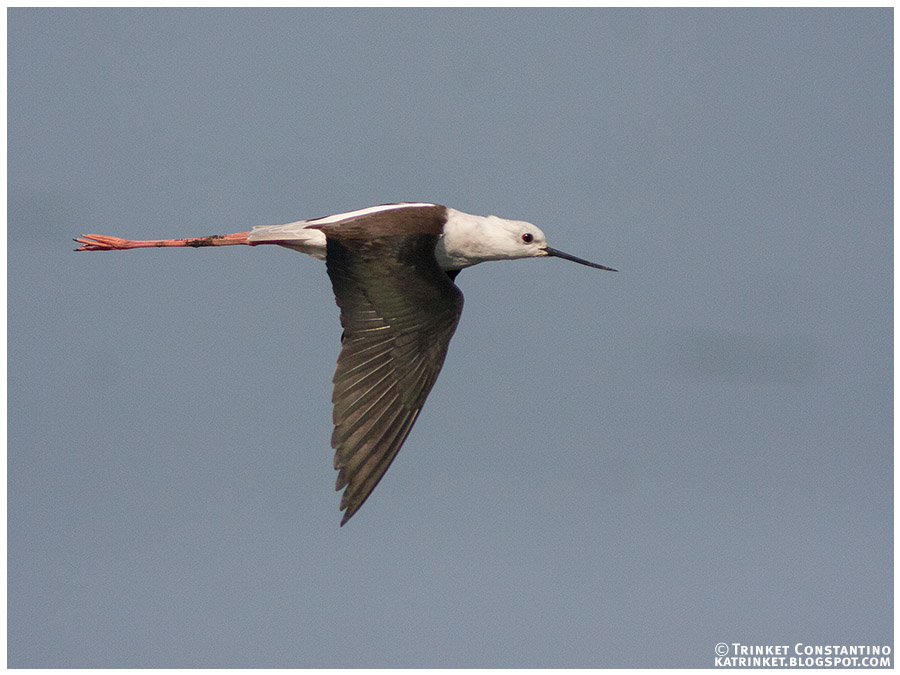


We were not the only humans on the beach, several meters away was a man busy with his boat, being ignored by most of the birds.


A few greenshanks decided to join the stilts.


And one of the beach dogs also came out to inspect the debris that had been carried in by the tide.


Soon the tide began to turn and we could tell the ground breaking event had finished, because we could see large groups of people descending on the beach.  In the distance, a large group in orange jackets were busy cleaning up the coast.


Nearby, a group decided to take the DENR trash boat (it had a huge net to catch floating trash out at sea) for a quick spin.  The Black-winged Stilts paid no attention to the people (probably because the people were not paying any attention to them either!)


The tide was eating up the thin stretch of beach so we decided to start heading back.  We ran into some of the participants and volunteers who were with Rey Aguinaldo (DENR Region IV and LPPCEHA Project Manager).  We were happy to show them some of the stilts through the scope.  They expressed their surprise at the number of birds along the beach, even commenting that they were happy that the event (with its many people and loud sound system) did not flush or scare them away.


As we walked back to the car along the more shaded inland trail, we spotted other migrants: a noisy Brown Shrike and a confiding Arctic Warbler.


We also ran into several groups of Barred Rails and Common Moorhens foraging under the mangroves.

At the end of the beach near the car, we saw a small group of three enjoying a swim in the water.  It was not something I would recommend!  I am still hopeful though, that one day, Manila Bay will be clean enough for more recreational activities.  With the threat of reclamation looming, perhaps a wetland park is just what LPPCHEA needs. Not just for humans, but for all the other wild ones that need it too.


Keeping my fingers crossed.


Monday, December 26

Back to Balanga!

It was the 7th Ibong Dayo Festival and we were off to Balanga City!


Adri and I were fortunate enough to have had our schedules free to join Balanga in celebrating the return of migratory birds to the city's wetlands.  The festival was established a year after the 4th Philippine Bird Festival (2009) hosted by the City of Balanga, and last year, it coincided with the 10th Philippine Bird Festival which returned to Balanga, this time hosted by the entire province of Bataan. This year, the festival won for the 3rd consecutive year an award from the Department of Tourism in recognition of its exceptional efforts as "Best Tourism Event" in the city category, allowing it to rise to the Hall of Fame for awardees.


We volunteered to man the scopes to show students and visitors the birds at the Balanga City Wetland and Nature Park on the shores of Manila Bay. We skipped the parade from the town plaza and headed straight for the park. There we found other WBCP volunteers Patty A., Richard R. and Brian E. already set up at the viewing decks.  


The mood at the park was quite festive already, as the early birds (haha) waited for the parade to arrive.

The tide was high and the birds quite a distance away, but it did not stop the enthusiastic festival goers (many of them students) from dropping by the viewing decks to peer through the scopes and our binoculars!


Great Egrets stood in the far shallows, a bright white under the sun.  


Black-headed Gulls, Whiskered Terns and Greater Crested Terns perched on the fish pen poles in the distance.


A pair of Collared Kingfishers were a source of great delight, perching on fence netting right next to a larger than life photo-tarpaulin which identified them.


Later the tide began to recede, exposing an expanse of mudflats.  The waders came in, flying in large flocks: sandpipers, stints, plovers and more!


Many of the birds were oblivious to the fishermen going about their daily business.


The first time birders were amazed to see clearly some Common Redshanks and Greenshanks feeding on the next beach through the scope.


Unfortunately, some of the mangrove wildlife was not so appreciated, and we saw a poor snake being taken away by some of the maintenance people.


A few Kentish Plovers and Common Sandpipers were foraging just in front of the viewing decks, until they were flushed by some kids enjoying stomping through the wet and sticky mud.  

Everyone in the view decks was amused by a little girl who was up to her knees in the mud. One of her playmates, quickly "rescued" her, only to get stuck as well!


Mid-morning and the festival was in full swing, complete with festival dancers and a busy trade fair.


Some kids arrived with a piece of paper they were supposed to fill up with the birds they saw.  To say they were competitive would be putting it mildly!


An Osprey was spotted, perched some distance away.  It was perched for so long, first eating a fish and later preening, that many of the students were able to see it through the scope and compare it to the illustration in the field guide.  Alex L was also a curiosity, taking photos with his huge lens!


The time passed quickly and soon it was lunch time!  Where did the morning go?!?

It was time to pack up and go.  We met up with the other volunteers and bid goodbye to the wetland park. We were fed (as usual!) a sumptuous meal by our hosts from the local government, and even given delicious ice cream to take home!

How can I not love the City of Balanga? A vibrant city, wonderful people, delicious food and a great wetland park: I keep coming back again and again! I'll be back to catch the spring migration next year!


Saturday, September 24

Saturday morning at the LPPCHEA


I was happy to be back at the LPPCHEA (Las Piñas-Parañaque Critical Habitat and Ecotourism Area) for a bit of Saturday morning birding with some members of the WBCP. 


The beach at LPPCHEA on a Saturday morning.

I had not been back for a few years and I was curious to see the beach we once dubbed as "rubber slipper beach" when I was just starting out birding.  All sorts of trash littered the beach, from your usual plastic packaging to styrofoam boxes, discarded nets and rope, furniture, handbags, clothes, toys... ANYTHING you can think up, including A LOT of rubber slippers. Well, there was still a LOT of the city's trash washed up on the beach, but it was not as thick as previous times I was there (and no, I don't think we could play the finding a matching-pair-of-rubber-slippers thrown away game anymore).

I had hitched a ride from fellow QC-ers Art and Riza and we were joined by Cathy and Rage.  When we arrived, the group was just about ready to enter the inner trail of Long Island towards the ponds and DENR station.


I was impressed by how big the trees which had planted a few years ago have grown, especially the Agoho trees.  The ends of the Agoho leaf "needles" held drops of the previous nights' precipitation which twinkled in the morning light.


Agoho-lined trails at Long Island

I could not miss the harsh calls of the Brown Shrikes, I counted no less than 10 individuals perched on top of the different levels of vegetation.  The song of Philippine Pied Fantails, Pied Trillers, Zebra Doves and Golden-bellied Gerygones could be heard from the mangroves.  High above, egrets, Whiskered Terns and Rock Doves flew against the lightening skies.  Every so often, a Black-crowned Night Heron would call as it flew over.

I was happily surprised to see several pairs of Grey-backed Tailorbirds in the mangroves.  They were calling loudly as they chased each other in the dark undergrowth.

When we arrived at the ponds, I was disappointed not to find any of the Common Moorhens or Philippine Ducks that were usually there.

But I could see that some of the group had moved to the beach so I made my way through the mangroves. The tide was just beginning to go out, but a small strip of sand was barely visible under all the flotsam washed up, mostly trash and piles of the invasive water hyacinth.

Every time I get a glimpse of the sand at the LPPCHEA beach, I try to imagine what it would look like if there wasn't any garbage on the beach, fine grey sand full of white bleached shells.


Grey sand littered with broken shells.


Out over the water were several Whiskered Terns.  Towards the shallows of the river were Little Egrets. A few Black-crowned Night Heron were perched on sticks. A particularly tall stick seemed prime property as herons, egrets, terns and even a Common Sandpiper would take turns perching on it. A Collared Kingfisher was patrolling by one of the prickly amor plants.


A Black-crowned Night Heron and a Little Egret


On the beach,  we observed a Little Egret which was very successful in catching breakfast.  In the midst of all the pollution, the shallows still provided what seemed like an abundance of small fish. We would constantly see schools jumping at the surface of the water.


Fresh catch of the day by a Little Egret still sporting its plumes.


And it was not just the birds who were taking advantage of this bounty. One of the beach dogs had caught a large tilapia and was carrying it back to its home!


One of the LPPCHEA beach dogs not to be outdone by the fishing birds.

The rest of the dogs didn't even mind the arrival of the furry fisherman, and they continued to nap in the shade as beach dogs all over the world do.


While the other dogs are just living the life.


A little further on, we began spotting a some more migrants.  A trio of Pacific Golden Plovers were foraging in the sand near a lone Common Greenshank.


A pair of Pacific Golden Plovers

A lone Common Greenshank got me thinking about the next AWC.


Later, we were happy to see a pair of Whimbrels with their long curved bills.  As the pair were alternately foraging and engaging in a little cockfight, a third Whimbrel was bathing in the water at the shore.


Whimbrels!

We also saw the unmistakable pink legs of a Black-winged Stilt as a single individual flew past us.

We were all delighted by the sudden appearance of a Common Kingfisher which darted out of the mangroves and hovered for quite some time over the water before diving in for a catch.  It would do this several times, gaining appreciative "ooooohs" as it fluttered in place, suspended over the surf.

Suddenly, another bird landed on the beach: a Rufous Night Heron!  It stood quite still for several minutes, its neck and body all stretched out.  


A Rufous Night Heron looking all forlorn.

Eventually it was disturbed by some of the fishermen and it flew over the sea right in front of us.  It's slow flight gave me a perfect opportunity to catch it in mid flight.


Rufous Night Heron in flight!

Toward the end of our stay, several other groups of visitors began to arrive at the park.  One of the groups was a a busload of University students doing a coastal clean-up as part of their NSTP CWTS (National Service Training Program - Civic Welfare Training Service). They were at the start of the beach, and were performing the insurmountable task of hauling trash from the beach.

I was happy to run into Sir Rey Aguinaldo of the DENR who managed the LPPCHEA.  He said that they thankfully did have a lot of volunteers who participated in beach clean-ups. But still of course, the trash kept coming in, from that undending source which is all the human settlements around Manila Bay.

As I watched the kids cleaning up the beach, a Little Egret hunting in the foreground came into focus.  What a juxtaposition of images.


A Little Egret forages for food amid the trash as students clean-up the beach further down the shore.

I can only dream of the time when our trash does not end up in the ocean, and when the white shell beach of the LPPCHEA will sparkle under the tropical sun.  When a nature walk here will not only show trees and plants and birds and insects, but actual marine organisms of the intertidal zone! 

Do I dare hope it be in my lifetime?


Tuesday, January 12

Candaba to start the birding year

Candaba is always a good idea to start the birding year.  A few days into 2016, Adri and I wanted to check out the roads leading to the ponds. A late December storm had flooded most of low lying Bulacan and Pampanga and Adri wanted to check out accessibility for his upcoming trips.

We started out at the back route at Brgy Paligue where the dirt road leading down from the highway was obviously not passable to most vehicles.  The first 10 meters or so was sticky mud, deeply rutted by tractor tire and still soft.  After that the road was quite dry and hard - but it hardly mattered since the first part was not passable.  We decided to walk to the mayor's ponds - many of the farmers were out working: plowing and tilling the fields to ready them for planting.

It's the time to ready the fields for planting.

Hundreds of Whiskered Terns were flying and landing all over the muddy fields, while a few egrets (all present: Cattle, Little, Intermediate and Great) congregated on some plots.  Every now and then a cloud of Black-winged Stilts would take to the air in their mesmerizing synchronous flight.

Whiskered Terns perched on the mud.


Egrets, egrets, egrets.


Along the path, Striated Grassbirds, Clamorous Reed Warblers, Zitting Cisticolas, Pied Bushchats and Common Kingfishers flew back and forth.

A male Pied Bushchat always has a female somewher nearby!

In ditches filled with water hyacinth, Yellow Bitterns, Common Moorhens, White-browed Crakes and White-breasted waterhens played hide-and-seek.  When we arrived at the back ponds, a Lesser Coucal was enjoying the hot morning sun.

A Lesser Coucal sort of out in the open.

As we approached the mayor's ponds we flushed the Red Turtledoves who predictably flew to the tall eucalyptus trees across from us.  We were happy to see several Philippine Ducks swimming in the vegetation choked water, with a few Wandering Whistling Ducks hiding nearby.

Philippine Ducks!

As we moved on, we also saw a few Green-winged Teal. A Black Bittern flew by and landed in the open quite a distance away.

A Black Bittern

In the distance somebody fired a few gun shots and all of a sudden the air was filled with hundreds of ducks!

Ducks in the air!


By then it was getting VERY hot and so we decided to walk back to our car on the highway and try out the roads from Brgy Bahay Pare and check out the ponds from the other side.

I saw all the farmers with their plows and carabaos working hard under the hot sun and reminded myself again to always finish the rice on my plate. (Not only did the farmers work hard for that rice, but the birds lost their habitat for it!)

Farmers busy in the fields


We had no difficulty at all on the dirt roads to the ponds.  On the un-planted plots of land nearing the ponds were several Wood Sandpipers foraging in the mud.

One of several Wood-sandpipers.


At the ponds we were pleasantly surprised to see many other migratory ducks.  Aside from the Green-winged Teal we had spotted earlier, there were also Northern Shovellers, Eurasian Wigeon, Tufted Duck, Garganey, and a lone NorthernPintail.  We thought we had spotted a Gadwall but we lost it on the scope and couldn't find it again for confirmation.

A Eurasian Wigeon and a Philippine Duck.


An Eastern Marsh Harrier flying over the ponds momentarily distracted us. Adult and juvenile Moorhens walked on the kangkong and Little Grebes would pop in and out of the water.

By this time the sun was bearing down heavily on us and waves of shimmering heat were making it difficult for us to view the ducks. The very still Grey and Purple Herons and Black-crowned Night Herons began to look like shiny mirages in the green.  


So, happy with the morning's sightings and having confirmed that the roads were passable, we decided that it was time to go.  Not too bad starting the birding year with several hundred ducks and waterbirds!


Sidenote: a few days later, Rob H., Irene D., and Mel T. would spot 2 ducks which were country records!  Looks like we need a return trip to Candaba soon!

For our complete birdlist for that day, click here.