The workshop venue was ideally situated at the Balinsasayao Twin Lakes Natural Park in Sibulan, Negros Oriental. The participants were members of the local community, many already familiar with birds, birding and birdwatchers. It was a great group: knowledgeable, enthusiastic and fun. The workshop was right at the doorstep of Lake Balinsasayao, a protected area which is a well-known birding destination.
 |
| The serenity of Lake Balinsasayao |
 |
| Birdwatching class of Sibulan |
One of the first birds I saw (and was on my target list!) was the Maroon-naped Sunbird. Latest taxonomy changes had split it from the Flaming Sunbird since I last saw it, so it was good to see it again. It was quite common, coming to feed on the red hibiscus flowers right at the main view deck.
 |
| Maroon-naped Sunbird |
Of course there were other sunbirds around also, enjoying the nectar buffet: Olive-backed Sunbird and the truly-deserving-of-its-name: Magnificent Sunbird.
 |
| Olive-backed Sunbird |
 |
| Magnificent Sunbird |
From the view deck we could also watch Balicassiaos, Visayan Hornbills (a lifer for me!) and Visayan Bulbuls throughout the day.
The workshop had of course included a birding activity, and so early in the morning, despite the gloomy weather and rain clouds, we set off as a large group to see some birds. An ever-cheerful Orange-bellied Flowerpecker was calling from its daily perch to greet us a good morning.
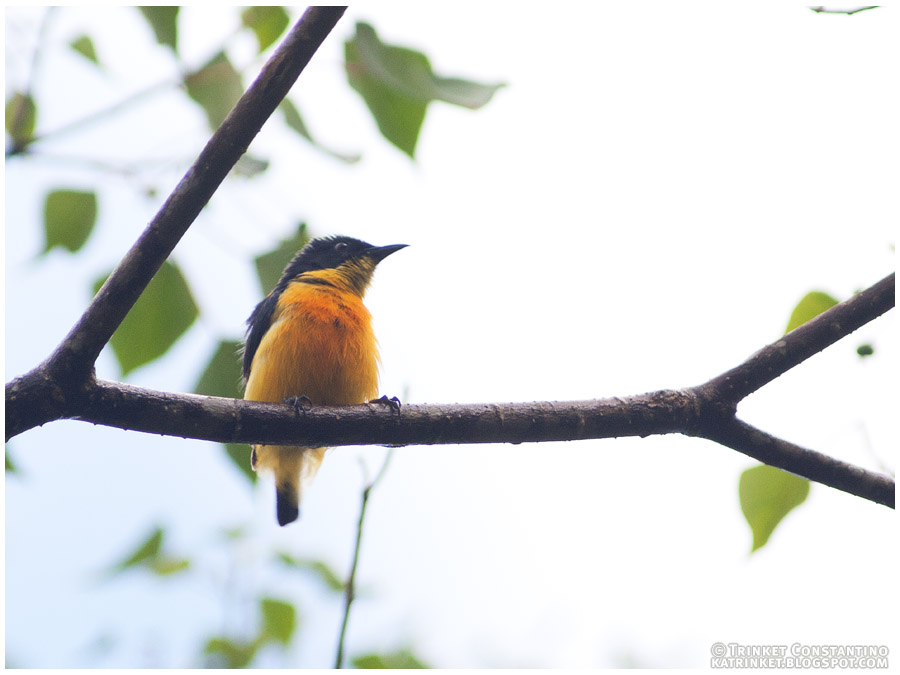 |
| The ever-cheerful Orange-bellied Flowerpecker |
Mixed flocks of sunbirds, monarchs, bulbuls, fantails and brown doves called from the trees by the side of the road. As we approached the lake's edge, we were stopped by a beautiful Yellow-breasted Fruit Dove quietly feeding at a nearby tree.
 |
| A Yellow-breasted Fruit Dove trying not to be seen. |
 |
| Quietly observing doves, bulbuls, woodpeckers and balicassiaos. |
A pair of Philippine Pygmy Woodpeckers were also moving around, with one exposing the seldom seen red patch on its nape. It was great to have the participants observe this and to note that they had never noticed it before!

 |
| Do you see the bit of red on the nape?!? |
As we were about to move on, a noisy group of Balicassiaos flew in! They flew around another tree, busy feeding. The group included a young bird which was still begging for food from its parents.
 |
| Begging baby Balicassiao |
There was a close encounter between the Balicassiaos and the tiny woodpecker, but after a noisy exchange and some raised feathers, they each went their own way.
 |
| Face off: woodpecker hidden behind the leaves: you can just see the tail and the beak! |
We took three twin hull boats (2 regular outriggers joined by a wide wooden platform) across the lake. Of all the boats I've ever taken birding, I'd say these are the most ideal: stable, spacious and affording full views of the surroundings.
 |
| Birding on twin boats on the twin lake. |
 |
| Ruvilu, Sir Rico, little kid, Jason, Sir Venee and Ayri: serious birders! |
We passed by a recently used Visayan Hornbill nest, while above us a Brahminy Kite flew over and Little Egrets surprised from the banks. Coletos, Dollarbirds, Visayan Bulbuls and hornbills flew around the forested edges of the lake.
 |
| Brahminy Kite overhead! |
Unfortunately, the weather was not with us, and when we reached the other side of the lake, the rain began to pour! Our only sighting overhead was a Philippine Spine-tailed Swift doing some aerial acrobatics in the rain. We tried to wait it out, but unfortunately it got worse so we decided to just head back and bird near the viewdeck while having breakfast. On the way back, some White-winged Cuckooshrikes were enjoying the rain were spotted near the dock.

 |
| Wet and no birds :-( |
After breakfast, some of the younger participants called us towards the fernery at the back of the venue. A Philippine Coucal was out in the open, drying out its short, chubby wings in the sunshine.
 |
| Philippine Coucal doing a wing stretch |
Several Balicassiaos were also flying around the fernery. With their white bellies, they look very different from the Balicassiaos in Luzon, which are all glossy black.
 |
| The mirabilis race of Balicassiao |
In the ferns, a Tawny Grassbird called loudy but refused to show itself. Visayan Bulbuls, Yellowish White-eyes and Black-naped Orioles flew around the trees around the fernery.
 |
| The fernery showcased several fern species, and provided produce for fern (pako) salad! |
 |
| Visayan Bulbuls were a-plenty: but I could never get a good photo! |
After breakfast, the workshop continued at an even more outdoor-sy venue, down the road by Lake Kabalin-an. Lake Kabalin-an is actually the first lake you will encounter on your way to the Twin Lakes (which refer to Lakes Balinsasayao and Danao). It is much, much smaller (more like a pond really), but is very distinct in that it has several willow trees growing right in the middle of the water!
 |
| Enchanting Lake Kabalin-an |
As we made our bird list and the participants had a short "quiz", we heard the loud calls of Blue-crowned Racket-tails echoing from the forest. What an apt setting for an outdoors activity class!
 |
| Classroom under the trees! |
The next part of the workshop involved emergency response and safety and so we endorsed the class to the next set of facilitators and... of course, continued birding! One of the participants from the regional DOT, Brian, decided to join us.
We took the trail around the perimeter of Lake Balinsasayao towards the view deck which would reveal the neighboring Lake Danao. It was a great trail, very rocky at some parts, going down, up or just level. Not too manicured but well maintained.
 |
| The Lake Balinsasayao trail |
Every now and then the path would reveal a small deck with some chairs and shade to enjoy the tranquility of the lake.
 |
| Surprise rest stops along the way |
Butterflies flew around us as we walked.


Along the way, we saw a few birds (it was very gloomy again). Elegant Tits, Visayan Bulbuls, Philippine Tailorbirds, Visayan Fantails. We also had great views of White-vented Whistler.
As we followed a tailorbird hopping around some vines, it landed near a snake (later identified as a Smooth-scaled Mountain Rat Snake) sitting quietly in the tangles. Very cool.

 |
| Snake-y! Smooth-scaled Mountain Rat Snake |
As we approached the view deck, we could hear a loud bird call. What was it??? It turned out to be a family of Dollarbirds! They would fly from one perch to another, with a young bird noisily begging for food.

 |
| Dollarbirds on patrol |
From the top level of the view deck we finally glimpsed Lake Danao... looking even more tranquil and pristine than Lake Balinsasayao!
 |
| Lake Danao under sunny skies |
As we were taking in the beautiful view, a group of Visayan Hornbills began gliding across the lake!
 |
| Visayan Hornbill |
As the gloom gave way to more sunny skies, the birding activity likewise picked up. Bar-bellied Cuckooshrikes and Coletos flew all round us.
 |
| Bar-bellied Cuckooshrike |
 |
| Coleto |
In a distant fruiting tree, we spotted several Yellow-breasted Fruit Doves while White-eared Brown Doves seemed to be hiding everywhere! (Note: This Brown Dove has been split from White-eared Brown Dove by Birdlife and HBW and is now Buff-eared Brown Dove)
 |
| A hiding White-eared Brown Dove, now Buff-eared Brown Dove |
A pair of Maroon-naped Sunbirds and an Orange-bellied Flowerpecker perched on branches just outside the viewdeck.
 |
| Maroon-naped Sunbird showing a purple chin and flaming breast. |
 |
| Orange-bellied Flowerpecker in profile. |
The birdy-ness was too much not to share! So we did! We showed the few tourists who dropped by the viewdeck many of the birds on the scope and we were delighted by their response. Many even digiscoped the birds with their phones for a souvenir.
 |
| Impromptu guided trip: showing local tourists the Dollarbirds. |
Later, while Brian was meticulously surveying the trees, he mentioned a large Yellow-breasted fruit dove with no yellow. Adri took a quick look and excitedly said: Pink-bellied Imperial Pigeon!
 |
| Can you spot the Imperial Pigeon? |
Wow! I have been hearing the booming calls of this imperial pigeon during several trips to Mindanao but I had never seen it! What an unexpected lifer! It was resting quietly on a branch on the same tree as the fruit doves.
 |
| Pink-bellied Imperial Pigeon |
Later, Adri spotted another individual, this one gloriously sunning itself, with its wings raised to the sky.
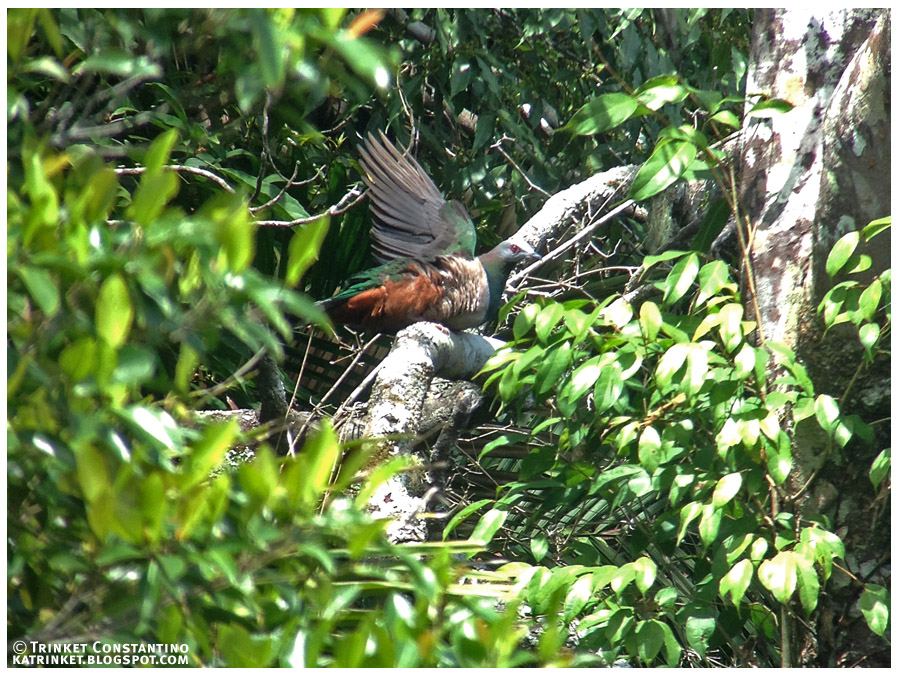 |
| Pink-bellied Imp nicely showing the underwing and belly. |
It was a great spot and a great morning to bird! We had to reluctantly head back though, as we had said we would be back for lunch and it was past one o'clock already! With no cellphone service in the area we had no way of telling our hosts that we were not in any trouble, but that in fact we were very happily distracted!
 |
| Boat service please! |
We were able to get a boat back to the dock, cutting short our travel time. But of course we were delayed again when we reached the lake shore because our boatman pointed to some White-winged Cuckooshrikes flying nearby! Oh the birding version of a long goodbye!
 |
| Kids fishing along the lake: unfortunately mostly invasives like tilapia. |
 |
| Wait: birding with the boatman! White-winged Cuckooshrikes. |
 |
| Since we saved time taking the boat, might as well extend the birding! |
So for a Zen birding experience that will make you lose track of time, head on over to the Twin Lakes!


