Showing posts with label warbler. Show all posts

Thursday, May 4

Stilts at LPPCHEAA

On the 1st of April, a few WBCP-ers (led by Mike L. and Arne J.) attended the groundbreaking for a wetland park at the LPPCHEA (Las Piñas-Parañaque Critical Habitat and Ecotourism Area). Finally!  Hopefully, this project, led by Sen. Cynthia Villar, will focus on the importance of the mudflats as a wetland (it is a declared RAMSAR site!) and as a green space in a city choked by urban developments lacking environmental planning.

Adri and I were there but unwittingly skipped the ceremonies as we were captivated by several Black-winged Stilts foraging along a relatively clean beach.  We had lost track of the time and got caught up documenting the graceful stilts as they were feeding along the waterline.

When we arrived at sunrise, I was delighted to see that much of the trash along the coastline had been cleared (still a lot left of course, I would think it almost impossible to clean all of it up, with more trash coming in daily with the tide).  The beautiful shell beach was exposed - revealing a diversity of gastropods and bivalves, together with a bit of plant litter: seeds, twigs (and sadly some plastic knick knacks).  It was definitely a bit of beauty one seldom would expect to find along the Manila beaches of the bay.


I could only imagine all the possibilities of having a clean beach in Metro Manila for the city-dwellers to enjoy.


A lone Common Sandpiper was busy preening in the golden monring light, stanind on a bit of muddy, discarded rubber/canvas/plastic.


A few stilts were on the beach at first, some resting and preening, others busy foraging for food. Many of them were quite vocal, twittering loudly.


There were few other migrants at the beach, although in the distance at the river mouth we could see several egrets, some herons and quite a number of waders.

A few Common Greenshanks flew past us, twittering loudly.


It was not only the birds out foraging, a man and his two young boys were also busy looking for shellfish in the shallow waters.


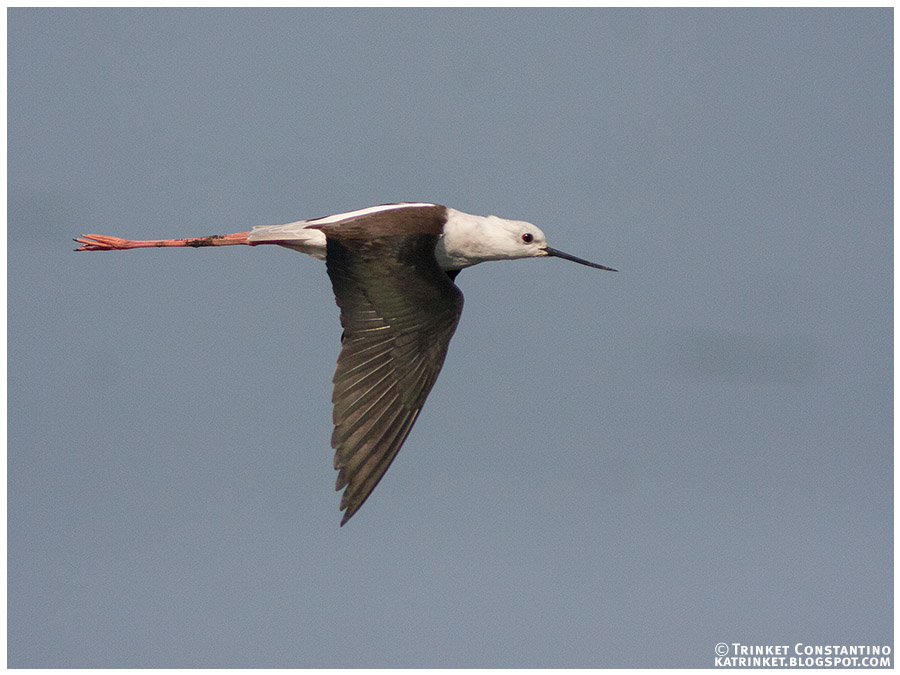
As the shadows receded with the rising sun, more and more stilts began flying in.  It was nice to see varying plumage, from the usual greyish markings of younger birds to elegant black and white plumage of the full adults.


Adri and I found a nice large log to sit on, under the shade of the mangroves.  The birds soon got used to our presence and began to get comfortable.

We practice in-flight shots with two Whiskered Terns.


And got a good laugh trying to outdo each other with stilts-in-flight shots.


Some of the stilts were flying back and forth right in front of us!  Sometimes they were too close!


We were not the only humans on the beach, several meters away was a man busy with his boat, being ignored by most of the birds.


A few greenshanks decided to join the stilts.


And one of the beach dogs also came out to inspect the debris that had been carried in by the tide.


Soon the tide began to turn and we could tell the ground breaking event had finished, because we could see large groups of people descending on the beach.  In the distance, a large group in orange jackets were busy cleaning up the coast.


Nearby, a group decided to take the DENR trash boat (it had a huge net to catch floating trash out at sea) for a quick spin.  The Black-winged Stilts paid no attention to the people (probably because the people were not paying any attention to them either!)


The tide was eating up the thin stretch of beach so we decided to start heading back.  We ran into some of the participants and volunteers who were with Rey Aguinaldo (DENR Region IV and LPPCEHA Project Manager).  We were happy to show them some of the stilts through the scope.  They expressed their surprise at the number of birds along the beach, even commenting that they were happy that the event (with its many people and loud sound system) did not flush or scare them away.


As we walked back to the car along the more shaded inland trail, we spotted other migrants: a noisy Brown Shrike and a confiding Arctic Warbler.


We also ran into several groups of Barred Rails and Common Moorhens foraging under the mangroves.

At the end of the beach near the car, we saw a small group of three enjoying a swim in the water.  It was not something I would recommend!  I am still hopeful though, that one day, Manila Bay will be clean enough for more recreational activities.  With the threat of reclamation looming, perhaps a wetland park is just what LPPCHEA needs. Not just for humans, but for all the other wild ones that need it too.


Keeping my fingers crossed.


Saturday, October 8

Sunny Saturday morning on campus

Sunny Saturdays are few and far between this rainy season, making it difficult to plan out-of-Metro-Manila birding trips.  Thankfully, the sprawling University of the Philippines grounds are just a stone throw's away.  So when the skies were looking clear last weekend, Adri and I went for a quick drive and walk to check out the birds.

We ran into birding couple Bob and Cynthia, and caught up on the latest news.  In typical birder and photographer fashion, our conversation remained uninterrupted while we stared up into the trees and pointed out birds in the canopy.  A few Golden-bellied Gerygones were hopping about, and we all happy to spot our very first Arctic (Kamchatkca/Japanese Leaf) Warbler for the season.


As we were about to go our separate ways, Adri spotted a lone migrant Ashy Minivet perched on a clump of bamboo in the distance.


When Bob and Cynthia left to check out other birding spots on campus, Adri and I continued our exploration of the College of Science Complex.  An unusually quiet Collared Kingfisher was sitting on a low branch in the dappled sunlight.


A few noisy Crested Mynas were flying around, perching from tree to tree.  At each tree they stopped for several minutes, inspecting the branches carefully.


A Long-tailed Shrike was busy following one of the gardeners who was trimming the grass, keeping a careful lookout for any insects disturbed by the noisy grass cutter.


The Black-naped Orioles were also very vocal, their piercing whistles heard from several blocks away.


But the definite bird-of-the-moment was the Brown Shrike. These newly arrived migrants seemed to be in the process of battling every resident bird in their annual territorial disputes!  They called loudly and harshly from every parking lot, quadrangle and unkempt green space.


There were also a lot of butterflies flying around, probably enjoying the sunny morning as much as we were.  The Leea plant in front of the Marine Science Institute was attracting several of them, which were perched and recharging under the bright sunshine.


While watching some Yellow-vented Bulbuls and a Coppersmith Barbet devouring the fruit of a Ficus beside the library, we ran into another familiar face: fellow WBCP-er Jon Villasper, and the conversation turned from the latest birds spotted to the latest Pokemon spotted on campus!

When Jon left us to battle it out in a nearby Pokemon Gym, our attention turned to a Red-keeled Flowerpecker hopping about on one of the trees. While its a bird often heard around campus, we seldom actually get a chance to track it down and spot it.


Time had flown by quickly and we had already been walking around for over a couple of hours!  Our spontaneous birding trip had given us the quick fix we were hoping for.

Good to have a great green space so near home.  I'm sure the Collared Kingfisher who saw us off agrees!


Thursday, September 29

Off to see the Bundoks


In Filipino "Bundok" literally means "mountain", and definitely one of the most popular mountain getaways for Metro Manila folks is Baguio, in Benguet province.

Last July, towards the end of my long intersession holiday, Adri and I were able to fit in a quick trip to Baguio.  The goal? To see the recently promoted Bundok Flycatcher.  Previously considered as a set of endemic subspecies of the resident Snowy-browed Flycatcher, it has been recently upgraded to full species status.


The now endemic Bundok Flycatcher, split from the Snowy-browed Flycatcher

And so, hoping for good weather in rainy July, we were off to see the Bundok (the bird, not the mountain though).


At the bus terminal in Dau, Pampanga

We boarded our bus early in the morning, planning to arrive in Baguio by noon.  The recent upgrading and construction of expressways leading north of Manila had made the trip very convenient, even by public transport.  We planned to stay the entire of our three days at Camp John Hay, away from the city traffic and congestion.

The cool Baguio weather to me is sleep-in-all-day weather, and it was still the case as the mid afternoons to early evenings were marked by heavy downpour and dropping of temperatures several degrees below the usual Manila heat.  We were lucky though to have wonderfully sunny mornings which allowed us to bird without worrying about rain. 


Sunny mornings on the Camp John Hay Eco Trail

The Camp John Hay Eco Trail was just a 15 minute walk from the Igorot Lodge where we were staying. Breakfast was not a problem since the lodge was also right beside a Starbucks and so we stocked up on sandwiches for our short birding hike.

The familiar birds of the Cordillera highlands greeted us as we walked.  Cheerful mixed flocks of  Mountain White-eyes, Elegant Tits, and Sulphur-billed Nuthatches wove in and out of the canopy.

Cheerful Mountain White-eyes

Even more cheerful Elegant Tits

Always busy Sulphur-billed Nuthatches

It is always a challenge photographing these tiny, active birds.  But with patience and luck, coupled with the sheer number of them encountered, success is almost assured.

Midway into the Eco Trail, from its start behind a paintball arena across the Le Monet Hotel, we crossed a picturesque bridge over a small stream.  


A bridge across a stream

Butterflies flitted around us in the morning sunlight.


A graceful Count (Tanaecia calliphorus) fluttering around.
Dark-colored Bushbrowns on the path.

A smaller bushbrown showing its upper side as it suns.

A graceful sailor soaking up some sun.

Nearby, an Elegant Tit was making a meal out of a not-yet-a-butterfly caterpillar.


Breakfast hiding under a leaf.

Citrine Canary Flycatchers were busy flying from perch to perch and back, hawking for little insects.  A Scale-feathered Malkoha gracefully flew above us, gliding from pine tree to pine tree.


A quiet Scale-feathered Malkoha

Ahead, a very noisy Tawny Grassbird was carefully inspecting the path and the foliage, moving in and out of our view.


A Tawny Grassbird in an acrobatic pose, now you see me...

...Now you don't!

A little Draco lizard caught our attention, crawling up the trunk of a nearby pine tree.


Little Lizzie up a tree

A praying mantis stood still as a statue, its front legs folded together in the usual worshiping pose.


Praying mantis in the morning sunshine

It was a beautiful morning, the sky above us blue and the faint scent of pine in the air. 


Pine trees and blue skies

Looking closer around me, I saw several daddy long legs on the tree trunks, their bodies shiny emerald green orbs.


Shiny Daddy Long Legs


A lovely moss carpeted the ground and most of the tree trunks too, a fairy land in miniature.  I've learned recently that "Baguio" was actually derived from "bigyiw" which is Ibaloi for moss


A mossy carpet

The flocks of Elegant Tits were mostly made of young birds, the distinctive black markings still greyish.  They moved energetically around the trees, playfully swinging upside down from pine needles and leaves as they searched for food.


Young Elegant Tits

In mid-flight catching a... feather?

Sulfur billed Nuthatches crept up and down and around the trunks and branches, moving forwards and backwards in a never ending inspection of the bark.


Nuthatches always on the move

As I was admiring all these creatures around me, I heard a familiar call of an arch nemesis bird and noticed Adri standing very still in some tall grass, camera in hand.

I joined him and kept my eye on the little brown birds giving off loud explosive and melodious calls. It was the first time I had seen many of them together, 4 of them moved deftly and quickly through the grass.  As usual, these Philippine Bush Warblers teased me with short glimpses, moving out of the cameras view just as the focus kicked in. Definitely still no improvement to the arch nemesis status after this trip.


Still in the most-hated bird list: Philippine (formerly Luzon) Bush Warbler
This is Adri's photo.
Obviously the bird loves Adri who harbors none of my ill feelings towards it at all.

Finally at mid-morning, we stopped by a small watering hole by the side of the trail.  A small movement behind us caught our attention, and there was our target.

A beautiful male Bundok Flycatcher, snowy brow and all, sitting quietly in the shadows (and look a small orchid in bloom right beside it)!


Bundok Flycatcher in the shadows (look, an orchid too!)

It stayed in that general area for the rest of the time we were there, sometimes perching quite near, other times farther away.  Sometimes in the light, and sometimes in the shade. 

We also caught a glimpse of its partner, a much drabber-colored female.  The female was more skittish than the male, moving around much more quickly.


The female Bundok Fly refusing to pose well for a photo.

It was great to watch them behaving as flycatchers do, flying to and from the perch as they caught insects on the wing. Standing very still on the perch and sometimes singing very softly. They were really neat and handsome birds. (I like flycatchers.) 

Light on the handsome Bundok Flycatcher.

So it was mission accomplished for us,  getting the Bundok flycatcher on my life list, In Baguio City, up in the bundoks of the Cordilleras.