Showing posts with label bunting. Show all posts

Saturday, February 6

Balcony birding

Most days were cold and grey,
Work-related trips out of the country are a dilemma for me birding-wise.  I always hope that, despite a packed schedule, I would have a chance for even just a bit of birding. My latest trip to Nara in Japan was no different.

I spent 8 full days on campus, but my schedule offered little time to go birding, having lab rotations scheduled the entire day.  I did have the weekend free, but since it was my first time in Japan, I opted to see the sights and experience the culture, rather than do a birding trip.  I also had a hard time dealing with the temperature, it was my first winter and the region just happened to experience a cold snap a couple of days after I arrived!

But, I did get a bit of birding done, and a few lifers: from my balcony!  I could have taken short morning walks around campus, but with my official workday beginning at 930am, and with temperatures too cold (-3 degrees Celsius was too cold for me to even think of leaving my warm room) for my tropical temperament, the best I could do was watch birds from the small terrace outside my room. It spanned the view from east to west across campus, and I was on the 4th floor, high enough to espy even birds perched on top of the buildings.

The dorm buildings to the east.

School buildings in directly in front.


And the sunset and more buildings (plus a tennis court) on the west,

Thanks to my Japanese birder friend from the Wild Bird Society of Japan, Asuka-san for giving  me a small Japan field guide last year.  It was very useful, and beautifully illustrated by Taniguchi-san (whom I met during the Philippine Birdfest last December in Balanga), I was able to identify all the birds I saw, even if the field guide was in Japanese! (At least I hope I did!)
My handy pocket field guide from the WBSJ!

Easily the most common and most visible birds were the Brown-eared Bulbuls. They pretty much owned the entire frontage of the guesthouse, chasing away most other birds. They kept careful watch over a tree laden with blue fruit, enjoying their feast every morning.  Their loud calls could be heard on campus all day.


Brown-eared Bulbul


The second most common would be the Jungle Crow.  I would hear them cawing as crows would, but it was only later that I was able to identify which species was common in Japan.


Jungle Crow

The first bird I actually noticed on campus was not a lifer for me.  White Wagtails were quite common, walking on the grassy fields and on the roads and paths. There were often two or even three of them together bouncing their behinds actively.  I tried hard to remember Richard's lessons of subspecies from the Laoag wagtails, but failed to identify them on the spot.


White wagtails

Another familiar bird was a male Blue Rock Thrush I would see everyday. It was quite handsome and not shy at all.  It was one of the birds the Brown-eared Bulbuls would tolerate having around for long periods of time.


Blue Rock Thrush

Also around every morning, but often quite a distance away were a few Dusky Thrushes. They were very handsome birds, not as noisy or active as the bulbuls, and often perched on the branches for long periods of time or foraging on the ground.


Dusky Thrush

Very common were several big, fat Rock Doves, on the ground or perched on top of the buildings or outside windows.


Feral Rock Doves

I was pleasantly surprised to spot a juvenile Japanese Grosbeak twice during my stay.  Again it was perched quite a distance away, but it showed itself well the first time, staying out in the open on bare branches.


Japanese Grosbeak

Japanese White-eyes would twitter a familiar sound as they moved about in the foliage and transferred from tree to tree.


Japanese White-eye

I had also spotted  a Japanese Tit one afternoon, but I wasn't able to take a photo of it.

And of course the Eurasian Tree Sparrows were  also daily visitors, not as common as back home though. And quite fluffed up all the time so they appeared much more... rotund... than usual.


Eurasian Tree Sparrow

Every now and then, a small flock of White-cheeked Starlings would attempt to intrude on bulbul territory, but they would quickly be chased away.


White-cheeked Starling

So those were my regular visitors I could enjoy every morning on my balcony.  I did see other birds on campus, my favorite being a female Daurian Redstart just outside our building.  Too bad I didn't have my camera with me!  It was sooo cute!  I knew right off it was some kind of flycatcher and the white wing patch helped me with the ID.


ID'ing the Daurian Redstart

Another lifer was a Meadow Bunting, which I saw while walking behind the dorm buildings to a nearby convenience store.  I would have never been able to identify it if i didn't have my pocket point-and-shoot with me.  Not a great photo, but it served its purpose.
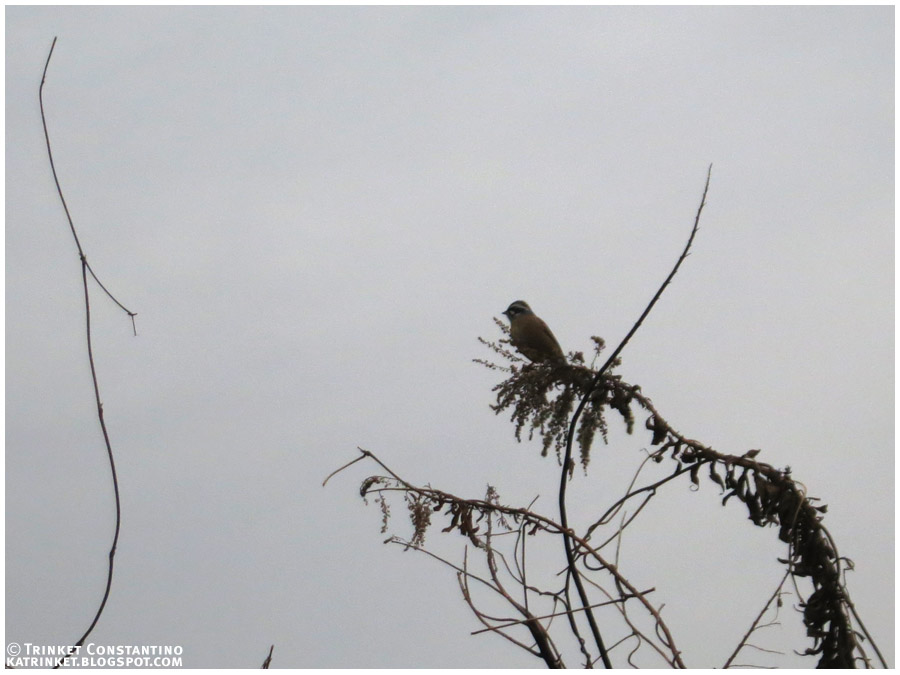

Meadow Bunting

The 10 days passed quite quickly, of course the days began to warm to a comfortable 6 -7 degrees towards the end of my stay.  I'm quite sure there were other birds I caught a glimpse of which I was unable to identify or even observe closely, and I wish I had more chances to go birding. Glad to have gotten a few lifers though on this work trip, even if it was just from my balcony!


My balcony's the top floor middle one.


(I do hope I got all the IDs correctly!  I would welcome corrections from more experienced birders!)


Tuesday, January 27

Migrant spotting at Laoag

While we were already up north, we had planned to visit Laoag-based birder Richard R. who always had nice surprises at his local birding patches.  Laoag in Ilocos Norte is a bustling city but its northern location, coupled with Richard's constant surveillance, makes it an ideal place to twitch migrants not easily seen elsewhere in Luzon.  Thankfully, the weather improved south of rainy Pagudpud and it was dry but still cool.

So early Sunday, Richard picked us up at our hotel for a full morning of birding. Our destination was nearby: privately owned fishponds which were no longer in use and were now home to hundreds of ducks.  Adri and I had been there before, and we were looking forward to a few good sightings.

As we entered the property, Richard immediately pointed out a team of ducks on the first pond. Among the more conspicuous Philippine Ducks were several Gadwalls!  They were out in the open, on the water where we could see clearly their white speculums! We had seen Gadwalls before (at Bani and more recently at Candaba), but these near and unobstructed views made it feel like we were getting it as a lifer for the first time!  Unfortunately, there was a noisy procession right behind us for the feast of the Sto. Nino, and the brass band music quickly disturbed the birds into flight. 

No matter, we were sure we would spot them again at one of the inner ponds away from the road.  And of course we did.

The main pond was full of Philippine Ducks!  It was a very zen experience, watching the ducks floating on the still, green waters. 


Ducks, ducks and ducks!

We quickly tried to find our main target.  Alex and company had spotted a pair of Spot-billed ducks here the day before.  They were not as bold as the other ducks and kept hidden behind the vegetation at the far end of the pond.  A quick survey revealed two of them, right where they had been spotted the previous day.  They were quite larger than the Philippine Ducks and of course the distinctive yellow spot at the end of their bills confirmed their identity. The species was a lifer for both Adri and myself.  Richard looked happy as usual to have contributed again (for the 3rd time in my case!) to our life lists.  


Do you see the pair of Spot-billed Ducks?

The ducks probably felt our inquisitive eyes focused on them and quickly retreated into the vegetation.  Every now and then they would come out, but never venturing out in the open water like the other ducks.

Of course among the ducks were our earlier targets, the Gadwalls. At first glance, both the male and female were rather drab-colored compared to the other ducks, however, long and clear views through our binoculars and scope revealed that the males had a beautifully intricate scalloping pattern on their breast.  Richard pointed out a great identification clue: a black patch on the undertail.  The female had the two toned bill of dark grey and orange. And for both, the white wing patch was evident.


A male Gadwall ...


... and a female Gadwall.
Quack! Quack!


As we admired the serenity of the duck pond, Adri suddenly spotted something different in the flock. "Is that a...? Cormorant! Cormorant!" 

Sure enough, a bird mixed in with the ducks  flies from the water straight up and above us.  A Great Cormorant!  We had just seen this bird for the first time a week before at the Bani Asian Waterbird Census (AWC), and here it was again!


A Great Cormorant in flight!

Our sighting excited even Richard, who had not seen this species at this site the past few years. Circling above the pond several times, it finally dropped out of sight into the neighboring pond behind the vegetation.  What a thrill!

Richard suggested we walk to the far side of the pond towards the coast, to check out the prickly aroma bushes (Kandaroma in Ilokano according to Richard or Acacia farnesiana (Linn.) Willd.).


Richard and Adri staking out the prickly Kandaroma bushes.

As we walked alongside the ponds' edge, the ducks surprisingly did not fly away ("They already know me," said Richard. "They know I am not here to harm them so they aren't afraid."). They did however, swim slowly away from us, ending up at the side of the pond where we had previously stood.  This slow movement allowed us to observe other ducks: a few Eurasian Wigeon (their light foreheads giving them an eternal-spotlight-on-their-head-look) and a single female Tufted Duck and a couple of Northern Shovellers.


One of these things is not like the other... find the Eurasian Wigeon.


I took a careful look at the Tufted Duck, which was in eclipse plumage - just to make sure it wasn't the mega Greater Scaup (wishful thinking!).


A female Tufted Duck in eclipse plumage - just making sure it isn't a Scaup!


A Wigeon and a Tufted Duck swimming with the locals.

As we reached the end of the pond, Richard pointed out the aroma bushes - perfect perches for the Yellow Buntings.  And of course, sure enough, not 5 minutes after he mentioned the buntings, in came 1... 2... 3... 4! Four yellow Bunting perched in the distance. Funny how a bird described as "uncommon to rare" by the field guide can be a regular visitor here!


Four Yellow Buntings!

We waited patiently for the buntings to perch closer for better photos.  As we waited, a Lesser Coucal flew across our path, its short wings giving it an awkward, ungainly flight.


Lesser Coucal in flight... check out that belly.

We could see the buntings in the distant bushes, being bullied by the ubiquitous Eurasian Tree Sparrows.  To our delight, there were't just 4 of them but 6!  I got a lucky shot with the scope-ipad combination and caught one in flight, wings open.


Yellow Bunting - in flight also!


The Cormorant surprised us again by suddenly appearing above us, circling the pond several times, only to disappear as before.


 The Great Cormorant still circling above us.

Sure enough, in time, a few of the buntings flew in and perched on the bushes nearest to us, giving me an opportunity for an improved photo.


Even if the wind was cool and the weather pleasant, we decided to go on our way and head back.  As we passed the pond, I caught a quick glimpse of bright orange legs of a duck sleeping in the shadows.  


Whose that sleeping under the bush?

Ever alert, it quickly woke up when I stopped walking and lifted its head.  It was one of the Spot-billed Ducks allowing me a final good look.  I hope it  decides to fly further south to Pampanga in the next few migration seasons, so I can see it more often!


It's the Spot-billed Duck again!
Our walk on the eucalyptus lined path interrupted a few Java Sparrows, pretty looking birds who are unfortunately very popular in the pet trade.  


A pretty pair of Java Sparrows.


Easy birding in pleasant weather with the Ilocos master.

The Cormorant flew above us one last time - maybe to say goodbye.


The Great Cormorant. Again.


A graceful Grey Heron stood as a sentinel to one of the smaller ponds. 


The silent sentinel.

 A Philippine Duck flew nearby, its speculum changing from green to blue to purple in the morning sunlight.


May Philippine Ducks always fly free here.

Here was a little sanctuary where a few hundred ducks found refuge.  Hopefully they will always find safety and protection here.


The magic ponds at Laoag.


Thursday, May 2

the northern twitch


around 480 km and a little over 8 hours drive. a pretty long way to go for a single bird.  

but the thing was, we were on a search for the jump off point  for the spring migration of raptors up north to taiwan, and laoag was conveniently on the way.  the perfect would-be twitch.

we had decided to spend the night in this ilocos norte city, for an early start the next day even further north towards cagayan. we met up with wbcp-er and laoag local birder richard, who had all sorts of interesting birds to report all-year round up north. one of the interesting birds he had birders travelling the distance all the way from metro manila was the yellow bunting. the yellow bunting is a tiny bird, and would probably not call much attention to itself were it not a rare migrant to the philippines.

we arrived at laoag right in time for dinner with richard at saramsam restaurant. we enjoyed a delicious dinner of ilokano food, including pinakbet with a modern twist: pinakbet pizza! yum.


 pinakbet pizza with fish bagoong  and chili oil dip. yummy!

over dinner plans were made for a not-so early start the next day: 6am.

when we got to the birding site, the summer skies were bright already.  it was actually a small road leading to some ricefields, lined with four bamboo clumps.  

richard told us to keep an eye out for the bunting perching on the bamboo near 7am.

while waiting, we had a lot of birds  (26 species to be exact!)to help pass the time.  cattle egrets in full breeding plumage walked alongside cows and carabaos.  white breasted waterhens walked along an irrigation canal quite near to us. striated grassbirds called quite loudly from the ricefields. a long-tailed shrike preened quietly in the bamboo thicket closest to us. bee-eaters sailed gracefully over the fields. zebra doves foraged on the dirt path. small flocks of java sparrows of all ages alighted on the bamboo near us.


adult and young java sparrows flew back and forth from the fields to the bamboo

as if these birds were not enough to keep us preoccupied, mang boy and adri spotted a handsome peregrine falcon perched on a tree not far away from us!


 a peregrine falcon keeping watch over the ricefields
 and flying off after allowing us to admire it for several minutes


near 7am, the peregrine falcon flew off from its perch and disappeared over the bamboo thickets apparently to remind us of our target.  so we concentrated on the bamboo thickets.  as if by appointment, richard suddenly cried out "bunting! bunting!"

sure enough, on the very top of the bamboo clump farthest away from us was a small yellow-green bird with distinctive markings on its wings and back! a lifer for all of us (except richard of course)!


 yellow bunting: my lifer #13 for 2013!
a frame grab from adri's digiscoped video brought the bird much closer

unfortunately, a pair of yellow-vented bulbuls soon chased off the tiny bird. still, although it was quite a distance from us, it had thankfully stayed out in the open long enough for us to admire it through our binoculars. 


thanks to richard for keeping tabs on the birds in the area and for being such a generous and accommodating guide! it was a great start to our northern birding adventures and we still had a long way to travel.


 happy twitchers with local birder richard (thanks to tere for the picture!)


our northern birding adventure to be continued...