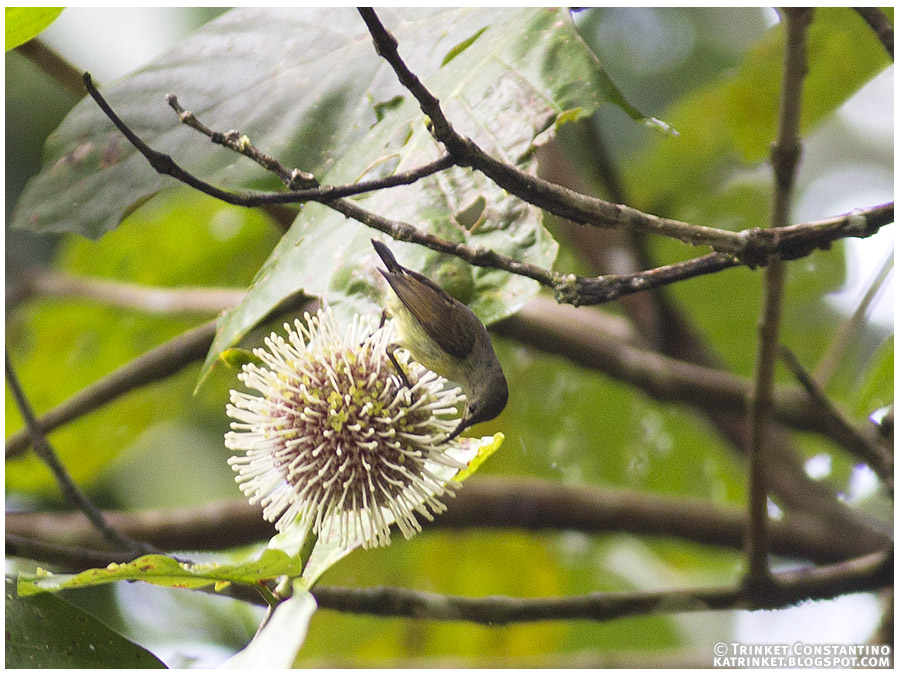
A few weekends ago I celebrated my nth year in this world with lunch with my family at home. Our dining room faces the backyard and we noticed a commotion in the backyard bird bath. The heat and humidity was almost unbearable and several bulbuls were lining up to take a quick dip!
Of course they were their usually orderly selves and lined up to take turns at the bird bath. Even if the bath was quite spacious for a bulbul, they only went in one at a time!
As soon as one bird stepped up to the rim of the bath, another quickly stepped into the water and splashed around.
From the rim they would fly up to perch on the nearby branches to continue flapping and shaking dry. All around the other bulbuls would patiently wait their turn.
At most there were maybe 16 bulbuls lined up!
The most we could get in one frame was 10 bulbuls though. Can you count them in the photo below?
Several years after having installed the first of many bird baths in the yard, I still get a thrill when I see a bird splashing in the water. Always glad to provide some refreshment to my feathered neighbors. And I was happy they dropped by during my birthday lunch as well!
Showing posts with label bulbul. Show all posts
Sunday, September 16
Saturday, September 8
A bulbul nest at our window
I love visiting our friends Peter and Indira who live up the hill! They have a beautiful home surrounded by greenery and wildlife.
On my last visit last March with Melanie, we were greeted every morning by an inquisitive Ashy-fronted Bulbul at our window.
On our second morning, we figured out why...
There was a nest with 2 baby bulbuls in it!
The photo above was taken while Melanie and I were standing on our bed, window open and curtains drawn, both of us playing contortionist, trying to find a good angle.
When we went outside to view the nest from there, we found the parent pair busy taking turns feeding the young ones.
How great is it to have a pair of busy bulbul parents attending to their young in a nest outside your bedroom window?
On my last visit last March with Melanie, we were greeted every morning by an inquisitive Ashy-fronted Bulbul at our window.
There was a nest with 2 baby bulbuls in it!
The photo above was taken while Melanie and I were standing on our bed, window open and curtains drawn, both of us playing contortionist, trying to find a good angle.
When we went outside to view the nest from there, we found the parent pair busy taking turns feeding the young ones.
How great is it to have a pair of busy bulbul parents attending to their young in a nest outside your bedroom window?
Labels:
bulbul,
palawan,
puertoprincesa
Saturday, August 25
Birding Bandilaan
Predictably, our tricycle driver Manong Glen seemed quite surprised that we didn't want to go the usual tourist route.
Cambugahay Falls? The old, enchanted balete tree? The springs? Cantabon Cave? The Lazi convent and Church? Salagdoong Beach? He offered all of them in succession.
We said no to all of the above! We loved our memories of Siquijor from more than a decade past, and we were happy to keep them as they were. Our top priority was the Bandilaan National Park, we were there to see the endemic Siquijor subspecies of the Streak-breasted Bulbul!
Manong Glen was familiar of course with the bulbul, locally called tagmaya. He agreed that it would be easiest to see in the forest. With a scratch of his head, he offered to pick us up at 6am the next day. From his own lips came the suggestion that it would be good to start early. Perfect! We made a compromise with Manong Glen though, in case we didn't spot it at Bandilaan, we would gladly go to Salagdoong (the forest not the beach!) where we knew it was also easily sighted.
Right on the dot, he was outside our resort. We sped off in a comfortable modernized tuk-tuk (better than a tricycle for the uphill drive he said!). But first, a quick stop at a neighborhood panaderia for some hot pan de sal and an irresistible loaf of cinnamon rolls!
On the way up the mountain, we could already hear some bulbuls calling. We drove thru good roads, passing several houses with signs offering hilot (traditional massage) services.
When we arrived near a tourist spot where an uphill path to the view point split from the road, Manong Glen parked the tuk-tuk and pointed up the overgrown, dark and wet (looked slippery too!) path. The open road actually looked more promising and so we told him we would just walk along it. We ate a pan de sal each, offered the rest to our driver, and went on our way. Our driver told us he would park a few meters back at a flatter area and would wait for us there.
The forest looked much thicker than we remembered, certainly a good sign. Although it could have just been greener because it was the rainy season.
Very quickly, we spotted the noisy bulbuls moving around the canopy. Wonderful!
Getting photos though was another matter. It was still a grey morning, and the little morning light available was filtered by the forest. On top of that, a beautiful light mist surrounded us! The air was fresh and cool, the forest alive with sound... but still, photography would surely be a challenge.
Hooded Pittas were singing loudly, the wet ground and leaf litter was perfect for their foraging. Every now and then when we turned a bend we would flush one from the road.
From above,the large hibiscus-like flowers from the native Vidal's Lanutan trees were dropping to the ground. They would land with a soft plunk (one time hitting my head!) and covered the road in an almost festive feel.
The Streak-breasted Bulbuls (if split in the future, this endemic subspecies siquijorensis may be known as the Siquijor Bulbul) were very active! It turns out that many were still feeding their young, who followed them around begging noisily.
One such parent-offspring pair were feeding at what seemed like a rattan vine, moving actively about the abundant fruit.
Many of the bulbuls were also in moult. Not a very handsome bird to begin with (in my opinion, that is!), they looked all the more awkward with missing feathers.
The bulbuls were not the only ones busy with their young. We encountered several Mangrove Blue Flycatcher families as well. They sang melodiously throughout the morning.
Begonias grew in great bunches on the ground, their bright orange flowers adding bursts of color on the ground. There were several other flowering plants also, attracting all sorts of insects.
It was too early and too cold though for butterflies, we spotted this Red Helen Menalaides helenus hystaspes, immobile, busy sunning itself on a leaf.
The sunbirds preferred the trees though, this female Purple-throated Sunbird was preoccupied with sipping nectar from the flowers of a bangkal tree.
A pair of White-bellied Munias were busy picking up long leaves to weave into their nest which they were building just off the side of the road.
A lot of other small birds were also very active. I was a bit confused by this one, which turned out to be an island endemic subspecies siquijorensis of Yellow-bellied Whistler. It looked just a bit smaller compared to the ones I've seen in Luzon and Mindanao.
Orange-bellied Flowerpeckers and Black-naped Monarchs also joined small mixed-species flocks.
As the morning wore on, the sun began shining more brightly, dissipating most of the mist. We came across a pair of very friendly Black-chinned Fruit Doves, one of whom posed for our cameras for several minutes. It was unusual behavior for them not to be afraid, since they are often the targets of hunters.
As birders know, a kilometer length of road can stretch on forever when you are looking out for birds and other creatures. We finally reached another sign (newer and better maintained and beside a picnic area, this was probably a more popular entry point), and so we decided to turn back.
By the time we got back to our tuk-tuk, 3 hours had elapsed. Manong Glen, not familiar with birders' lack of time perception, was relieved to see us. I guess he did not expect to wait so long, and he was actually thinking we might be lost! After all, who would spend so much time looking at birds?!?
We showed him photos of the bulbul, and he could not believe it when we said that it was only found in Siquijor island. "Nakapagtataka!" (loosely, "magical" or "amazing") he kept on saying over and over again in wonder. (Of course he was also in maybe equal disbelief that we came just to see the bird.)
With our target accomplished, we quickly downed the cinnamon rolls (all the pan de sal seemed to had been demolished by our driver in his anxiousness over our return) - and decided to call it a day for birding... back to the resort and the beach!
Cambugahay Falls? The old, enchanted balete tree? The springs? Cantabon Cave? The Lazi convent and Church? Salagdoong Beach? He offered all of them in succession.
We said no to all of the above! We loved our memories of Siquijor from more than a decade past, and we were happy to keep them as they were. Our top priority was the Bandilaan National Park, we were there to see the endemic Siquijor subspecies of the Streak-breasted Bulbul!
Manong Glen was familiar of course with the bulbul, locally called tagmaya. He agreed that it would be easiest to see in the forest. With a scratch of his head, he offered to pick us up at 6am the next day. From his own lips came the suggestion that it would be good to start early. Perfect! We made a compromise with Manong Glen though, in case we didn't spot it at Bandilaan, we would gladly go to Salagdoong (the forest not the beach!) where we knew it was also easily sighted.
On the way up the mountain, we could already hear some bulbuls calling. We drove thru good roads, passing several houses with signs offering hilot (traditional massage) services.
When we arrived near a tourist spot where an uphill path to the view point split from the road, Manong Glen parked the tuk-tuk and pointed up the overgrown, dark and wet (looked slippery too!) path. The open road actually looked more promising and so we told him we would just walk along it. We ate a pan de sal each, offered the rest to our driver, and went on our way. Our driver told us he would park a few meters back at a flatter area and would wait for us there.
![]() |
| Bandilaan National Park on the slopes of Mt. Malabahoc |
The forest looked much thicker than we remembered, certainly a good sign. Although it could have just been greener because it was the rainy season.
Very quickly, we spotted the noisy bulbuls moving around the canopy. Wonderful!
Getting photos though was another matter. It was still a grey morning, and the little morning light available was filtered by the forest. On top of that, a beautiful light mist surrounded us! The air was fresh and cool, the forest alive with sound... but still, photography would surely be a challenge.
Hooded Pittas were singing loudly, the wet ground and leaf litter was perfect for their foraging. Every now and then when we turned a bend we would flush one from the road.
![]() |
From above,the large hibiscus-like flowers from the native Vidal's Lanutan trees were dropping to the ground. They would land with a soft plunk (one time hitting my head!) and covered the road in an almost festive feel.
The Streak-breasted Bulbuls (if split in the future, this endemic subspecies siquijorensis may be known as the Siquijor Bulbul) were very active! It turns out that many were still feeding their young, who followed them around begging noisily.
One such parent-offspring pair were feeding at what seemed like a rattan vine, moving actively about the abundant fruit.
Many of the bulbuls were also in moult. Not a very handsome bird to begin with (in my opinion, that is!), they looked all the more awkward with missing feathers.
The bulbuls were not the only ones busy with their young. We encountered several Mangrove Blue Flycatcher families as well. They sang melodiously throughout the morning.
The damp forest was also excellent for fungi spotting. Tiny and huge, dull and colorful - all sorts grew on the branches and ground.
Of course there were also my favorite epiphytes in abundance - ant plants (Myrmecodia)! They grew thickly on the trees, together with moss, ferns, orchids and others. Their bulbous caudices hanging on to their hosts' branches while their green leaves sprouted at the opposite end of the plant.
It was too early and too cold though for butterflies, we spotted this Red Helen Menalaides helenus hystaspes, immobile, busy sunning itself on a leaf.
The sunbirds preferred the trees though, this female Purple-throated Sunbird was preoccupied with sipping nectar from the flowers of a bangkal tree.
A pair of White-bellied Munias were busy picking up long leaves to weave into their nest which they were building just off the side of the road.
A lot of other small birds were also very active. I was a bit confused by this one, which turned out to be an island endemic subspecies siquijorensis of Yellow-bellied Whistler. It looked just a bit smaller compared to the ones I've seen in Luzon and Mindanao.
Orange-bellied Flowerpeckers and Black-naped Monarchs also joined small mixed-species flocks.
As the morning wore on, the sun began shining more brightly, dissipating most of the mist. We came across a pair of very friendly Black-chinned Fruit Doves, one of whom posed for our cameras for several minutes. It was unusual behavior for them not to be afraid, since they are often the targets of hunters.
As birders know, a kilometer length of road can stretch on forever when you are looking out for birds and other creatures. We finally reached another sign (newer and better maintained and beside a picnic area, this was probably a more popular entry point), and so we decided to turn back.
By the time we got back to our tuk-tuk, 3 hours had elapsed. Manong Glen, not familiar with birders' lack of time perception, was relieved to see us. I guess he did not expect to wait so long, and he was actually thinking we might be lost! After all, who would spend so much time looking at birds?!?
We showed him photos of the bulbul, and he could not believe it when we said that it was only found in Siquijor island. "Nakapagtataka!" (loosely, "magical" or "amazing") he kept on saying over and over again in wonder. (Of course he was also in maybe equal disbelief that we came just to see the bird.)
![]() |
| Streak-breasted Bulbul, Hypsipetes siquijorensis, endemic to the Philippines and only found on Siquijor, Cebu, Romblon and Tablas islands. |
![]() |
| Mission accomplished, back to the beach in our little red tuk-tuk! |
Labels:
bandilaan,
bulbul,
butterflies,
dove,
flowerpecker,
flycatcher,
mtmalabahoc,
munia,
pitta,
siquijor,
whistler
Saturday, September 30
South Cot and Gen San birding
Adri and I still had the full weekend ahead of us after Friday's Tacurong Bird Festival and our day birding at the Baras Bird Sanctuary. SOX is a great place for some quick target birding, and Felix already had it all planned out for us.
On Saturday morning, we got up early to go birding at Mt. Matutum in South Cotabato. It was a long drive across dirt roads criss crossing hectares of pineapple farms and avocado orchards just to get to the foot of the mountain. I certainly can't imagine walking all that way!
We picked up our guides along the way and the view of Mt. Matutum was quite ominous. It was a grey morning and the mountain was shrouded in cloud! Not looking very good!
We left the vehicle at a school house at the edge of the residences, and walked through vegetable farms so commonly seen at the edges of protected areas. We soon heard the familiar twittering of white eyes. After a brief discussion on their identity (Everett's or Mountain?) and good looks at their underparts, we decided they were Everett's White eyes.
We did spot Mountain White eyes later.
We flushed several White-eared Brown Doves (Short-billed Brown Dove) along the path. Small mixed flocks were flying around the still wet leaves, we saw Brown Tit Babblers, Little Pied, Turquoise and Citrine Canary Flycatchers.
In the distance, flocks of Short-tailed Glossy Starling flew across the valley. Closer to us, a pair of Scarlet Minivets were moving around.
It was only a short walk to a few stands of exotic African Tulip Trees where we waited for our main target. We settled down and had a quick breakfast on our feet (ground was wet!) while waiting.
Flowerpeckers zipped back and forth above us: Olive-capped, Bicolored, Red-keeled, Buzzing and Orange-bellied. White-eyes also joined in an occasional frenzy.
We watched the bright orange African tulip blooms carefully. Colasisis came and go nibbling at the blooms. I distracted myself with looking at the red flowers of thick boughs of mistletoe growing on the tops of trees. A fallen branch gave me a close up view of the bright red flower clumps.
Orchids also adorned the moist tree branches which were also covered with thick lichen and moss.
I was looking at a distance at a Colasisi on the orange flowers when it jumped out of my view to be replaced with... Apo Sunbird! This tiny bird was our target! It's not yet split as a separate species, but many birders are looking forward to when it will be recognized as T'boli Sunbird.
It was a brief view. Both Adri and I would see it a few more times, but unfortunately for us, no photo.
Felix was exploring further up the trail and came back to say that we might want to try another Matutum specialty: Mindanao Miniature Tit Babbler. A heavy mist was coming in and precipitation was starting to form, but hey why not? He led us to a huge (gigantic!) tree where the birds were usually seen.
Erm. The weather was too much and soon dampened our optimism. It was just too misty and dark! Soon we made our way back, still happy with our Apo Sunbird (T'boli soon!) despite the disappointment of the miniature tit babbler dip.
Rain fell for the rest of the day, making us call off any birding plans... so we comforted ourselves with: food of course! A popular halo halo snack store on the highway provided a sugar high and dinner in GenSan wouldn't be complete without a seafood dinner cooked fresh from the day's catch.
The next morning we drove past Mt. Matutum towards Lake Sebu and it famous waterfalls. It was a pleasant drive and we passed the town of Surallah with a cheerful rotunda. The rotunda depicts the T'boli, the Muslims and the Christians in a musical parade around various agricultural produce.
We proceeded to one of Lake Sebu's waterfalls - a regular birding site for Felix. From the main road, we took a small path that led downhill to a view of the waterfall. Our first bird was a quiet Philippine Cuckoo Dove, with its tail feathers quite worn. We saw quite a number of them that morning.
There were also several White-eared (Short-billed) Brown Doves. We got both distant and close-up views.
The Philippine Bulbuls were making their usual racket while chasing each other through the canopy. But they were definitely outnumbered by the Yellow-vented Bulbuls that seemed to be perched everywhere!
We passed a flowering papaya, where a Rufous-fronted Tailorbird was hopping around. And of course I got the most comical photo of it:
A pair of Purple-throated Sunbirds also showed up. They were the subspecies juliae, quite distinct in their coloration from the other Purple-throated sunbirds elswhere in the Philippines. Of course while the drab female posed gamely, the more colorful male did not seem to want to!
We had several other views and heard other birds: Guaiaberos, Common Emerald Dove, Plaintive Cuckoo, Blue-throated Bee-eaters, Collared and White-throated Kingfishers, Large-billed Crows, Black-naped Monarchs, Coletos, and Yellow-bellied Whistlers. We spotted migrants too: a Grey-streaked Flycatcher and a noisy Brown Shrike.
A few creepy crawlies were also out on display!
When we got down to the falls, it was an impressive sight. The heavy rains must have amplified the cataract's flow, white gushing water poured out into the brown river below.
It was turning out to be a sunny morning, and the hot air and wet ground was attracting a few butterflies to a marigold plot.
While I was passing time taking photos of butterflies and dragonflies, a young boy out with his family on a swimming picnic approached me and began to ask several questions. Despite the language barrier, I tried my best to explain what I was looking at and doing, showing him photos from my camera and the field guide. He got very excited, even pulling his un-interested younger sister to show her the photos.
Later, as Adri, Felix, Roland and I settled at a nearby picnic hut, the little boy left his picnicking family to join us, He excitedly pointed out the birds flying around and checked them out through our binoculars, scope and book. He was very keen, insisting he was seeing a yellow bird on some hagimit fruit hanging quite a distance across from us. He patiently leafed through the book and was contemplating the Elegant Tit. Every now and then he would glance at the hagimit and point "there it goes again!".
Eventually we all saw what he was pointing at. A tiny Orange-bellied Flowerpecker!
Many other birds were interested in the hagimit including brown doves, Coletos, a Wattled Bulbul and Hair-crested Drongos.
We also saw a pair of Black-faced Coucals and a pair of Philippine Coucals skulking around the vegetation.
A quiet Mindanao Hornbill played hide-and-seek with us up a nearby tree.
We heard the sharp call of a Silvery Kingfisher as it made its way up and down a nearby stream. Each bird we saw and heard brought a new excitement to our young companion! His enthusiasm was infectious.
Soon it was time for us to go, as we had an afternoon flight back to Manila to catch. We stopped by a restaurant with a view of Lake Sebu on a sunny Sunday for lunch. On the lakeside we saw Yellow Bitterns, Javan Pond Herons, Little Egrets and White-browed Crakes walking along the fish pens. Barn Swallows and Glossy Swiftlets were gliding across us, and in the gardens below Chestnut Munias were busy building nests. The SOX birding weekend had turned out to be more eventful than I had expected!
But that isn't the end of our SOX adventure. Felix had one more ace up his sleeve for us. On our way to the airport after picking up our things at the hotel, Felix asked if we wanted to check to see if the Spotted Kestrel was around. This is a new addition to the Philippine Bird List, in fact, a pair had been spotted and documented last year nesting - so it was definitely a resident. We made a quick detour to the rocky face of a hill on the outskirts of Gen San. The bird had not been spotted recent to our visit but it was close enough to warrant a check.
As we got down from the car, we surveyed the holes which dotted the bare rock face. And there it was! Sitting very still in one of the shallow caverns was a Spotted Kestrel!
It was later identified through our photos as a young, subadult individual. Was it one of the offspring from the last breeding season? We did a little dance of joy by the side of the road. A last minute lifer from our weekend SOX adventure.
On Saturday morning, we got up early to go birding at Mt. Matutum in South Cotabato. It was a long drive across dirt roads criss crossing hectares of pineapple farms and avocado orchards just to get to the foot of the mountain. I certainly can't imagine walking all that way!
We picked up our guides along the way and the view of Mt. Matutum was quite ominous. It was a grey morning and the mountain was shrouded in cloud! Not looking very good!
![]() |
| Not the best of weather to go up a mountain and bird! |
We left the vehicle at a school house at the edge of the residences, and walked through vegetable farms so commonly seen at the edges of protected areas. We soon heard the familiar twittering of white eyes. After a brief discussion on their identity (Everett's or Mountain?) and good looks at their underparts, we decided they were Everett's White eyes.
![]() |
| A pair of Everett's White-eyes |
We did spot Mountain White eyes later.
We flushed several White-eared Brown Doves (Short-billed Brown Dove) along the path. Small mixed flocks were flying around the still wet leaves, we saw Brown Tit Babblers, Little Pied, Turquoise and Citrine Canary Flycatchers.
In the distance, flocks of Short-tailed Glossy Starling flew across the valley. Closer to us, a pair of Scarlet Minivets were moving around.
![]() |
| One of a pair of Scarlet Minivets - a bird I've only ever seen on Mindanao |
![]() |
| Signage to remind visitors of the Protected Landscape. |
Flowerpeckers zipped back and forth above us: Olive-capped, Bicolored, Red-keeled, Buzzing and Orange-bellied. White-eyes also joined in an occasional frenzy.
We watched the bright orange African tulip blooms carefully. Colasisis came and go nibbling at the blooms. I distracted myself with looking at the red flowers of thick boughs of mistletoe growing on the tops of trees. A fallen branch gave me a close up view of the bright red flower clumps.
![]() |
| Mistletoe in bloom high up in the trees and a closer view from a broken branch I found on the ground. |
Orchids also adorned the moist tree branches which were also covered with thick lichen and moss.
![]() |
| Orchids up in the trees. |
I was looking at a distance at a Colasisi on the orange flowers when it jumped out of my view to be replaced with... Apo Sunbird! This tiny bird was our target! It's not yet split as a separate species, but many birders are looking forward to when it will be recognized as T'boli Sunbird.
It was a brief view. Both Adri and I would see it a few more times, but unfortunately for us, no photo.
Felix was exploring further up the trail and came back to say that we might want to try another Matutum specialty: Mindanao Miniature Tit Babbler. A heavy mist was coming in and precipitation was starting to form, but hey why not? He led us to a huge (gigantic!) tree where the birds were usually seen.
![]() |
| The misty forest and the huge tree where we were supposed to spot the Miniature Tit Babblers - maybe next time! |
Erm. The weather was too much and soon dampened our optimism. It was just too misty and dark! Soon we made our way back, still happy with our Apo Sunbird (T'boli soon!) despite the disappointment of the miniature tit babbler dip.
Rain fell for the rest of the day, making us call off any birding plans... so we comforted ourselves with: food of course! A popular halo halo snack store on the highway provided a sugar high and dinner in GenSan wouldn't be complete without a seafood dinner cooked fresh from the day's catch.
![]() |
| Yummy food! |
| Tukiba Surallah: Discover Surallah (Hiligaynon) |
We proceeded to one of Lake Sebu's waterfalls - a regular birding site for Felix. From the main road, we took a small path that led downhill to a view of the waterfall. Our first bird was a quiet Philippine Cuckoo Dove, with its tail feathers quite worn. We saw quite a number of them that morning.
![]() |
| Philippine Cuckoo Doves |
There were also several White-eared (Short-billed) Brown Doves. We got both distant and close-up views.
![]() |
| White-eared (Short-billed) Brown Doves |
The Philippine Bulbuls were making their usual racket while chasing each other through the canopy. But they were definitely outnumbered by the Yellow-vented Bulbuls that seemed to be perched everywhere!
![]() |
| Yellow-vented Bulbuls busy preening |
We passed a flowering papaya, where a Rufous-fronted Tailorbird was hopping around. And of course I got the most comical photo of it:
![]() |
| Photo fail! Rufous-fronted Tailorbird with the rufous front hidden! |
A pair of Purple-throated Sunbirds also showed up. They were the subspecies juliae, quite distinct in their coloration from the other Purple-throated sunbirds elswhere in the Philippines. Of course while the drab female posed gamely, the more colorful male did not seem to want to!
![]() |
| A pair of Purple-throated Sunbirds, with the male not wanting to show his purple throat! Another photo fail! |
We had several other views and heard other birds: Guaiaberos, Common Emerald Dove, Plaintive Cuckoo, Blue-throated Bee-eaters, Collared and White-throated Kingfishers, Large-billed Crows, Black-naped Monarchs, Coletos, and Yellow-bellied Whistlers. We spotted migrants too: a Grey-streaked Flycatcher and a noisy Brown Shrike.
A few creepy crawlies were also out on display!
| I caught these two bugs in the middle of some action! |
When we got down to the falls, it was an impressive sight. The heavy rains must have amplified the cataract's flow, white gushing water poured out into the brown river below.
| The waterfalls of Lake Sebu are a big tourist attraction! |
It was turning out to be a sunny morning, and the hot air and wet ground was attracting a few butterflies to a marigold plot.
![]() |
| Butterflies on a sunny Sunday morning! |
![]() |
| Damselflies and dragonflies too! |
While I was passing time taking photos of butterflies and dragonflies, a young boy out with his family on a swimming picnic approached me and began to ask several questions. Despite the language barrier, I tried my best to explain what I was looking at and doing, showing him photos from my camera and the field guide. He got very excited, even pulling his un-interested younger sister to show her the photos.
Later, as Adri, Felix, Roland and I settled at a nearby picnic hut, the little boy left his picnicking family to join us, He excitedly pointed out the birds flying around and checked them out through our binoculars, scope and book. He was very keen, insisting he was seeing a yellow bird on some hagimit fruit hanging quite a distance across from us. He patiently leafed through the book and was contemplating the Elegant Tit. Every now and then he would glance at the hagimit and point "there it goes again!".
Eventually we all saw what he was pointing at. A tiny Orange-bellied Flowerpecker!
![]() |
| Our young companions sharp eyes kept on seeing this Orange-bellied Flowerpecker. It took us oldies quite a while before we spotted it on its nth visit to the fruiting hagimit. |
Many other birds were interested in the hagimit including brown doves, Coletos, a Wattled Bulbul and Hair-crested Drongos.
![]() |
| A handsome Wattled Bulbul |
![]() |
| Noisy Hair-crested Drongos |
We also saw a pair of Black-faced Coucals and a pair of Philippine Coucals skulking around the vegetation.
![]() |
| Black-faced Coucal |
![]() |
| Philippine Coucal |
A quiet Mindanao Hornbill played hide-and-seek with us up a nearby tree.
![]() |
| A hiding Mindanao Hornbill |
We heard the sharp call of a Silvery Kingfisher as it made its way up and down a nearby stream. Each bird we saw and heard brought a new excitement to our young companion! His enthusiasm was infectious.
| Our enthusiastic birder for the morning! |
Soon it was time for us to go, as we had an afternoon flight back to Manila to catch. We stopped by a restaurant with a view of Lake Sebu on a sunny Sunday for lunch. On the lakeside we saw Yellow Bitterns, Javan Pond Herons, Little Egrets and White-browed Crakes walking along the fish pens. Barn Swallows and Glossy Swiftlets were gliding across us, and in the gardens below Chestnut Munias were busy building nests. The SOX birding weekend had turned out to be more eventful than I had expected!
| Sunny views of Lake Sebu |
But that isn't the end of our SOX adventure. Felix had one more ace up his sleeve for us. On our way to the airport after picking up our things at the hotel, Felix asked if we wanted to check to see if the Spotted Kestrel was around. This is a new addition to the Philippine Bird List, in fact, a pair had been spotted and documented last year nesting - so it was definitely a resident. We made a quick detour to the rocky face of a hill on the outskirts of Gen San. The bird had not been spotted recent to our visit but it was close enough to warrant a check.
As we got down from the car, we surveyed the holes which dotted the bare rock face. And there it was! Sitting very still in one of the shallow caverns was a Spotted Kestrel!
| Adri and Felix scanning the rock face. |
![]() |
| Can you spot it? |
![]() |
| A Spotted Kestrel: one of the latest Philippine records! |
It was later identified through our photos as a young, subadult individual. Was it one of the offspring from the last breeding season? We did a little dance of joy by the side of the road. A last minute lifer from our weekend SOX adventure.
Labels:
bugs,
bulbul,
butterflies,
coucal,
dove,
dragonflies,
drongo,
flowerpecker,
food,
hornbill,
lakesebu,
minivet,
mtmatutum,
raptor,
soccsksargen,
southcotabato,
sunbird,
tailorbird,
waterfalls,
whiteeye
Subscribe to:
Posts (Atom)