Showing posts with label flowers. Show all posts

Monday, July 4

Dainty blooms of the strong narra and molave

Early in June, just as summer faded into the humid air of the upcoming rainy season, I received a text from Abby F. about a late-blooming narra in its full yellow glory.  The next day, I decided to take a peek and hopefully some photographs, but unfortunately, the afternoon rains previously had all but brought down the golden yellow flowers!


Sprays of yellow narra flowers


As I looked down at the yellow confetti flowers at my feet, I noticed that they were mixed in with lavender!  The molave trees, much less showy than the narra trees, were also in bloom!


Lavender blooms mixed with yellow:  Molave with a splash of narra.


The dainty cornflower blue blooms on the trees were attracting several bees and other insects, although I could not catch a scent.  


Pale blue-lavender blooms of the molave,


Popular as a hardwood used in furniture and to literary analogies of strength and resiliency, I only recently found out what this native tree actually looks like. 

I am glad to have several molave trees planted around the university campus where I can admire them everyday, in bloom or not.


Happy to see rows of molave around the Loyola Heights campus.


Side by side with the narra trees, the yellow and pale blues contrast quite well, although it is easy to miss the muted molave blooms beside the much more cheerful narra flowers.


Molave and narra: native trees you can get to know.

Tuesday, April 26

Eksenang peyups

At the start of the month of April, native plant enthusiasts in Quezon City were all abuzz with news of the UP Diliman Salimbobog  tree (Crateva religiosa) in bloom.


I first found out about this tree when I joined a tree walk organized by the Philippine Native Plants Conservation Society (PNPCSI) waaaay back in 2012. It was introduced to me by a less flattering name Balai Lamok.  I was amazed at how strikingly beautiful it was in bloom - a play on pastels: pale yellow, pink and lavender.


Adri and I couldn't resist and dropped by the UP Lagoon one afternoon after work to admire its beauty.  We only had a few weeks while the flowers lasted. 

The flowers must be pretty sweet too, there were all sorts of buzzing insects hovering about. A particularly showy Papilio butterfly flitted about the top blossoms.


I can only imagine what a grove of these native plants would look like in full bloom!  I hope the city planners or private developers take notice of this lovely tree.

And since we were in the area, we crossed the street to check on how the fire which razed the Faculty Center a few days before might have affected the popular Philippine Nightjar celebrity.

There it was, sleeping blissfully at the same spot.  Fire? What fire?


(I only hope that future rebuilding will not adversely affect this trusty, dependable local.)


Thursday, June 13

the butterflies (& birds!) of radar hill

since we had traveled all the way to ilocos norte for the great spimp twitch, we decided to spend an additional morning exploring other birding sites in the area.  one area which looked  good to explore was radar hill. off the main highway, a road around 9 km long, led up the hill and ended at a military camp, the jose paredes air station, around 550 masl.

the area looked quite promising, many parts looked like they were part of a well-forested area spanning several hillsides. we did see and hear several  birds on the road.  philippine coucals and blue-throated bee-eaters were quite common. several whiskered-treeswifts were perched on the trees by the road. there were philippine pygmy woodpeckers, colasisis, white-browed shamas, blue-headed fantails, elegant tits and black-naped monarchs. there were also white-throated, collared and spotted wood-kingfishers.  hooded pitas were quite common too, we heard a different one calling at almost every turn.  a small spotted buttonquail was seen twice at the same stretch of raod.


one of several whiskered tree-swifts

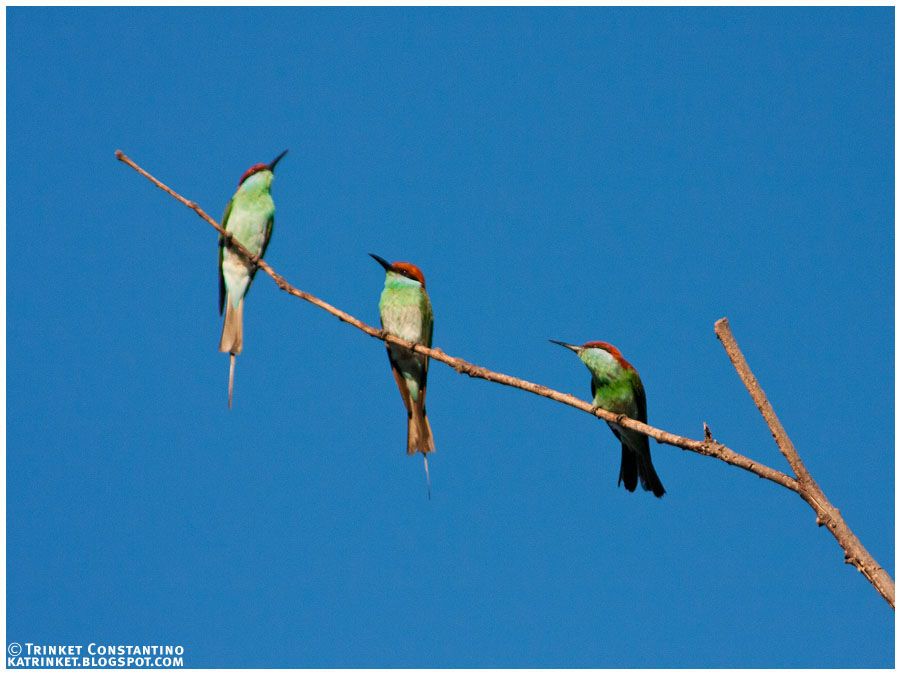
a trio of bee-eaters in a row

we had a surprise raptor too! actually 3 of them: 3 common buzzards flew above us heading northeast! unusually low altitude as they are most often reported in the high mountain provinces of the cordilleras. it was an extension of our raptorwatch for migrating birds of prey last month!

on a not-so-good note- there were only a few doves: pompadour green-pigeon, white-eared, yellow-breasted, black-chinned, reddish cuckoo-, and common emerald doves were all heard or seen. however, we had a feeling there must be some hunting going on as they were all extremely skittish, as were the other medium-sized birds like the blackish and bar-bellied cuckoo shrikes.  we also observed a lot of old large woodpecker holes on the wooden posts along the road, however, we did not glimpse a single one!

we did observe at least one pair of birds who had successfully fledged their young: a pair of yellowish white-eyes were busy feeding 2 young birds perched below their nest, probably having just left the nest that day. (we also saw some lowland white-eyes, unusually overlapping in habitat with the yellowish!)


a yellowish white-eye busy looking for food

a fluffy white-eye fldgeling under its nest
(can you see the other fledgling and the nest near the top of the photo?)

mom/dad with food!  each fledgling had its turn getting fed, very efficient!

we also observed a pair of scale-feathered malkohas who were just starting out: they were in the process of building a nest. definitely not nest parasites these relatives of the cuckoos.


one of a pair of scale-feathered malkohas building a nest

as the others walked ahead of me, i got distracted by the many, many butterflies flying around! 

we first noticed them puddling underneath a huge tree.  fine drops were falling to the road, was it dripping tree sap that was gathering butterflies underneath its shade?


several of these papilios were puddling under a tree

the papilios' wings showed varying degrees of wear and tear 

quite a beaten specimen of one of my favorite lycaenids: caleta roxus


there were a lot of interesting looking plants as well.  at one area, all the duhat trees were host to a now familiar mistletoe. the bright red flowers were a beautiful sight, and many of them invited olive-backed sunbirds to sip their nectar.


the trees were dripping with the red flowers of the mistletoe amyema incarnatiflora

a female  olive-backed sunbird taking a sip of nectar

by the side of the road i saw at least two different kinds of vines, both with clusters of star-shaped flowers.


this reminded me of a hoya but the flowers and leaves weren't so succulent


one of them grew profusely over the small trees, and its flowers attracted quite a few lycaenids and pierrids.


a lycaenid (one of those whose identity eludes me: it had a bright orange upper side)
sipping nectar from the flowers of a very profuse vine.

caleta roxus joining the lycaenid in the previous picture (do you see its false head?)


some of the butterflies were attracted to less pleasant things: a pair of cruisers were joined by a skipper another nymphalid taking in minerals from the remains of a dead lizard.


a variety of butterflies attracted to a dead thing on the road!

as i hurrried to catch up with the others,  i saw that they were in the same predicament as i was.  they were being distracted by the butterflies! how could they not be?  several small lycaenids were perching on our shirts, bags, and even our hands and faces!


a fresher specimen of c. roxus on adri's bag

another lycaenid stayed perched on my hand as i walked for several meters!


some of the butterflies were perching on the road and the rocks by the side of the road, bathing in the hot mid-morning sun!


another cruiser on a lily flower planted near a grotto

a common jester perched on the grotto walls 
how i wish i got a better photo of this skipper!

i was not familiar with this sunning nymphalid so i took pictures of its underside... 
... and its upperside!

a tiger sipping from the rocks

and a crow sipping from the concrete road!

many of the them were chasing each other, perhaps guided by the scent of another chemical (not salts nor flowers nor decay but love!): pheromones!


the chase of ages

guided by the scent of lurve!


it's too bad that radar hill is quite far away from metro manila.  it looks like such a promising place to watch both birds and butterflies!


Friday, June 7

nymphs, lycans and ruby red flowers


the leeas are starting to bloom!

while in subic a few weeks back, the familiar ruby red blooms of the leeas were starting to dot the landscape. the flowers are pretty in themselves, but i always pay special attention to them because they seem to attract their fair share of butterflies plus other insects!


even if most of the flowers were still buds, they were already a beacon to many butterflies, including one of my favorite lycaenids: the club silverline.


in fact most of the butterflies i saw feeding were an assortment of lycaenids, I saw at least 4 kinds.


there was also a single nymphalid, a type of crow, fluttering around one of the inflorescences  quite skittish compared to the lycaenids which seemed intent on savoring the nectar.


it was not only butterflies attracted to the leea flowers, there were flies, hornets and strange beetle-like insects (any ideas on what kind they are?)


meanwhile, other members of the nymphalid family, most probably of the mycalesis genus (bushbrowns), seemed to be immune to the call of the leea blooms.  i saw at least 3 kinds lurking in the shaded parts of the vegetation.


another pair of lycaenids were neither on the leea blooms nor any vegetation. they were on the ground, preoccupied with procreation!  let the butterfly-watching season begin!


Thursday, September 6

putat ng ateneo


(please excuse the the title of this essay )

what i am referring to is a beautiful tree native to the philippines and many parts of SE asia, india and polynesia.  it is common and grows in damp places along the seashore, rivers or creeks. however, with most of  metro manila's waterways paved with concrete, very few of these trees can be found in the city.


the putat: read more about it at the very useful stuartxchange


one of these places is by the creek separating the ateneo de manila university and miriam college campuses.  a fairly large (and probably old) putat grows by the culvert on the ateneo side, clearly visible from katipunan beside the pedestrian overpass crossing the road.


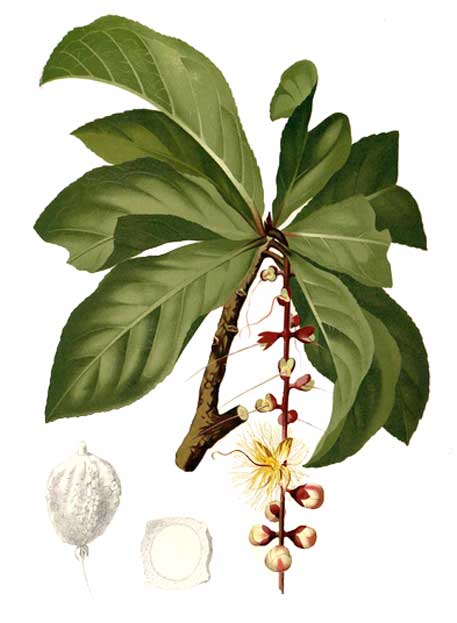
the putat (barringtonia racemosa) or fish poison wood (hinting at its traditional use to fisher folk) is small tree, somewhat "normal" looking. but when it flowers, its pink blooms can drip thickly from its branches and cover the ground in a carpet of pink. if only we had more waterways around the city to plant it! (too bad the mmda is no longer trying to paint the metro pink!)


i collected a few of the fallen seeds around the ateneo putat and at least three of them germinated.  hopefully i can re-plant them where they can grow and bloom.


i would have never noticed this tree if it wasn't mentioned to me by fellow-birder/native plant enthusiast cel (of the pnpcsi) and co-teacher abby (of the ateneo aemc). unfortunately, this putat, rare-tree-in-the-city, is in danger of being cleared for future road widening. katipunan traffic is no joke and this threat is very real. hopefully it won't fall victim to the concretization of the city.

the putat is one of the native trees that is not very popular, certainly not as popular as the non-native fruit trees from childhood: the duhat, atis, langka, santol and many other trees that were introduced from other parts of asia or the americas.  recently, a book on native philippine trees: Philippine Native Trees 101: Up Close and Personal, was launched.  cel was the chief photographer of the project so i was able to get advanced (and autographed! thanks cel!) copies before it comes out in the bookstores.  it talks of the kamuning, kamagong, lumbang, ipil and other native trees now more associated with streets and places than with the tree! it's a great book, filled not only with information, but delightful anecdotes from people from all walks of life.  to learn more about philippine native trees like the putat, go and grab your own copy!


Monday, March 26

a sunday morning tree walk

i was excited to receive a text message from cel t. inviting me to join a pnpcsi (philippine native plants conservation society, inc) tree walk at the up diliman campus on sunday morning.

i met up with a small group at the admin building behind the oblation and we got up and started soon enough at a very familiar corner: university avenue cor. jacinto st, right near albert hall (my second home for oh so many years).

our guide, arch. patrick gozon (http://pinoytrees.blogspot.com/) began with a short introduction on the definitions of native, indigenous, endemic and introduced (so similar to how we start our bird walks!), pointing to several palm trees right there at the outpost, beside the lady bathing. obviously, aside from the huge palm oil palms and coconuts, i had never noticed these other palms!

it was a very educational and interesting morning. we walked from university avenue to the up lagoon area (horrors, the lagoon had been half filled in and overlaid with concrete!) on the side of vargas museum, to the back of the main library by the beach house, to engineering and beta way, back to the as building and the faculty center to nsri and msi.

it was a good time to go around, several of the trees were in bloom.

pili (Canarium ovatum) trees in bloom and fruiting on university avenue! imagine that!


a lifer tree: the salingbobog (Crateva religiosa) by the lagoon had such pretty flowers! they must be pretty sweet too, several pierid butterflies were drinking their fill.

the kalumpit (Terminalia microcarpa) tree in by the library in front of phan was still blooming. i know the fruit but i've never seen the flowers (or knew what the tree looked like!)  

katmon (Dillenia philippinensisin up!  i know katmon because i kept on seeing its lovely flowers in the forest while birding, and the first time in palaypalay.  i learned in agusan that the fruit was used as a souring agent. 

this is a botong/putat (Barringtonia asiatica) flower and dried fruit.  i've seen this at the cbd at subic and even in ateneo! i didn't even notice the one at the msi!

(this isn't a tree but how can i resist the msi blue rock thrush when it lands right beside me and picks up a huge juicy caterpillar? silent note: when my main agenda ISN'T birding! it may be my last sighting of this handsome fellow for the season. )


i'd best be joining more of the tree walks and hitting the books and the internet... i definitely have a LOT more to learn about our native trees... even in up where i stayed for more than 10 years! i'm definitely looking forward to learning more!