Showing posts with label updiliman. Show all posts

Saturday, October 8

Sunny Saturday morning on campus

Sunny Saturdays are few and far between this rainy season, making it difficult to plan out-of-Metro-Manila birding trips.  Thankfully, the sprawling University of the Philippines grounds are just a stone throw's away.  So when the skies were looking clear last weekend, Adri and I went for a quick drive and walk to check out the birds.

We ran into birding couple Bob and Cynthia, and caught up on the latest news.  In typical birder and photographer fashion, our conversation remained uninterrupted while we stared up into the trees and pointed out birds in the canopy.  A few Golden-bellied Gerygones were hopping about, and we all happy to spot our very first Arctic (Kamchatkca/Japanese Leaf) Warbler for the season.


As we were about to go our separate ways, Adri spotted a lone migrant Ashy Minivet perched on a clump of bamboo in the distance.


When Bob and Cynthia left to check out other birding spots on campus, Adri and I continued our exploration of the College of Science Complex.  An unusually quiet Collared Kingfisher was sitting on a low branch in the dappled sunlight.


A few noisy Crested Mynas were flying around, perching from tree to tree.  At each tree they stopped for several minutes, inspecting the branches carefully.


A Long-tailed Shrike was busy following one of the gardeners who was trimming the grass, keeping a careful lookout for any insects disturbed by the noisy grass cutter.


The Black-naped Orioles were also very vocal, their piercing whistles heard from several blocks away.


But the definite bird-of-the-moment was the Brown Shrike. These newly arrived migrants seemed to be in the process of battling every resident bird in their annual territorial disputes!  They called loudly and harshly from every parking lot, quadrangle and unkempt green space.


There were also a lot of butterflies flying around, probably enjoying the sunny morning as much as we were.  The Leea plant in front of the Marine Science Institute was attracting several of them, which were perched and recharging under the bright sunshine.


While watching some Yellow-vented Bulbuls and a Coppersmith Barbet devouring the fruit of a Ficus beside the library, we ran into another familiar face: fellow WBCP-er Jon Villasper, and the conversation turned from the latest birds spotted to the latest Pokemon spotted on campus!

When Jon left us to battle it out in a nearby Pokemon Gym, our attention turned to a Red-keeled Flowerpecker hopping about on one of the trees. While its a bird often heard around campus, we seldom actually get a chance to track it down and spot it.


Time had flown by quickly and we had already been walking around for over a couple of hours!  Our spontaneous birding trip had given us the quick fix we were hoping for.

Good to have a great green space so near home.  I'm sure the Collared Kingfisher who saw us off agrees!


Tuesday, April 26

Eksenang peyups

At the start of the month of April, native plant enthusiasts in Quezon City were all abuzz with news of the UP Diliman Salimbobog  tree (Crateva religiosa) in bloom.


I first found out about this tree when I joined a tree walk organized by the Philippine Native Plants Conservation Society (PNPCSI) waaaay back in 2012. It was introduced to me by a less flattering name Balai Lamok.  I was amazed at how strikingly beautiful it was in bloom - a play on pastels: pale yellow, pink and lavender.


Adri and I couldn't resist and dropped by the UP Lagoon one afternoon after work to admire its beauty.  We only had a few weeks while the flowers lasted. 

The flowers must be pretty sweet too, there were all sorts of buzzing insects hovering about. A particularly showy Papilio butterfly flitted about the top blossoms.


I can only imagine what a grove of these native plants would look like in full bloom!  I hope the city planners or private developers take notice of this lovely tree.

And since we were in the area, we crossed the street to check on how the fire which razed the Faculty Center a few days before might have affected the popular Philippine Nightjar celebrity.

There it was, sleeping blissfully at the same spot.  Fire? What fire?


(I only hope that future rebuilding will not adversely affect this trusty, dependable local.)


Tuesday, April 22

Easter Triduum birding

The last 3 days of Holy Week is traditionally family, prayer and quiet time and even if summer classes started on Holy Monday, the long exodus to the provinces left a sizzling Metro Manila tranquil and traffic-free.  The break from work afforded Adri and I a few bird encounters.

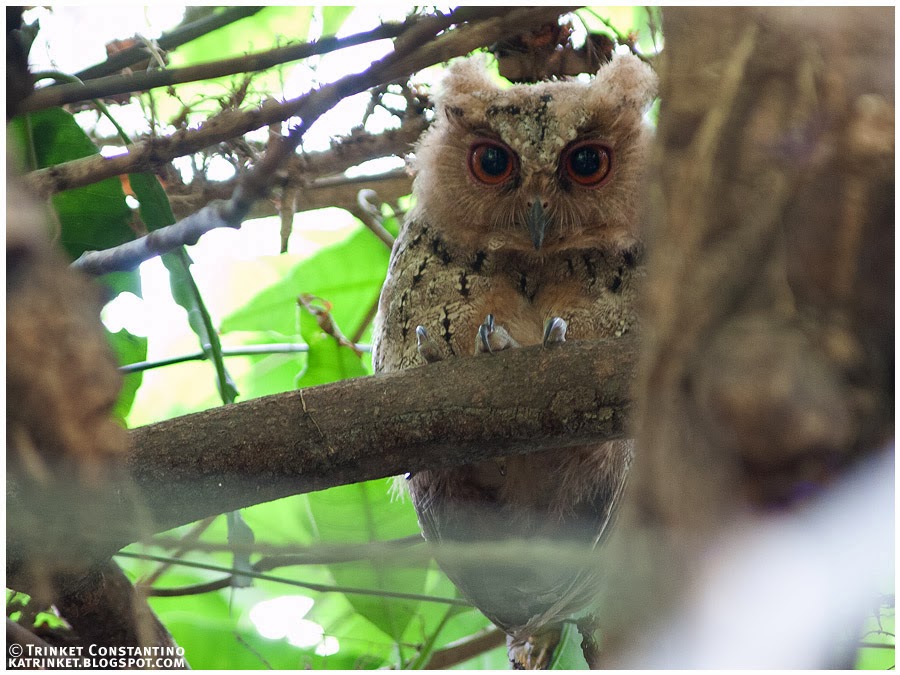
On Holy Thursday, Adri and I took a peek at the UP campus Scops Owl.  My brother and sis-in-law were taking morning walk on campus and we were excited to show them this nocturnal creature.  When we got to the site, I was surprised to see how the summer heat had thinned out the lush vegetation which the owl took refuge in during the day.  It took us quite a while to find the owl, and to our delight, we found a pair of them.  They looked very sleepy and were unperturbed at our presence.


I didn't plan to bird on Good Friday, but I was delighted to get a new record for the backyard (well, front yard, strictly speaking).  A small bird perched on an almost leafless flamboyant tree caught my attention.  It flew off its perch only to circle back and land on the same branch.  A Grey-streaked Flycatcher!  Even if it was high up in the tree, I was able to take a photo of this tiny migrant.  It was probably on its way back north for spring.


For Black Saturday, we wanted to take advantage of the calm before the storm and took a short road trip up to Candaba before the city dwellers began returning to the city.  Together with Melanie, we decided to leave Quezon City way before sunrise, to take advantage of the short, cool hours of the morning.

When we arrived at the main ponds, we were greeted by views of the busy rookeries of the Black-crowned Night-herons and the Purple Herons.  A few Philippine Ducks and Wandering Whistling Ducks were swimming around the few remaining water surfaces still available.  A stately male Watercock stood proudly above the water hyacinths.

Having parked the car under the shade of a tree (big mistake!), we backtracked to take a picture of the Watercock (failure!), a small bird scuttled out to the middle of the dirt path.  It was a Siberian Rubythroat!  We positioned ourselves with the rising sun at our backs and facing the handsome bird.


Later we were joined by WBCPers Jude, Alex, Tere and Patty.  Adri pointed out the area where they could stalk the Rubythroat while we moved on to look for other targets.

As early as half past the hour of eight, the heat was already becoming unbearable.  We parked ourselves under the shade of some acacia trees.  In front of us the pond was choked with lotuses in full bloom.  The pale flowers were calming to look at, and several Barn swallows perched on the lotus peduncles.


Jude and Co. soon joined us, and we became firmly planted at the spot, the heat keeping us from venturing further.  We entertained ourselves looking at the swallows, spotting a Common Kingfisher, a family of Purple Swamphens and a lone female Northern Shoveller.

While we exchanged stories, a loud chirping interrupted us.  Above us was a tiny warbler.  The Arctic Warbler was recently split into 3 separate species: Arctic, Kamchatka and Japanese Leaf Warblers.  These 3 species are frustratingly similar to each other in terms of appearance and until recently, Adri and I would jokingly argue about the ID of what warbler we were seeing.  A recent article (ebonph.wordpress.com/2014/04/13/ask-the-experts-the-arctic-warbler-splits) though in the WBCP online newsletter explains clearly how to differentiate these 3 species by their call. So I could finally say with confidence that I have the Japanese Leaf Warbler on my life list.


 A (half?) lifer, a backyard record and great views of familiar (though not-so-often-seen) birds.  Great birding for a non-birding long weekend.


Sunday, March 2

night birds during the day

I have always considered owling an especially patience-requiring type of birding, often testing the perseverance and persistence of even the most stoic birder. The challenge of finding nocturnal birds in the darkness, with only their calls to give you a hint of where they are, is exciting and can be difficult, but the rewards of finally getting the target in the beam of the torch (no matter how fleeting) is just as fulfilling.

Finding a regular roost site for night birds is a different type of pleasure.  It is not easy to spot a night bird, even knowing where it sleeps by day.  These are birds not meant to be seen by the harsh light of the sun, they often sleep in tangles and hidden crevices, or camouflaged to look like part of  the environment.  After all, they need to rest and sleep while the rest of the world is wide awake and busy with their daily tasks.

It is lucky for me that two known roosting sites are on my way to school.  Last week I needed a pick me up before facing the rush of finals week for our graduating seniors.  So I asked Adri if he wanted to check out recent reports of an owl on campus and to also take a look at the nightjar which has been very reliable the past few months.

It took quite a while for us to find the Philippine Scops Owl in the complicated mass of vines and branches. I was about ready to give up when Adri finally spotted it!  Of course it had already spotted us by then, the crunch of dried leaves under our feet giving us away.  Viewed at night, the owl can look very stern, but in the daytime, it looked... cute!  It had twisted its head at a right angle to get a better view of us between the tangles, giving it a slightly comical appearance.  I'm sure Adri and I were also in some yoga-worthy poses as we tried to get an unimpeded view of it.

I can see you!


I am still in awe of all these owls in the city.  This one was sleeping right next to our old hangout when I was still an undergraduate student! The old structure had already been torn down and replaced with new buildings that were an extension of the neighboring research institute (it actually smelled like an animal house, the familiar smell of mice from grad school, maybe an additional bonus for the owl).  Did these owls live here so many years ago when these were all tambayans for our student orgs? Probably!

The owl eventually got comfortable to our presence, and after one last wide-eyed glare, slowly closed it eyes to catch up on some sleep.

The Philippine Scops Owl giving us a stern look
before catching up on some shut eye.

Our owl search-and-find took a little longer than we had anticipated, which left us no time for the nightjar for that morning.  So we checked on it a few days later.

Even though the mango tree it slept in was quite small, we still had a hard time spotting it.  Again, we were almost resigned to the fact that it had found another roost when I finally spotted an out-of place broken branch.  Looking through my binoculars, I confirmed that it was the Philippine Nightjar!  Despite the live and loud kulintang music coming from the arts building beside the mango tree, it seemed fast asleep.  

A nicely camouflaged Philippine Nightjar.

A curious security guard approached us, and although he already knew we were looking at a sleeping bird, he still engaged us in conversation and took a look through the scope.  He shared his amazement at the regularity of the roost of the bird, and how it seemed unfazed by the hustle and bustle of the university during the day. Adri and I both nodded in agreement, although, we pointed out to the mango blooms which would soon give way to fruit by the end of the summer.  Harvesting the fruit would surely drive the bird to find another perch in a few months.

A slight breeze blew, and the nightjar gave a little shake, as if to sway with the branches and the leaves.  All the time, it kept its eyes closed.  Sleep well, sweet dreams little nightjar!

A slight breeze blows the leaves obstructing our view,
giving us a good look at its white tail patch.


Sunday, August 4

nightjars up a mango tree

we were first tipped off by  wbcp-er and nigs faculty allan about a pair of philippine nightjars roosting on a mango tree on a busy corner of the campus.  we finally got a chance to see them several weeks after, during a short up birdwalk requested by my sister-in-law.  


2 v iews of the nightjars up the tree: a great lifer for my sister-in-law, brother and niece!


there was no difficulty at all spotting them. sitting quietly on the branches of a small mango tree.  we were able to show them to my sister-in-law, my niece an my brother. we even got to show them off to a couple of regular weekend joggers.

last week, we were able to show them to visiting birder rob, who was passing through the country and had a single free morning to bird.  he was pleasantly surprised by the ease of the sighting. when we told him that we could show him a pair of sleeping nightjars at the university campus (we had spent the morning birding at lmep), he had initially thought that it would involve searching through some tall grass! it was in the middle of the week, the hustle and bustle of students walking around didn't seem to disturb the sleeping birds at all. 

the nightjars (you can see one partially through the leaves on the left)
 still up the mango tree 2 and a half weeks after our first sighting


sleep well nightjars! 


Tuesday, March 26

pink flowers in the month of march

albert hall at jacinto corner lakandula street was part of my regular routine for more than a decade. by the driveway and parking lot (parking was not so much of a problem yet then!) was a palawan cherry tree. it showered the driveway with pink flowers as the school year ended and summer started. for several years i would search for seedlings at its base, and constantly ask our all around maintenance man, mang lito, to try to grow me a tree from seed. we never succeeded at either.

i've moved on to katipunan from up, and i'm delighted that i still get to see pink flowers in march (or april) annually. in front of miriam college are two palawan cherry trees, not as large as the one at albert hall, but just as pink!


Sunday, November 11

wish i was a bird...

sometimes i wish i were a nightjar and i would sleep all day.
(or maybe more often than sometimes.)


upd nightjar, i wonder if you (or your forebears) were already sleeping in that mango tree when i was an undergraduate and a squatter in a building of an institute that i was not a major of.

Wednesday, May 23

serendipity

although i am always on the lookout for nests, finding them is always a serendipitous moment. never on purpose, often by chance, but always a pleasure.

we spotted the wood-swallow nest last weekend from the car.  we were on our way home from sunday mass and we passed by the electric pole at the exact same moment one of the parents landed on the nest, pinpointing its exact location.  on monday, i left for work earlier than needed, to give me around three quarters of an hour to observe the nest.  whlie adri and i were documenting the nest and watching the wood-swallows, we noticed a crested myna flying back and forth several times to a location we couldn't figure out.  but its behaviour made us think that it, too, had a nest nearby.as we were driving home that afternoon, we slowed down by the wood-swallow nest to check on them and as we drove on slowly, adri suddenly said, "ayun ung myna!" sure enough, the myna was perched on top of the 2nd electric pole down from the wood-swallow's (this one was an old, wooden post). after a couple of seconds, again at the exact time as we drove by the pole, it dropped into the hollow of the pole and disappeared from sight!

now you see me...


and now you don't...


mystery solved!

the next morning, we were able to squeeze in a few minutes before work (again) to check on our old (well, one day older) and new nest finds.  we wanted to try to figure out what stage the myna nest was at.  we could hear the adult mynas calling from nearby palm trees. in a few minutes, we spotted an adult flying in and perching on the electric wires, carrying green, leafy material. after a quick look around, it flew to the top of the wooden pole, took a peek inside and hopped in, out of sight.


a delivery of  grass... nesting material for a new nest?


they were still building the nest!!!

this un-nerved us a bit, because it meant that there was still a high chance they would abandon the nest if they got too suspicious of our surveillance.

after the adult left the nest, we moved under some trees where we were better hidden from view and waited a while more.  we realized that one of the adults kept watch from the top of the taller adjacent concrete pole or from the palm tree beside us across the street, as the other adult flew off further.  at times, both of them would meet up at the palm and fly off together, but never for more than 5 minutes at a time.

after a short while, one of the adults flew in carrying something in its beak, landed on the palm, looked around, flew to the nest, looked around again and dropped into the hollow.  it was carrying a lizard!!!


what's that you have there? that doesn't look like nesting material...


food! a lizard for hungry chicks?

it probably wouldn't stock up on food if there weren't any young birds to feed, would it?

the traffic on the road was too noisy, and the pole too high up for us to hear any distinct calls.  the next delivery brought in was vegetation again. and then another lizard. and then more leaves.


more grass...


...and another lizard via the same circuitous delivery route.

and then more leaves...

i was in danger of being late for a meeting, so we decided to leave.  i was also uncomfortable with the looks the myna seemed to be giving in our general direction, i was sure we had been spotted.

a quick check of the wood-swallows revealed that the young birds were getting bolder and bolder, venturing further out from the nest on the iron bars. i wondered if there was any inter-species communication between these neighboring birds both raising families. oh if birds communicate like humans, what conversations i could make up!

later that afternoon, adri told me that as he processed his video footage, he could hear excited chirps picked up by the camera's mic as the parents arrived at the nest.  the mynas, it would seem, are feeding a family. we'll keep our eye on them, fingers crossed that we will witness the fledging.


adri's video helped confirm young birds, listen for soft chirping when the parents come in and one of the parents carrying off a fecal sac in slow motion


wood-swallow update: this afternoon, the pair of woodswallows were out of the nest and on the top of the next electric pole down the street!  they were still chirping noisily and begging from their parents, but it looked that they were in the middle of a flying lesson!  the parents would fly from the nest pole to the next pole (nest to next, get it? haha) with the 2 young birds following them, with more agitated and ungainly flapping of the wings. while still a bit unsure in their flight, they were already showing a bit of the aggressiveness and character of wood-swallows. it looks like this one's a successful fledging!


Tuesday, May 22

a nest on magsaysay st.


and the quest for nests continues as the rainy season approaches!  

on one of my routes going to the office and back home, adri & i spotted another nest! cradled on the V of iron bars supporting high tension electric wires was a white-breasted wood-swallow nest! 2 young birds, fully feathered and probably about ready to fledge in a few days, were being watched over and fed by 2 adults.

the nest was built by a very busy street, in fact, construction was going on to improve the pedestrian walk just below the electric pole where the nest was located.

on my way to work this morning, adri &; i checked out the nest and did our usual documentation.  it was just a little past 7am, but the construction workers and their supervisors were already about their business, and after a few minutes couldn't resist taking a peek at what we were doing.  even the security guard at the nearby building got curious.  at first they would steal glances in the general direction of where we were looking. not seeing what it was that caught our attention, they hovered closer and closer to us until we finally pointed to the nest. they all took a few minutes to watch adri's camera screen as he recorded the activity at the nest. 

"dahil may pugad sa langit, o diba nasa langit sya?" one of them chuckled softly. 

they themselves noticed that the young birds were already probably several days old already, and were amazed that even if the nest was just right above them as they worked, they had never noticed it.  how did we see it, they asked?

seek and you shall find.


the wood-swallow nest was nestled on 2 iron bars of an electric post. it looked like it was made of mostly dried grass.  the 2 young birds. looking like mini-wood-swallows, were already very active and moved around the nest a lot.  the nest must be pretty deep though, because at times both birds would sink into the nest and disappear from sight completely!


"here comes mom/dad!"

"feed me! feed me!"


"nom nom nom nom nom..."

"what about meeeeee moooooooom/daaaaaaaaad?!?"


the young birds were very, very active.  they would spend several minutes preening and stretching or even pick at  nesting material. sometimes they would venture out of the nest and walk on the iron bar, which looked a bit slippery. at several points we were afraid they would actually fall off.

here's the video adri took of the activity at the nest.  it's all ambient sound, you can hear not only the birds, but also the traffic on the road, the up carillon playing and the comments of the workers who took the time to take a look at what we were doing...


postscript: a few electric posts down the street, we suspect there is another nest, of another bird. this one pretty well-hidden from curious eyes, even ours.  we noticed this bird flying out and back again and again while we were documenting the wood-swallow nest, and on our way home in the afternoon, we finally figured out how it kept on disappearing.  it would drop into the hollow of the wooden post, out of sight. can you guess what bird it is? wish us well as we try to figure out this next nest puzzle.


we suspect there is a nest inside the hollow of this wooden electric post.  will we ever confirm it? wait and see!

Monday, March 26

a sunday morning tree walk

i was excited to receive a text message from cel t. inviting me to join a pnpcsi (philippine native plants conservation society, inc) tree walk at the up diliman campus on sunday morning.

i met up with a small group at the admin building behind the oblation and we got up and started soon enough at a very familiar corner: university avenue cor. jacinto st, right near albert hall (my second home for oh so many years).

our guide, arch. patrick gozon (http://pinoytrees.blogspot.com/) began with a short introduction on the definitions of native, indigenous, endemic and introduced (so similar to how we start our bird walks!), pointing to several palm trees right there at the outpost, beside the lady bathing. obviously, aside from the huge palm oil palms and coconuts, i had never noticed these other palms!

it was a very educational and interesting morning. we walked from university avenue to the up lagoon area (horrors, the lagoon had been half filled in and overlaid with concrete!) on the side of vargas museum, to the back of the main library by the beach house, to engineering and beta way, back to the as building and the faculty center to nsri and msi.

it was a good time to go around, several of the trees were in bloom.

pili (Canarium ovatum) trees in bloom and fruiting on university avenue! imagine that!


a lifer tree: the salingbobog (Crateva religiosa) by the lagoon had such pretty flowers! they must be pretty sweet too, several pierid butterflies were drinking their fill.

the kalumpit (Terminalia microcarpa) tree in by the library in front of phan was still blooming. i know the fruit but i've never seen the flowers (or knew what the tree looked like!)  

katmon (Dillenia philippinensis) in up!  i know katmon because i kept on seeing its lovely flowers in the forest while birding, and the first time in palaypalay.  i learned in agusan that the fruit was used as a souring agent. 

this is a botong/putat (Barringtonia asiatica) flower and dried fruit.  i've seen this at the cbd at subic and even in ateneo! i didn't even notice the one at the msi!

(this isn't a tree but how can i resist the msi blue rock thrush when it lands right beside me and picks up a huge juicy caterpillar? silent note: when my main agenda ISN'T birding! it may be my last sighting of this handsome fellow for the season. )


i'd best be joining more of the tree walks and hitting the books and the internet... i definitely have a LOT more to learn about our native trees... even in up where i stayed for more than 10 years! i'm definitely looking forward to learning more!