Peter says that the Ashy-fronted Bulbul is the equivalent of the Yellow-vented Bulbul in our yards back in Luzon, and true enough, several of them were enjoying the familiar morning rituals in the garden.


A nice looking lizard was also enjoying the morning sunshine whilst looking for breakfast up a tree trunk.

Because it was a garden in Puerto Princesa, so many other birds were out! A Hooded Pitta hopped around, a pair of Black-naped Monarchs chased each other, Palawan Flowerpeckers, a Pale Spiderhunter and even an Ashy-headed Babbler made appearances! Of course there were also a lot of birds we had in common with our garden: Noisy Pied Fantails, reticent Zebra Doves, che-che-che-ing Pied Trillers, colorful Olive-backed Sunbirds (much more colorful here though!). Instead of a caw-ing Large-billed Crow on our fire tree, a Slender-billed Crow on a Parkia (Cupang) tree made a strange kwek-kwek-kwek-ing (almost duck-like!) sound.
A very active Rufous-tailed Tailorbird took center stage. As we were having our breakfast and conversation, it kept distracting us by coming very close to the veranda and hopping about some very low branches!

A bit later, it even spared us a the effort of chasing it around and trying to get it focused on camera. It landed in some tangles and spent the next ten minutes preening and fussing with its feathers!


Too soon, we had to bid Indira and Peter goodbye. It only took us less than an hour (!!!) to get our business done, but it wasn't goodbye to Puerto Princesa yet! It being the Holy Week holiday in school, we decided to make the most of our trip and slip in a couple more days of birding.
Our customary Puerto birding itinerary is to base ourselves in Sabang Beach, so we could bird along the highway around Sabang and neighboring Cabayugan. This time, we decided to do it a bit differently. Adri chose a less popular tourist destination in Buenavista: a small, homey cottage at Jenny's Kahamut-An, right on the shores of the fishing village at Ulugan Bay.

With the concrete highway all the way to Sabang, it took us just a couple of hours (including a yummy pho lunch at the Viet Ville!) to get to Buenavista, and we arrived early in the afternoon. We were met by our lovely host Jenny, who showed us our cottage and after the usual introductions (emphasizing "We're birders so we eat dinner and breakfast at odd hours we hope you don't mind" on our part and "We run on solar power here, but it shouldn't be much of a problem" on our host's part), we settled in comfortably.
One of the first birds to greet us was a Plaintive Cuckoo, hanging around the center of the garden!

Not to be outdone were a pair of Palawan Flowerpeckers up a huge mango tree.


A pair of Common Ioras were also regular visitors, coming right by our cottage veranda regularly.

And of course some Olive-backed Sunbirds, who seemed to have a singing competition every afternoon, just in time for siesta hour.


We decided to take it easy the first afternoon, it was, after all, meant to be a relaxing vacation. As we admired the afternoon sun lighting sparkles on the waters of Ulugan Bay, Adri suddenly had a bright idea to check the beach for plovers.
Despite the blinding light on the huge expanse of sand exposed by the low tide, he managed to get a tiny bird on the scope. Was it a Malaysian Plover? We got all excited, gathered our gear, and decided to check it out.
Some kids were also out playing in the hot afternoon sun, gathering starfish far out to where the sea grass beds were exposed. (Only kids and birders would voluntarily be out in the sun at 3pm)

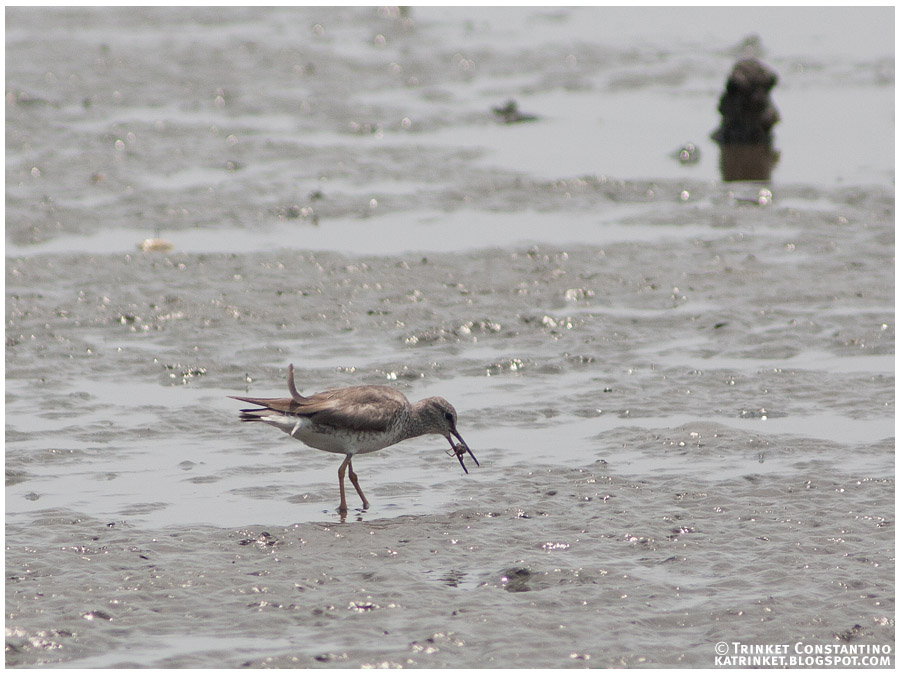
The bird Adri had spotted turned out to be a Common Sandpiper, foraging in the shade of a parked outrigger.
But as we scanned the beach, three plovers came into view!


They were busy scurrying across the hot sand (just like the kids!), in various stages of plumage. Hmmmm... three plovers? The Malaysian Plover idea was not looking very good (they're usually in pairs).
Nonetheless, we waited patiently and crossed shallow tide pools, and sat on the sand, trying to get good views. It's wonderful what a bit of patience can bring. When I stopped moving, the sand itself seemed to come alive with tiny crabs and other creatures... marching to the beat of a silent drum.
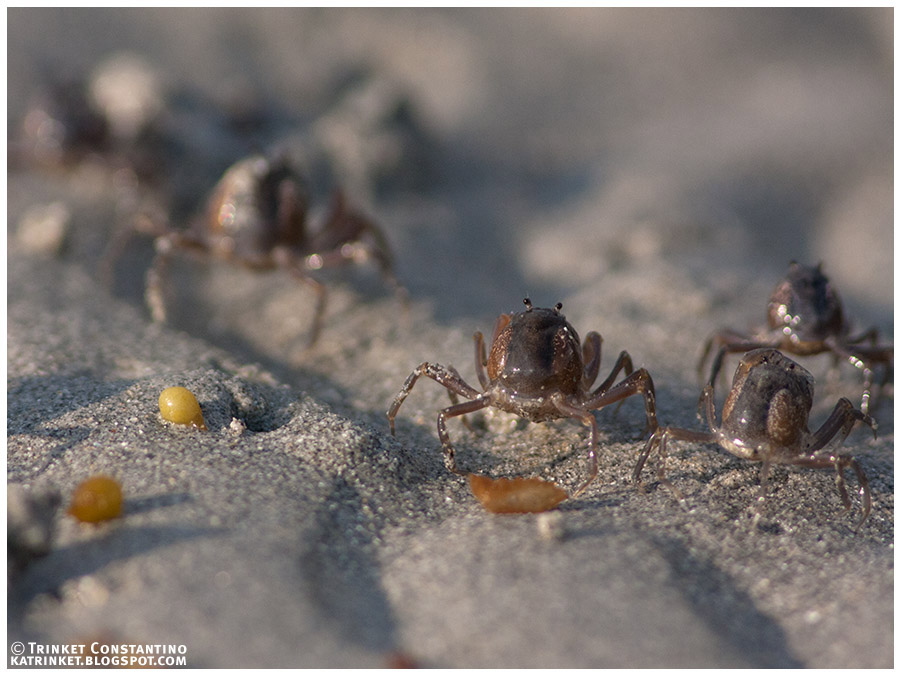
In no time, one of the plovers got comfortable enough to get close to me, both preening and foraging.

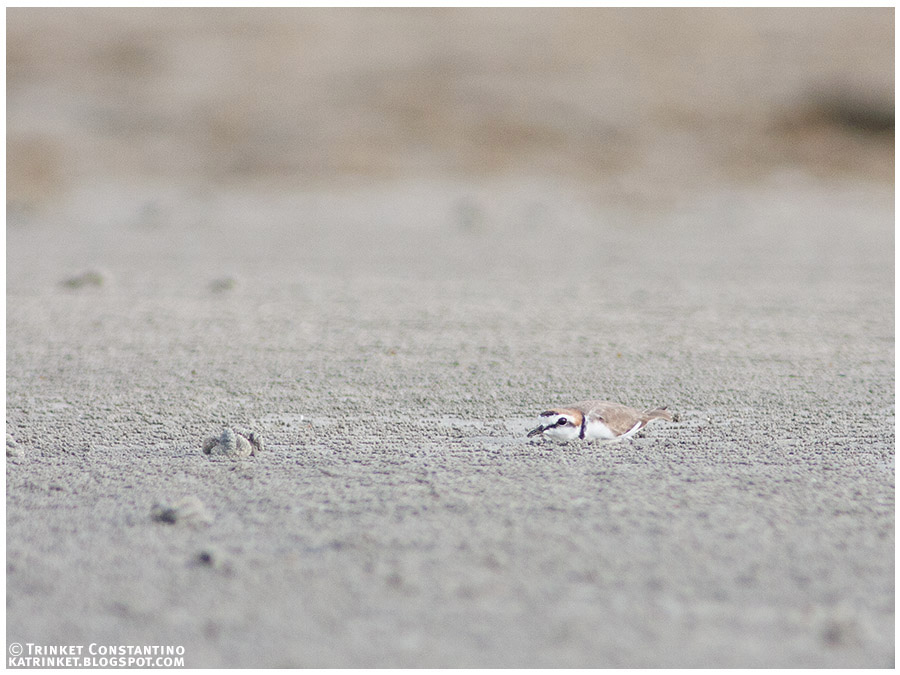
As it turns out, the plovers turned out to be the very common migrant Kentish Plovers! But no matter, the hours spent on the beach were very enjoyable for me and Adri. It actually got me thinking: Other than birders, who would be out stretching their legs and crouching on their knees on wet sand in the heat of the afternoon doing this... and enjoying it?!?
We had gotten so acquainted with the 3 plovers that they would pass right by me while they were scuttling around:

Sometimes, they would get spooked by our sudden movement (I can't stay in a squat position for that long!) or by a fisherman passing by to load some branches in his boat for fish traps. The plovers would crouch low on the ground, motionless (reminding me of the tension in a cat about to pounce on its prey).
Occasionally, a Pacific Reef Egret would also fly into view, and farther away, a Whimbrel was also foraging.

I suppose we got enough sun on the beach that afternoon, because for the next couple of days, we enjoyed the view from our veranda, at least when we were not out birding on the highway.

At night, we had a regular visitor to the veranda, one our host had already warned us of. Jenny must have thought us strange (or at least not your regular tourists), when we assured her that we welcomed such visitors, even if they did leave a bit of a mess on the floor the next morning.
A little bat had decided that the thatched roof was a perfect spot to enjoy his dinner. We would see him there busy nibbling at some figs from a nearby tree.

We even took photos of him to show Jenny, who was too polite to say anything except: "Few visitors would be so understanding of a bat on the veranda!"

On our last day, we had an early lunch to catch our flight back to Manila. As we were packing up, Adri suddenly caught sight of several frigatebirds thermalling above the cottages!
They started out low and rose higher and higher until they were out of our view!


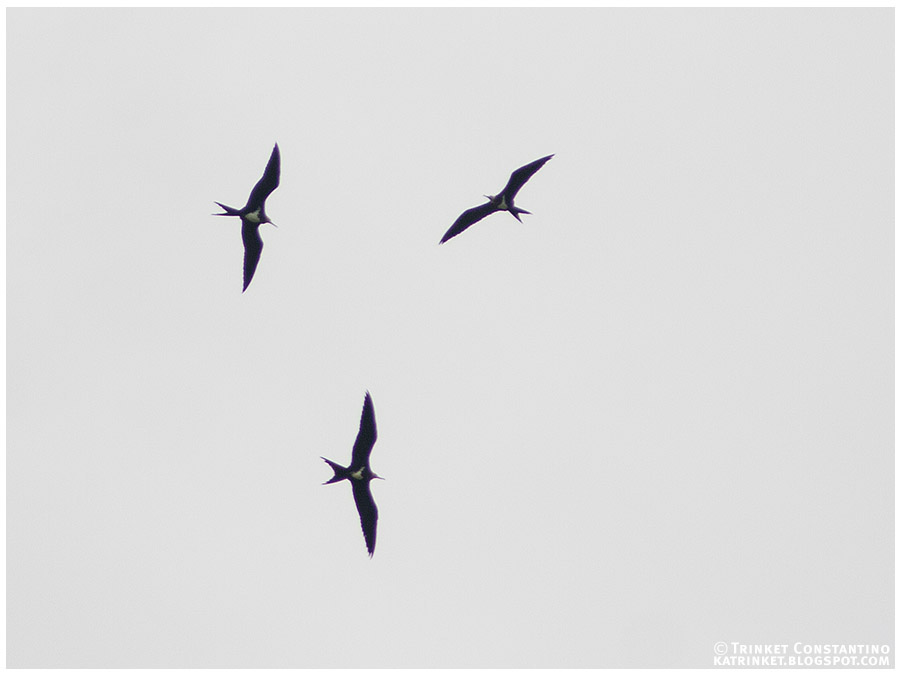
The seven frigatebirds looked to be Lesser Frigatebirds. We were concerned that their behavior might signal a change in the pleasant weather we were having and hurried on our way. (Sure enough we ran into a bit of a thunderstorm in the middle of the highway!) What a send off for another great Palawan trip.

Kahamut-an was a great place to stay. Far from the tourist crowd (it was Holy Week remember), very clean and neat, great food and the quiet company of Jenny and her family. A nice change from our usual Puerto Princesa routine.