Showing posts with label creepycrawlies. Show all posts

Wednesday, September 9

Sunday Garden Buffet

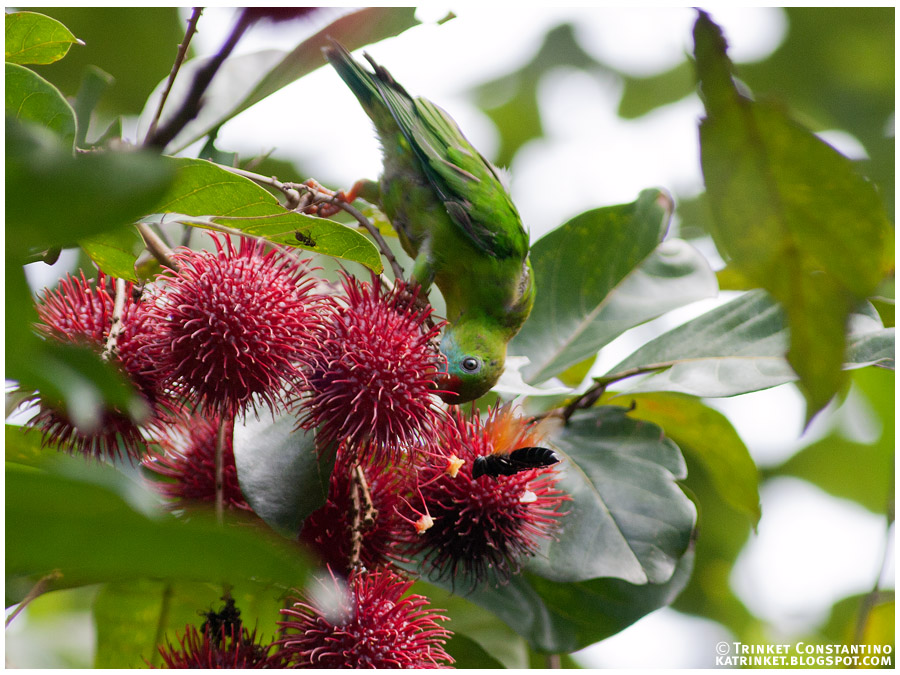
The last of the ripe rambutan has been gathered from our garden, leaving only some of the fruit on the tree for our regular guests.  The Colasisi are always expected this time of the year, dropping by and perching for long periods (rather than just the quick twittering call as they fly past the house's airspace).


A Colasisi surveying the scene before committing to the feast.


This female was partaking of the remaining feast, quite oblivious to our admiring eyes and lenses.  She patiently took bites of the thick red rind, until the juicy white pulp was exposed.


Dainty bites.


We have garden benches that are situated under the rambutan trees, and a sure sign of a feeding colasisi (they are quite quiet as they munch along), are bits of red fruit skin falling on your hair or lap from above.

Unfortunately, the sweet scent of the juicy white fruit soon attracts huge wasps (hornets? I confuse the two). They quickly come around, buzzing all over the hard working Colasisi.

And along came a big, buzzing wasp!


Soon, the Colasisi is so bothered by the large hovering insect that it takes its leave, twittering harshly as it flies off.

This year, many of us rambutan pickers fell victim to the painful sting of hairy caterpillars (higad).  These large creepy crawlies love the rambutan leaves, but it is only this year that the height of the hairy caterpillar population boom coincided with harvest season.

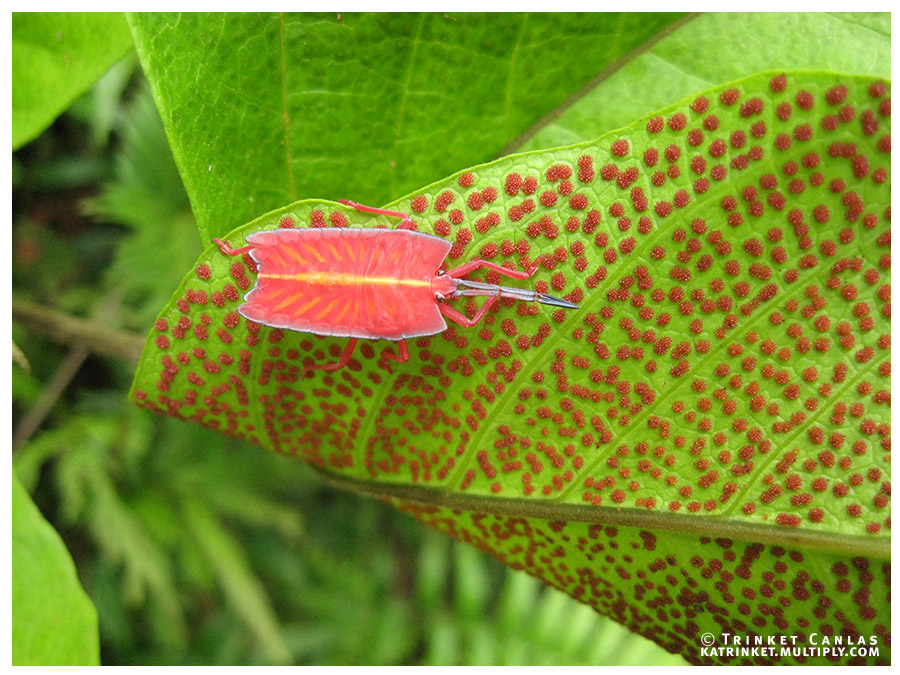
So it was good to see that the caterpillars fall victim too, we saw a strange-looking bug (beetle?) grasping to one of the caterpillars, sucking up its juices through its mouth parts. Sluuuuuuuurp. Yummy.


Predator and prey. Sluuuuurp!


Of course many of the backyard birds also scour the leafy foliage for these juicy prey.  

The Pied Triller is a regular visitor to the Flamboyant Tree in front of the garage, just across the garden from one of the rambutans.  Its soft che-che-che-che can often be hear as it ambles about the branches looking for smaller hairy caterpillars.


A Pied Triller patiently looking for creepy crawling food.


While we were watching this particular male individual, a flash of yellow in the Narra beside the Flamboyant Tree caught my attention.  A young (and very quiet!) Black-naped Oriole was also on the hunt!

Soon it had in its beak a wiggling, huge hairy caterpillar!  


And another caterpillar falls prey!


It hopped and down a large branch, slapping the prey on the wood.  Does the slapping stun the caterpillar? Does it remove some of the stinging spines? Maybe both? (Does it tenderize the soft body even further?!?)


Oriole versus hairy caterpillar.

SLAP, slap, slap. Back and forth (somewhat violently!) until it is quite satisfied, and gulps down the caterpillar in one swallowing motion.


Some violent slapping going on.


I eat rambutan, I get stung by a caterpillar. Caterpillar gets slapped silly and then eaten by the oriole.

(In the meantime, a Colasisi is quietly eating rambutan at the top of the tree I can't reach. And the bug is still sucking up caterpillar juice.)


Sluuuuuuurp!


Fair enough.

Sunday, June 30

a lifer, a marauder and mixed flocks at bk valley


before the rainy season made up its mind to dominate the days (and more especially the weekends!) with cloudy skies and buckets of precipitation, adri and i joined our friends jops and maia and visiting birder dave for some relaxed birding at bangkong kahoy valley.


a view of mt. banahaw from bangkong kahoy valley


settled between the mythical mountains of mt. cristobal and mt. banahaw, bangkong kahoy is a favorite go-to, mostly because of the pleasant weather, the good food and the friendly hospitality of our host dion.  adri and i had been up several times, although not so much for birding as to take my mom, siblings and nieces for fresh and cool mountain air.  our last birding adventure was up the mountain with jops, maia, jon j and jun o.  it was a memorable (if not slightly traumatic) experience, as it was a strenuous and difficult hike up slippery trails and moss-covered rocks. to top it off, we dipped on our target, a nesting whiskered pitta!  we vowed that we would be back for a more laid back birding holiday.

first on our agenda was to check on some besras which had recently fledged.  we had also dipped on a previous nesting the last time and i was hoping for better luck this time round as the besra would be a lifer for me. i didn't want to get too excited, given that the besras had already fledged, and according to our guide chris, were no longer seen daily at the nest site.

as we walked along the road, we encountered our first mixed flock of elegant tits, citrine canary flycatchers, blue-headed fantails, yellowish white-eyes and sulphur- billed nuthatches.  i've always enjoyed these high elevation flocks of cheerful and colorful birds and we all took the time to watch these energetic little birds as they zipped around a small tree.

as we were leaving, i had a mini-lifer: a common nawab was perched on the ground, sipping minerals from the ground. i had always wanted to see this particular nymphalid, and there it was, for all of us to admire. i took it as a good sign for the weekend that had just begun.


a sign? the common nawab was a lifer butte for me

we continued on to the small village through trellis laden fields of chayote and beans to the edge of a forested area where the nest was found.  chris, who was walking ahead of all of us, quickly signaled us to hurry and position ourselves beside him.

perched above us were 2 young besras! sunlight filtered through an opening in the canopy above and lighted their perch in the surrounding green.  there were supposed to be 3 fledglings, so 2 out of 3 was a pretty good sighting.  they were calling softly, perhaps their sibling and parents were nearby, well-hidden.


a pair of fledging besras

we watched them and they watched as as well, 4 raptor eyes on us and 10 human eyes on them.  they preened and stretched for several minutes and then took off for another perch, not far, but hidden from our view.


looking at us looking at them


around us, insects teemed: a dragonfly perched on a nearby stick and metallic green bugs went about their business on a taro leaf.


a blue and red dragonfly

metallic green and orange beetles going about their business


as we left the site, chris suggested we go up the mountain to check on a mountain verditer flycatcher nest he was observing.

UP the mountain?

not far he said.  and the trail was not difficult he added.

uhm ok. so off we went.

this was the part of the weekend which was not relaxing!  we found ourselves scrambling up steep trails and mossy stones. again! i couldn't believe i fell for the "easy trail" description... for the THIRD time!

and so at the last part of the trail, i eyed the moss covered rocks angled steeply, and adri and i decided to pass.  a mountain verditer flycatcher nest just did not seem worth the effort to me.  and we had recently had our fill of mountain verditer flycatchers a few weeks ago anyway. (yes, i had all sorts of rationalizations in my head). kung gusto may paraan, kung ayaw maraming dahilan. truly.


jops coming down the steep part we climbed up halfway before deciding not to go  on.

maia decided to wait it out with us too, and we scrambled down the rocks (yes, laughing with a tinge of hysteria) to wait for chris, jops and dave at a more level area. there weren't too many birds to entertain us, so it seemed quite a while before dave and then chris and jops came down the trail.  they had been distracted by a largish bird on the ground which they had flushed.  was it the elusive whiskered pitta? they couldn't be sure.

chris decided to take us through another route down (one i had taken before), and we stopped along the way to enjoy some of the birds. near a small house, chris spotted a scale-feathered malkoha which quickly disappeared in the undergrowth. while waiting for it to reappear, a pair of buzzing flowerpeckers suddenly arrived, perching very near us.


a singing buzzing flowerpecker 

a pretty orange mycalesis


further down we ran into some chestnut-faced babblers and mountain white-eyes which seemed to be feeding at one of the trees we passed. a larger flock of elegant tits, blue-headed fantails, sulphur-billed nuthatches and even a green-backed whistler made us stop for several minutes.


one of several chestnut-faced babblers on the trail

we arrived back at the homestead at lunch and we enjoyed a long delicious lunch served with fresh lipote juice. after lunch, we parked ourselves at the deck of the private home of ramon q, having obtained his permission to bird from his very comfortable terrace facing the forest.

in the early afternoon, there was very little bird activity, and i distracted myself by looking at the various moths on the walls of the house and the butterflies perching on a tree with lovely lavender-pink flowers. 


buttes and beetles on the lavender flowers

an interesting caterpillar on the table


later in the afternoon, a movement in another tree in front of us caught our attention.  it was a a brush cuckoo busy eating caterpillars! at first we had quite a hard time getting good views of it, but later on it was more bold and came out to perch in the open.


a brush cuckoo busy eating caterpillars


as the sunlight waned, more birds came.  a pair of philippine cuckoo doves flew across the forest. philippine coucals, a red-crested malkoha and a scale-feathered malkoha skulked nearby.  maia was even able to observe and catch on video the red-crested malkoha raiding a nest!  we were all aghast as we viewed maia's playback (watch it here), even if we knew theoretically of the malkoha's dining habits. the image of a marauding malkoha is something i will remember for a long time!


the remains of the marauded nest

we had such a good time on the deck that we decided to spend the next morning there as well.  dion even had our yummy breakfast served on site!  all that relaxation definitely made up for our exertions the previous morning.


a very delicious breakfast!!!

in the early morning, a few balicassiaos were the first to perch on the tree tops. a lone tarictic also made a brief appearance. maia and i even saw another philippine coucal with what looked like an egg in its beak! 


a balicassiao showing its blues

a male tarictic perched far away


as the fog lifted from the mountain tops and the sunshine warmed the valley, the mixed flocks of small birds began to come in.  more elegant tits, grey-backed tailorbirds,  blue-headed fantails, citrine canary flycathers and yellowish white-eyes made the trees fronting us buzz with activity and cheerful song.


a very, very active blue-headed fantail


in the busy mixed flock, dave even spotted a trio of fledgling citrine canary flycatchers all huddled together as their parents diligently gathered food for them. 


cutie-pies: a trio of fledgling citrine canary flycatchers


as the bird activity died down, our adrenalin rush subsided as well. too soon it was time to go. our relaxing weekend birding was over. there will be surely be more to come! 


Friday, June 7

nymphs, lycans and ruby red flowers


the leeas are starting to bloom!

while in subic a few weeks back, the familiar ruby red blooms of the leeas were starting to dot the landscape. the flowers are pretty in themselves, but i always pay special attention to them because they seem to attract their fair share of butterflies plus other insects!


even if most of the flowers were still buds, they were already a beacon to many butterflies, including one of my favorite lycaenids: the club silverline.


in fact most of the butterflies i saw feeding were an assortment of lycaenids, I saw at least 4 kinds.


there was also a single nymphalid, a type of crow, fluttering around one of the inflorescences  quite skittish compared to the lycaenids which seemed intent on savoring the nectar.


it was not only butterflies attracted to the leea flowers, there were flies, hornets and strange beetle-like insects (any ideas on what kind they are?)


meanwhile, other members of the nymphalid family, most probably of the mycalesis genus (bushbrowns), seemed to be immune to the call of the leea blooms.  i saw at least 3 kinds lurking in the shaded parts of the vegetation.


another pair of lycaenids were neither on the leea blooms nor any vegetation. they were on the ground, preoccupied with procreation!  let the butterfly-watching season begin!


Friday, November 11

the industrious ants

while waiting for the female violet cuckoo to reappear last week in tanay, i accidently disturbed an ant nest.  i was kicking around the smooth stones lining the path, looking for fossils, when i found this under one of them:


(click the photo for a larger view)

the poor things suddenly rushed into a frenzy to bring their clean, white eggs to safety!  amazingly, in less than 2 minutes, every single one of the eggs was gone from the exposed hole! in what seemed to me like organized chaos, each ant had carried egg after egg to a more secure location.  all that was left was clean and bare dent in the soil which had no trace of the treasure that had been stashed there.

pretty cool if you ask me!

(i've heard ant eggs are a delicacy in some provinces, although i've never tasted or even seen them.  seeing how small they are, it must take a lot of ant eggs to make a big enough snack!)


Monday, August 29

leea and the butterflies

(click on the photos for larger pictures please)

Several years ago while birding in Subic, we came across a shrub with bright red flowers that was crawling with several butterflies.  These butterflies were so intent on sipping the nectar of these little flowers that Tere was able to get a photo of them using the macro mode of her point and shoot!  if you look at the picture below, there are at least 5 species of butterflies: several Eurema sp., an Appias sp, a pair of cruisers (V. dejone), satyrids and even skippers!


Tere's 2007 picture of a then unknown butterfly magnet.

Since then we have learned that when we see this plant in bloom, it's a good opportunity to check out the butterflies getting drunk on it and to take decent butte-pics. And I've seen (and looked for) it all over the country, Luzon, Visayas, Mindanao and Palawan!


Some butterflies I've taken pictures of feeding on Leea flowers in Subic (of course, fave nearby birding site):  Caleta, a skipper, Eurema, and another lycaenid. 


In Bangkong Kahoy, Quezon, this mapwing enjoyed perching on the fruit of Leea.

Recently, I finally found out that this wonderful butterfly nectar plant is of the Leea genus, mali-mali in the local dialect. My first internet searches turned up information that it was from, of all places, Africa!  That led me to thinking that it was an introduced species!  I was literally amazed at how it had seemed to distribute itself throughout the Philippines! During my recent visit to Coron, there was on plant hanging on to the limestone face of the entrance to Barracuda Lake! Of course, even in there in the sea, a bright orange butterfly was intent on feeding.
A Leea at the entrance of Barracuda Lake in Coron.

Hah.  The bane of rushed internet searches.  I finally found out today that it is actually indigenous to several countries across the tropics, the Philippines included! Madulid (A Pictorial Cyclopedia of Philippine Ornamental Plants) says that there are actually 13 leea species  in the Philippines. Yahoo! A true local and not introduced.

I stand corrected.

Today, during the club trip to Palay-palay, Adri & I spotted several leea (what a nice name I must say) in bloom!  (Okay, before I proceed, I have to explain that the weather was horrible for birding, the wind was so strong even the brahminy kites seemed to be tossed around like paper airplanes AND...  well, Palay-palay is just not what it used to be, what with the huge concrete road and a tunnel blasted right through one of the mountainsides and settlers with caged birds hanging outside their houses. But that's another story)

At the first plant, I saw several lycaenids (I'm still not so good at butterfly ID) plus a gorgeous lemon yellow spider.  Which of course I promptly pointed out to Adri, Alex, Mai, Tere and anyone who cared to look (remember, there were no birds!).  If it was terrible weather for birding, it was even more horrible to attempt any form of butterfly photography (yes, the weather ruined even the alternative activity!).  The thin leea branches were waving frantically in the wind.  Looking through my bins, I found out that one of the lycaenids (which was bright orange above or "inside") had gotten on the wrong side of the wind as well... and landed straight in the waiting yellow arms of my (now vicious-looking) yellow spider!


This poor lycaenid found death on the leea... the deadly embrace of a yellow spider, strangely perfectly camouflaged in the red flowers.

The other more fortunate Leea drinkers, a couple more lycaenids, a sailor and wasp,  oblivious to the deadly drama (on the left corner of the picture) - blurry picture, sorry! It was too windy.

Another good find on the leea flowers today were at least 3 club silverline butterflies (Spindula syama)!  I love these little yellow lycaenids with silver streaks outlined in black.  And of course their little fake heads!  Again, too windy to get really good shots, but Adri and I were lucky to pull a couple off.


A better photo of the club silverline at last!

It's wonderful to see how nature is interconnected. So next time you see a leea in bloom while birding, try to check what little jewels are hiding in its petals! No harm in squeezing in a little plant/butte-watching!

Saturday, April 30

bislig birding

three full days of birding in picop, bislig!

we finally made plans to bird at picop (paper industries corporation of the philippines) for the summer, right before my summer classes began. the vast (former) logging concession extends across the provinces of surigao del sur, agusan del sur and davao oriental.

adri and i decided to forego our plans for a palawan trip, prompted by the horror stories of forests literally disappearing before your very eyes. go now! go now! everyone who had been there recently said. and with this sense of urgency on our minds, we arranged an almost-last-minute trip. happily, alex, tere and carmela were able to join us.

from manila, we were traveled to bislig via davao.  the drive to bislig brought us though san francisco, agusan del sur.  as we drove in the shadow of mt. magdiwata, we reminisced the events of the exciting trip we had in the mountains and marshes of agusan a few years back.

remembering agusan during lunch at san franz

arriving at paper country inn in the middle of the afternoon, we decided to make the most of the remaining day by visiting the tinuy-an falls right in bislig city.  it was around an hour's drive to the falls, mostly through unpaved (but smoothened with crushed limestone, we were to find out later, as most of the logging roads were) road.  

the falls did not disappoint!  the wide, multi-tiered falls took our breath away.  the strong waters sprayed the air with a fine mist, enough to get us wet when we approached the falls.  definitely the most beautiful waterfall i've seen in the country.


having satisfied our touristy side with picture-taking, we took advantage of the remaining light by birding a couple of kilometers of the road leading to the falls.  in a short time before the darkness fell, we took in the sights of two rufous hornbills flying overhead, of yellowish bulbuls, various pigeons & doves(pompadour green, yellow-breasted fruit, green imperial, white-eared brown), assorted flowerpeckers.  we hoped that the couple of hours of birding was an omen of good things to come in the next few days.

productive birding on the road to tinuy-an

that evening we had dinner with zardo goring, THE guide in bislig , and vice mayor conrad cejoco, who shared with us a few of his projects and insights regarding the state of picop. looking forward to an early start the next day, we ended the evening early to get a good nights' rest.
dinner with zardo and vice

the early start we had on our first full day of birding was an indication of the next two days of the trip.  up at 3am, on our way by 330am or 4am. the roads seemed endless in the darkness, and the rows of wooden make-shift houses gave us a clue to what everyone who had encouraged us to go (with such urgency) was talking about.  we started the morning (again like every morning of the 2 days after that) attempting to owl.  Emphasis on attempting.  But by the end of our trip, our dipping on the nightbirds would be overshadowed by the wonderful assortment of birds we would see and the wonderful views we had of them.


birders in bislig

on our very first morning, we had easily seen the steere's pitta (which called out loudly from the same patch of forest every morning) AND we had watched a pair of writhed hornbills inspect a tree hollow with utmost detail and seriousness.

a pair of writhed hornbills apartment hunting (see video here)


beetles, butterflies, spiders, snails... so many other creatures to distract us!

of course, beyond birds and other creatures, there were the people who live in picop now.  it was impossible not to think of them. and probably, they thought of us (or at least birders in general) also.  mang lucio, the english speaking 84 year old gentleman who lived by himself, away from the settlements which had formed, had expressed his shock upon seeing us "oh my god! you're all filipinos! thank god!" (of course he started all his sentences with "oh my god":  "oh my god! would you want some coffee?") children along the road would shout and wave at us as our jeepney zoomed by "hey joe!" obviously, they were more used to foreigners visiting, than brown skinned locals. they, who now live in the forest, who live off the forest, above all, are probably the ones who hold its fate in their hands.

lucio, omg!

it was a trip of contrasting scenery, of contrasting emotions.

the excitement of being within 5 meters of the celestial monarch perched on a low tree sobered by the memory of a cleared forest patch not 500 meters away.

the joy of seeing 53 writhed hornbills in flight was tempered by the sadness of seeing logging trucks laden with huge logs stealing off into the night.

the pleasant sound of bird calls and bird song rang in our ears while the scent of burning vegetation filled our noses.

the wonder of a family flock of mindanao (tarictic) hornbills feeding on a single tree matched with the wonder of dozens and dozens of small children of the settlers with machetes in hand.

to be sure, picop is still a wondrous place, with surprises at every twist and turn of the logging road... not only birds, but butterflies and beetles, dragonflies and spiders, fruit and flowers.


if i include the philippine oriole (split from the white-lored oriole) and the rufous fronted tailorbird (split from the philippine tailorbird), i count 10 lifers from this trip. very, very productive birding; we had large flocks of hornbills (on our last afternoon we had 53 writhed hornbills, 25 mindanao hornbills and "only" 7 rufous hornbills), good mixed flocks of babblers, monarchs and flycatchers, a falcatta grove with 4 species of cuckoos, a very accomodating steere's pitta and many raptors on the wing.

my bank bird: rufous-fronted (philippine) tailorbird

always at the back of our minds though was the very urgency that prompted us to drop other plans to come to this place. whatever can be done, should be done. now. i don't think it is too late. but for how long can this forest hold out and hold on to its treasures?

picop
bislig city, surigao del sur
5 - 9 april 2011

check out other treasures of bislig at:
http://katrinket.multiply.com/photos/album/104/birding_bislig_picop
http://katrinket.multiply.com/photos/album/105
http://katrinket.multiply.com/photos/album/103/tinuy-an_beauty
http://www.facebook.com/media/set/fbx/?set=a.1722934642393.2089483.1509153322&l=6ccf29963d