After a successful workshop and fruitful birding at Twin Lakes, Adri and I were ready to move on to the next destination on our Negros Island itinerary. So after an early breakfast with our hosts from the DOT, we headed for the bus terminal to start our journey. From Dumaguete we took a bus over the mountains to Kabankalan City on the Occidental side of the island. After a quick lunch, we transferred to a bus headed to Hinoba-an.
 |
| No problem taking public transport: the Ceres Lines bus terminals are very organized (we took the air conditioned buses, not the one in the photo!) |
 |
| A view of Danjugan island (on the right) from the mainland |
Our accomodations were at Moray Lagoon, a twenty minute outrigger boat ride from the mainland. As we approached the island, the deep blue-green waters became crystal clear, revealing a vibrant underwater world.
 |
| Entering Moray Lagoon |
 |
| Moray Lagoon Camp |
We were shown to our open cabana which faced the lagoon and after a brief rest, our guide Ramram gave a short overview of the island's history and vision-mission.


A great outdoor classroom!
Looking at and identifying photos of birds posted at the learning center, Ramram quickly guessed we were birdwatchers and correctly assumed that we were here to see the recent island star bird: a Beach Thick-Knee. He assured us that the thick-knee was still around and it would be no problem for us to see it. In fact, we could go right then and there if we wanted!
Of course! While we were looking forward to swimming and snorkeling and trekking (and other island activities!), we had to admit that we were primarily there to catch a glimpse at a rarely reported bird in the country. So Ramram took us on a quick walk across the island through limestone and sandy trails to Tabon beach, where the sun was just about to set.
 |
| Trails across Danjugan island: lots to see! |
He pointed to the beach and the next cove, saying: "It should be here." It was low tide and we walked along the quiet beach while Ramram told us of how the thick-knee was "discovered". One of the guides had seen the bird last year and asked his guest to take a photo, since he had never seen the large bird before. In this age of internet and social media, word spread quickly of the sighting, tempting several members of the bird club to a quick twitch. My friends Irene and Kitty write about their adventures here and here. Since the discovery, the staff of Danjugan island have limited access to Tabon beach to avoid disturbing the bird.
Unfortunately for us, the thick-knee was nowhere to be found that afternoon. With a puzzled scratch of his head, Ramram confidently assured us it was just here somewhere and we would definitely see it tomorrow ("Unless you are really unlucky," he adds with a smirk!). Adri and I stayed behind as Ramram had to catch the boat back to the mainland.
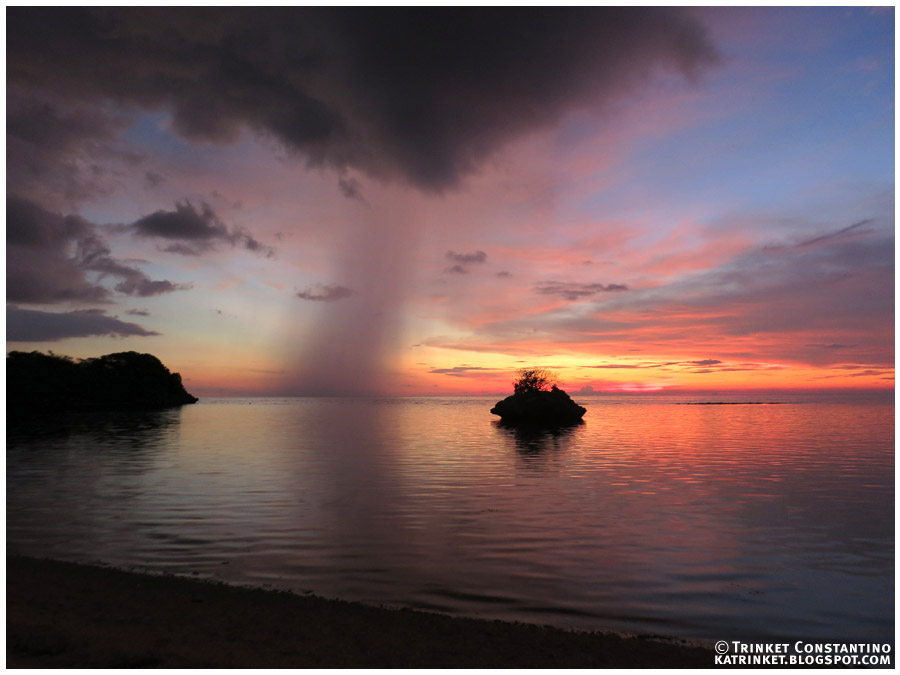 |
| Picture perfect rain and a sunset |
We enjoyed a dazzling sunset with a few Black-naped Terns flying around a rocky outcrop off shore. We watched the rain falling in the distance and the sky blazing as the sun touched the horizon. It was surely going to be a good stay.
 |
| The golden sun touching the sea |
As darkness began to fall, we made our way back to Moray Lagoon for a huge dinner. The only other guest on the island was Robin from the UK, who was actually doing his academic thesis on ecotourism on Danjugan. While enjoying dinner, we enjoyed the calls of night birds: hawk owls hooting from the mangroves and a frogmouth growling softly across the lagoon. Once in a while we would hear a splash of water as fish and other night-time creatures moved beneath the restaurant on stilts over the water. Having had a long day, we went to bed early, tucking our mosquito nets snugly under our mattresses and falling asleep to the soft sound of waves lapping on the shore and a gecko on our ceiling.
 |
| Waking up to the sound of bird call and waves on the shore. |
The skies lightened up early the next day and we woke up to a beautiful view of the lagoon. But we wanted to check on the thick-knee right away so we quickly geared up and headed over to Tabon Beach before breakfast.
The Beach Thick-knee is crepuscular and nocturnal, meaning it is most active during twilight and at night. We hoped we were still early enough to catch it on the beach. Adri walked ahead of me, and just before the trail through the mangroves opened up into the beach he gave me a surprised whisper: "There he is!"
Sure enough, on the beach just at the end of a trail was this huge bird! Whichever of us was more surprised, humans or bird, I couldn't tell. Flushed, the thick-knee quickly took to the air and circled around the shore. He flew left then right then left again then right again, giving us magnificent views in flight. He then disappeared around the next cove. Wow.


Beach Thick-knee in flight!
Not wanting to spook it further, we sat down on the beach for a few minutes to allow it to settle down before we took a look at the next cove. While waiting, the resident White-bellied Sea-Eagle flew past us. As it passed the rocky outcrop, the Black-naped Terns took to the air and began mobbing it!
 |
| It's not easy being top predator on the island: a sea-eagle being mobbed by terns |
Thinking that the thick-knee was settled by now, Adri and I waded to the next cove quietly. It was high tide and the water was much higher than the afternoon before, reaching way past our knees! As we rounded the corner, we took a peek. Huh. Nothing.
Suddenly, from out of the mangrove nearest to us walks out the thick-knee! Just as Ramram had said, it would be curious enough to check out people on the beach! It eyed us carefully, looking like some prehistoric bird.
 |
| Beach Thick-knee on Tabon beach: what a lifer! |
After a few awkward steps towards us, it begins to relax. And then it actually lies down on the sand. Wow again.
 |
| Relaxed enough to lie down, but still keeping one big yellow eye on us. |
Adri and I take turns looking through our binoculars, and then through our camera lenses. After several minutes, the thick-knee gets up, walks slowly towards the farther end of the beach and stops again to lie down. Then finally it gets up and disappears back into the mangroves.
 |
| Birding while standing in the water with the thick-knee just around the rock! |
Yay!
We wade back to the beach and take time to relish the moment. The sun is completely out now, casting a golden light on the Black-naped terns and their little rocky islet.


Resident Black-naped Terns on the rocky outcrop: were they nesting there?
As I settled on the driftwood we were sitting on, I noticed some fresh bloody leftovers: a bit of a hairy jaw and skull! It looked like some poor bat fell prey to the sea-eagle just that morning. .
 |
| Somebody was a messy eater and left behind some of their food. |
Yum, breakfast. It was time for us to head back to Moray Lagoon for our own. It was only 7:00am, we still had a whole day ahead of us to explore the island!
Our island adventure to be continued...


