Tuesday, August 1

Chasing Plovers at Ulugan Bay

So the day after our Irawan and Narra adventures, we got down to our "official business" which brought us to Puerto Princesa.  And as our morning schedule had permitted us, we first had a leisurely and delicious breakfast with the Widmanns, not only enjoying the human and canine company, but the avian neighbors as well!

Peter says that the Ashy-fronted Bulbul is the equivalent of the Yellow-vented Bulbul in our yards back in Luzon, and true enough, several of them were enjoying the familiar morning rituals in the garden.


A nice looking lizard was also enjoying the morning sunshine whilst looking for breakfast up a tree trunk.


Because it was a garden in Puerto Princesa, so many other birds were out!  A Hooded Pitta hopped around, a pair of Black-naped Monarchs chased each other, Palawan Flowerpeckers, a Pale Spiderhunter and even an Ashy-headed Babbler made appearances!  Of course there were also a lot of birds we had in common with our garden: Noisy Pied Fantails,  reticent Zebra Doves, che-che-che-ing Pied Trillers, colorful Olive-backed Sunbirds (much more colorful here though!).  Instead of a caw-ing Large-billed Crow on our fire tree, a Slender-billed Crow on a Parkia (Cupang) tree made a strange kwek-kwek-kwek-ing (almost duck-like!) sound.

A very active Rufous-tailed Tailorbird took center stage.  As we were having our breakfast and conversation, it kept distracting us by coming very close to the veranda and hopping about some very low branches!


A bit later, it even spared us a the effort of chasing it around and trying to get it focused on camera.  It landed in some tangles and spent the next ten minutes preening and fussing with its feathers!


Too soon, we had to bid Indira and Peter goodbye. It only took us less than an hour (!!!) to get our business done, but it wasn't goodbye to Puerto Princesa yet!   It being the Holy Week holiday in school, we decided to make the most of our trip and slip in a couple more days of birding. 


Our customary Puerto birding itinerary is to base ourselves in Sabang Beach, so we could bird along the highway around Sabang and neighboring Cabayugan.  This time, we decided to do it a bit differently. Adri chose a less popular tourist destination in Buenavista: a small, homey cottage at Jenny's Kahamut-An, right on the shores of the fishing village at Ulugan Bay.


With the concrete highway all the way to Sabang, it took us just a couple of hours (including a yummy pho lunch at the Viet Ville!) to get to Buenavista, and we arrived early in the afternoon. We were met by our lovely host Jenny, who showed us our cottage and after the usual introductions (emphasizing "We're birders so we eat dinner and breakfast at odd hours we hope you don't mind" on our part and "We run on solar power here, but it shouldn't be much of a problem" on our host's part), we settled in comfortably.

One of the first birds to greet us was a Plaintive Cuckoo, hanging around the center of the garden!


Not to be outdone were a pair of Palawan Flowerpeckers up a huge mango tree.


A pair of Common Ioras were also regular visitors, coming right by our cottage veranda regularly.


And of course some Olive-backed Sunbirds, who seemed to have a singing competition every afternoon, just in time for siesta hour.


We decided to take it easy the first afternoon, it was, after all, meant to be a relaxing vacation.  As we admired the afternoon sun lighting sparkles on the waters of Ulugan Bay, Adri suddenly had a bright idea to check the beach for plovers.

Despite the blinding light on the huge expanse of sand exposed by the low tide, he managed to get a tiny bird on the scope.  Was it a Malaysian Plover?  We got all excited, gathered our gear, and decided to check it out.

Some kids were also out playing in the hot afternoon sun, gathering starfish far out to where the sea grass beds were exposed. (Only kids and birders would voluntarily be out in the sun at 3pm)


The bird Adri had spotted turned out to be a Common Sandpiper, foraging in the shade of a parked outrigger.

But as we scanned the beach, three plovers came into view!


They were busy scurrying across the hot sand (just like the kids!), in various stages of plumage. Hmmmm... three plovers? The Malaysian Plover idea was not looking very good (they're usually in pairs).

Nonetheless, we waited patiently and crossed shallow tide pools, and sat on the sand, trying to get good views.  It's wonderful what a bit of patience can bring.  When I stopped moving, the sand itself seemed to come alive with tiny crabs and other creatures... marching to the beat of a silent drum.
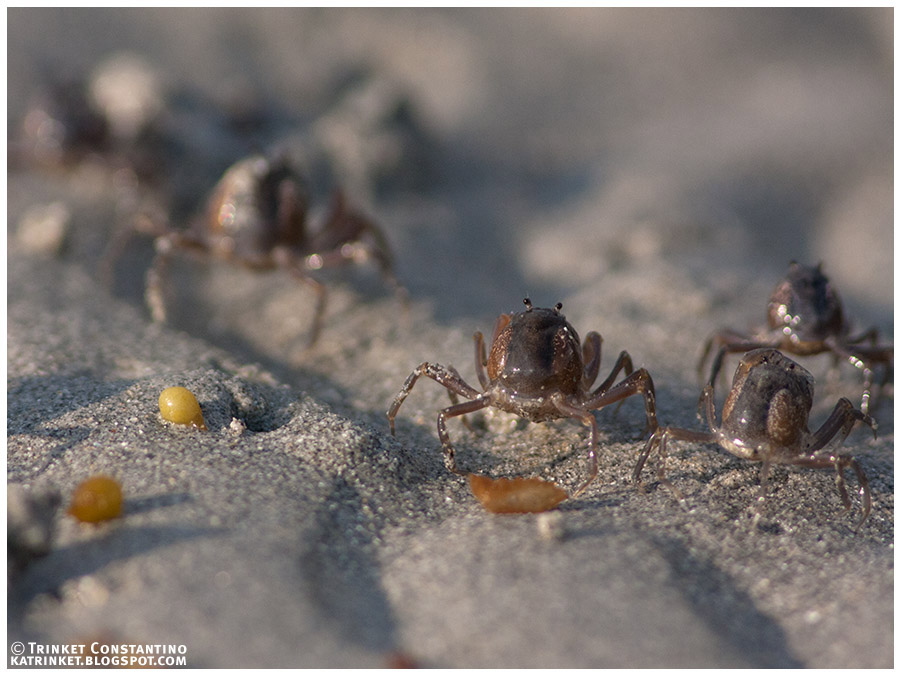

In no time, one of the plovers got comfortable enough to get close to me, both preening and foraging.


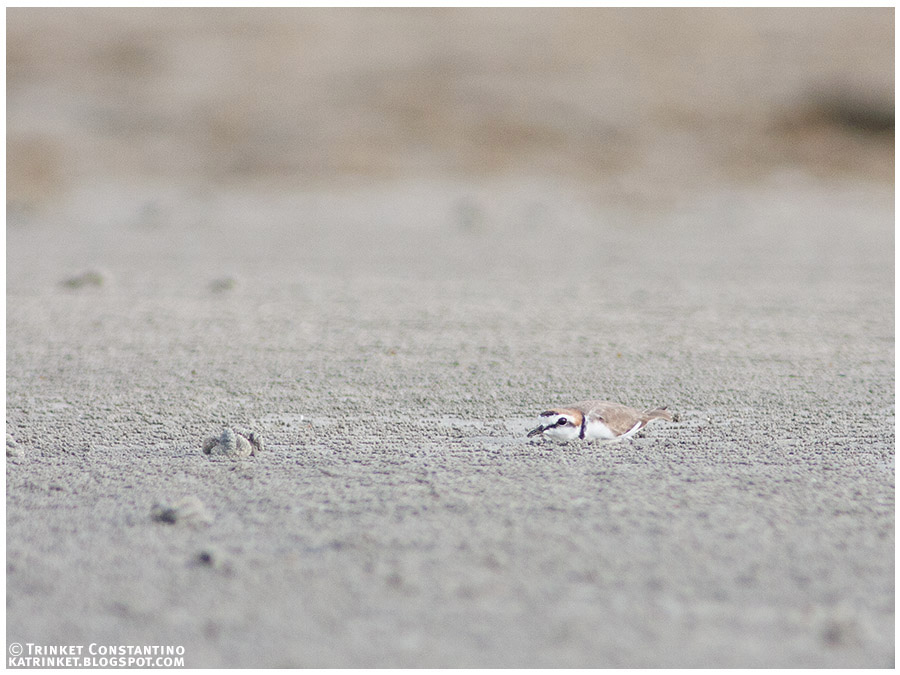
As it turns out, the plovers turned out to be the very common migrant Kentish Plovers! But no matter, the hours spent on the beach were very enjoyable for me and Adri.  It actually got me thinking: Other than birders, who would be out stretching their legs and crouching on their knees on wet sand in the heat of the afternoon doing this... and enjoying it?!?

We had gotten so acquainted with the 3 plovers that they would pass right by me while they were scuttling around:


Sometimes, they would get spooked by our sudden movement (I can't stay in a squat position for that long!) or by a fisherman passing by to load some branches in his boat for fish traps.  The plovers would crouch low on the ground, motionless (reminding me of the tension in a cat about to pounce on its prey).


Occasionally, a Pacific Reef Egret would also fly into view, and farther away, a Whimbrel was also foraging.


I suppose we got enough sun on the beach that afternoon, because for the next couple of days, we enjoyed the view from our veranda, at least when we were not out birding on the highway.


At night, we had a regular visitor to the veranda, one our host had already warned us of.  Jenny must have thought us strange (or at least not your regular tourists), when we assured her that we welcomed such visitors, even if they did leave a bit of a mess on the floor the next morning.

A little bat had decided that the thatched roof was a perfect spot to enjoy his dinner.  We would see him there busy nibbling at some figs from a nearby tree.


We even took photos of him to show Jenny, who was too polite to say anything except: "Few visitors would be so understanding of a bat on the veranda!"


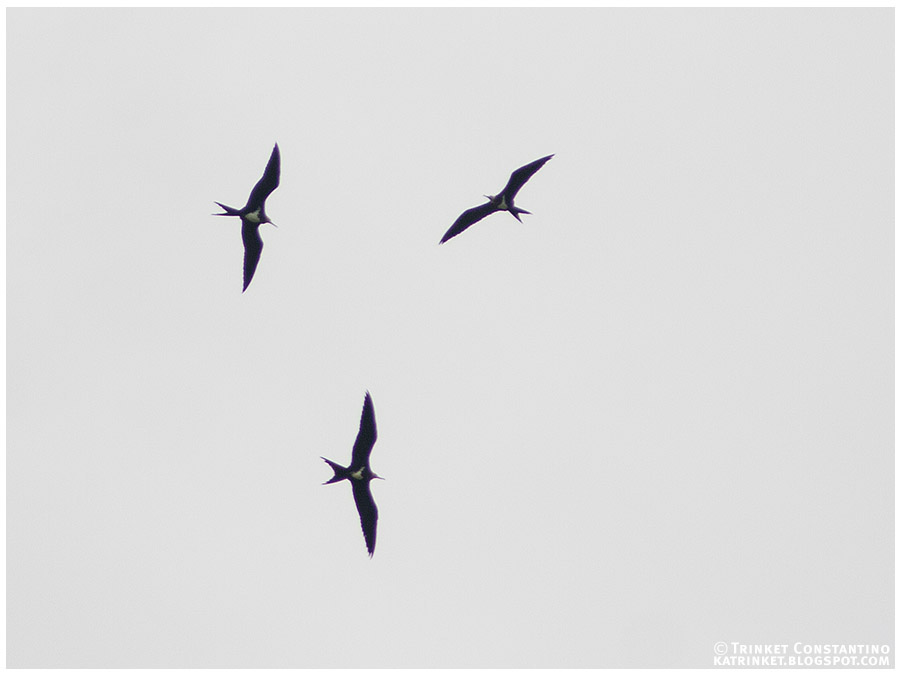
On our last day, we had an early lunch to catch our flight back to Manila.  As we were packing up, Adri suddenly caught sight of several frigatebirds thermalling above the cottages!

They started out low and rose higher and higher until they were out of our view!


The seven frigatebirds looked to be Lesser Frigatebirds.  We were concerned that their behavior might signal a change in the pleasant weather we were having and hurried on our way.   (Sure enough we ran into a bit of a thunderstorm in the middle of the highway!) What a send off for another great Palawan trip.


Kahamut-an was a great place to stay.  Far from the tourist crowd (it was Holy Week remember), very clean and neat, great food and the quiet company of Jenny and her family. A nice change from our usual Puerto Princesa routine.


Monday, July 31

A birdy morning at Irawan

*Watch out! Series of late posts coming up!  With the rainy season comes time to write about the past summer's adventures!

On our first full day in Puerto Princesa, we had a full day ahead.  For our morning, we planned on an early start by birding at Irawan Eco Park.  The last time I had attempted birding there was waaaaaaay back in 2009 during the bird festival! It wasn't a place I was familiar with, but Adri had been there several times.  

As we parked our car on a clearing by the side of the road, the musical calls of a White-vented Shama and a Melodious Babbler greeted us, as well as the low hoots of a Greater Coucal.  Ah Palawan!  Your birds so different from Luzon!   Ashy-headed Babblers called loudly from the undergrowth just at our feet, rustling leaves giving clue to their whereabouts.  The noisy bising (Palawan Tree Squirrels) were busy scurrying up and down trunks and from branch to branch.

While Dollarbirds and Slender-billed Crows took their place on obvious perches above the canopy, a very vocal Asian Koel was harder to spot, even for a large-ish bird moving about in the foliage. We finally spotted it in a small clearing, behind some branches.


We came upon a huge rain tree beside a stream, and there was a steady flow of small birds moving around.  Several Pale Spiderhunters were  very active, proving a difficult target to catch on camera.  Their long, thin and curved beaks seemed out of proportion with their tiny bodies.


A migrant Grey-streaked Flycatcher was also flying around and back as it caught flying insects.


Sunbirds, flowerpeckers, Phylloscopus warblers, Black-naped Monarchs and Black-headed Bulbuls flew in an out of our view.  

I was pleasantly surprised with a lifer: a trio of Velvet-fronted Nuthatches came in and crept around and about the high branches.  Their bright orange beaks clearly differentiating them from the Sulphur-billed Nuthatches so common in high elevation Luzon.


A Hooded Pitta surprised us by flying right in front of us and landing beside the stream, quickly disappearing into the brush. Our binoculars revealed Pin-striped Babblers and several Ashy-headed Babblers moving around the vegetation in the distance.

As we walked further on, we ran into a few locals about their daily routine.  We were recognized as birders right away and they greeted us with a silent nod and, sometimes, with a few suggestions on where to find birds.  As we were in such a conversation with a local woman, a Spot-throated Flameback landed on a tree high above us.  Try as we did to get a good view though, the thick leaves and branches confounded us!


It was the same case with a White-bellied Woodpecker we ran into a little later on (this time at eye level, but still behind the leaves and branches)!


Thankfully, we did get excellent views of other birds.

A Palawan Tit was busy preening and paid no attention to us observing  it.


We came across several Rufous-tailed Tailorbirds on the trail.  Of all tailorbirds in the Philippines, these must be the easiest to spot and photograph!


A pair of Blue Paradise Flycatchers were busy catching food - probably to take to a nest nearby. I love the blue beak and blue eye ring on this bird!


Several Ashy Drongos were also flying around and perching on branches like they were swings.


The loud calls of several Hair-crested Drongos  would break the otherwise serene forest sounds, they would come flying through in groups chasing one another like a riotous group of teenagers.  This one had a juicy bug to eat quickly before its mates interrupted it.


Every now and then a Striped Flowerpecker or a Pygmy Flowerpecker would fly in, look around a bit, and then fly off.


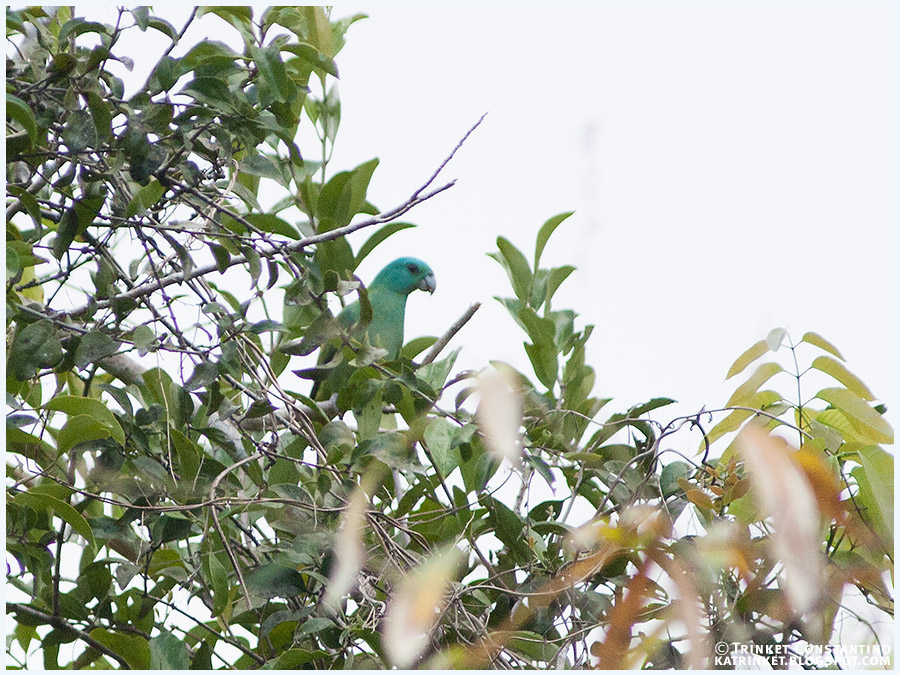
Un-naturally quiet, we were surprised to see a Blue-headed Racket-tail fly in and land on a tree nearby.


I love parrots.  They walk gingerly along the branches, twisting their head and torso around as they use both their feet and their beaks.  This one was sooo quiet, that we were surprised to see it still around after having been distracted by other birds for several minutes.


As it was already approaching lunch time (you tend to lose track of time when there are a lot of birds around, no?), we decided to it was time to head back to the car.  We ran into several more birds going back, including a Chestnut-breasted Malkoha, several Yellow-throated Leafbirds, and an Oriental Dwarf Kingfisher that appeared as an orange bullet whizzing by with a high pitched call.

At the car, the Hill Mynas we had spotted when we arrived were still busy eating.


Our morning birding had churned out 53 species, and after lunch we were off to visit the Katala Foundation's Katala Institute for Ecology and Biodiversity Conservation (KIEBC) at Narra. (I had already written about that trip previously here.)

What a wonderful way to start our impromptu Palawan trip! 

Tuesday, June 13

Golf cart birding at QC: birdies on the green!


As June rolled in, the rainy season official on its way, we were already becoming lazy in planning any weekend birding trips.  So I was excited when Anna G. invited us to bird at a site around my area of the world: Capitol Hills Golf and Country Club.

Although I had been to the surrounding commercial and residential areas in the vicinity of the golf club, I had never actually been inside the 18 hole golf course.  It had been in existence since I was born, but it had recently been under the management of Ayala Land, who was also developing the nearby residential areas.

I literally pass by the boundary of the golf course almost everyday of my life, but have only had glimpses of the course. And while most Universities, parks and cemeteries are easily accessible, this green space was membership (or at least golfer-) only.

We met up Anna and George (of ALI) and WBCP-er Willem at a row of restaurants which overlooked the greens of the course before our ocular.  It was a relief not to be troubled by early rising or traffic - we leisurely sipped our coffee before starting.  Already (beginning at the parking lot) we had seen several Golden-bellied Gerygones chasing each other.  Black-naped Orioles called loudly as they flew from tree to tree.  Yellow-vented Bulbuls gurgled all around us. We could hear a hidden Philippine Magpie Robin singing melodiously behind the buildings and shrubbery. A Collared Kingfisher was patrolling nearby.  This patch of sprawling greenery was probably an oasis for the city birds!

As we exchanged morning pleasantries, we were entertained by a Glossy Swiftlet gathering some fiber from a nearby fishtail palm.


A few Black-crowned Night-herons also flew overhead, probably traveling between hunting ground and day roost sites.


Soon, we were off!  We were joined by one of the managers, Gino, who would show us around.  We were paired of and each of us given our own golf cart to drive around the course!  Silently I added "golf cart" to my list of birding vehicles which have so far ranged from the comfortable air-conditioned coaster, to the barely manageable breathing four-legged pony!


Almost immediately we spotted several Long-tailed Shrikes watching from various levels of viewpoints along the holes.


The edges of the greens were kept "wild", the grasses grew long and wildly - obviously serving as great refuge for city wildlife. We soon stopped at a nearby pond and waterway.  To our delight, a very friendly family of moorhens was foraging!  I think, it was the closest encounter I have ever had with these waterbirds!  Though  alert to our presence, a pair and a fluffy chick came as close as a few meters to our group.  They wove in and out of the greenery.


A more skittish White-breasted Waterhen also made a brief appearance as it dashed across the short water line.

As we drove along the winding pathways, through tunnels and over bridges, Gino showed us a much larger pond.  Again, we saw several Moorhens, going about their business. Another young moorhen was up in a fig tree at the water's edge opposite from us, sunning itself.


A noisy pair of Collared Kingfishers were calling from a residence at the edge of the course.  Above us a pair of Pied Trillers was foraging for insects in the canopy of a huge rain tree. A playful pair of Philippine Pied Fantails chased each other noisily around the nearby vegetation.


It was not only the birds out to enjoy the morning sun.  Several skinks were out sunning themselves, hardly paying heed to the golfers or the gardeners.


As we crisscrossed the property, passing through gated residential communities, we saw several pairs of  Crested Mynas flying above us, slashing their white wing markings as they flapped their wings. Once in a while a Large-billed Crow would also fly overhead.  Noisy Striated Grassbirds would call from the tops of bushes and fences.
  
Soon we came across an even larger pond!  Again, several Moorhens were at the water's edge, preening and foraging.  There was even one individual swimming across the surface!  On the far edge of the pond, we could see a White-breasted Waterhen taking a morning dip.  A closer look revealed a downy chick beside it!  The darkly plumaged young bird was perfectly camouflaged among the rocks.


Several dragonflies and damselflies danced along the grass at the edge of the pond.


Sadly, there was also a dead Cinnamon Bittern at our feet.  Its eyes were still fresh and bright, indicating that it was a recent death.  It had no obvious injuries or wounds, save for a few damp and ruffled feathers.  We were discussing what the cause of death could be, considering that we could have interrupted a monitor lizard with its meal. Throw in a little mystery to our morning bird walk!


Again, we appreciated how the edge vegetation was kept a bit overgrown, and just to emphasize our point, another White-breasted Waterhen walked in and out of the long grass.


As we rounded the curve of the pond, we stopped to catch a glimpse of a White-throated Kingfisher flying off.  We stopped a while at the shade of a rain tree, surprised by some movement and the sight of a Common Moorhen preening quite near to us!  


Some of the tall grasses were in seed, and Adri spotted a couple of Scaly-breasted Munias picking at the grains.


Even on a weekday, there were a few golfers out, and every now and then we had to stop as they hit their balls across the greens (Is that the even a correct term? I am golf - illiterate).  Many Zebra Doves seemed to be unaware of this etiquette as they continued to forage on the ground unmindful of the balls flying around.


We also spotted a few Barred Rails.  Their behaviour was the normal skittish, paranoia, running into the nearest grass cover as soon as they spotted us. 

Several White-breasted Woodswallows were perched all over: on the huge nets which prevented the golf balls from flying off-course, on the light posts, and on the trees.  They were their usual vocal and boisterous selves. 


Near another grassy thicket, Anna spotted a Philippine Coucal! It quickly scuttled into the growth, revealing only bits of bright brown or black, until it completely disappeared from our sight.


Golf cart birding sure beat walking! We navigated the course easily and efficiently, slowing down and stopping (for flying birds AND flying balls!) any time we needed to.  Even if it was a hot, humid and sticky morning we barely broke a sweat! 


At the end of the two hour drive across the 18 hole course, we tallied a total of 32 species of birds! It was good to know that the exclusive golf course (while for human members only) was an open refuge to our feathered friends in the city.

Thanks again to Anna and ALI for the invite and the chance to explore this hidden bit of urban greenery!


And of course we end with a group picture!