Thursday, May 4

Stilts at LPPCHEAA

On the 1st of April, a few WBCP-ers (led by Mike L. and Arne J.) attended the groundbreaking for a wetland park at the LPPCHEA (Las Piñas-Parañaque Critical Habitat and Ecotourism Area). Finally!  Hopefully, this project, led by Sen. Cynthia Villar, will focus on the importance of the mudflats as a wetland (it is a declared RAMSAR site!) and as a green space in a city choked by urban developments lacking environmental planning.

Adri and I were there but unwittingly skipped the ceremonies as we were captivated by several Black-winged Stilts foraging along a relatively clean beach.  We had lost track of the time and got caught up documenting the graceful stilts as they were feeding along the waterline.

When we arrived at sunrise, I was delighted to see that much of the trash along the coastline had been cleared (still a lot left of course, I would think it almost impossible to clean all of it up, with more trash coming in daily with the tide).  The beautiful shell beach was exposed - revealing a diversity of gastropods and bivalves, together with a bit of plant litter: seeds, twigs (and sadly some plastic knick knacks).  It was definitely a bit of beauty one seldom would expect to find along the Manila beaches of the bay.


I could only imagine all the possibilities of having a clean beach in Metro Manila for the city-dwellers to enjoy.


A lone Common Sandpiper was busy preening in the golden monring light, stanind on a bit of muddy, discarded rubber/canvas/plastic.


A few stilts were on the beach at first, some resting and preening, others busy foraging for food. Many of them were quite vocal, twittering loudly.


There were few other migrants at the beach, although in the distance at the river mouth we could see several egrets, some herons and quite a number of waders.

A few Common Greenshanks flew past us, twittering loudly.


It was not only the birds out foraging, a man and his two young boys were also busy looking for shellfish in the shallow waters.


As the shadows receded with the rising sun, more and more stilts began flying in.  It was nice to see varying plumage, from the usual greyish markings of younger birds to elegant black and white plumage of the full adults.


Adri and I found a nice large log to sit on, under the shade of the mangroves.  The birds soon got used to our presence and began to get comfortable.

We practice in-flight shots with two Whiskered Terns.


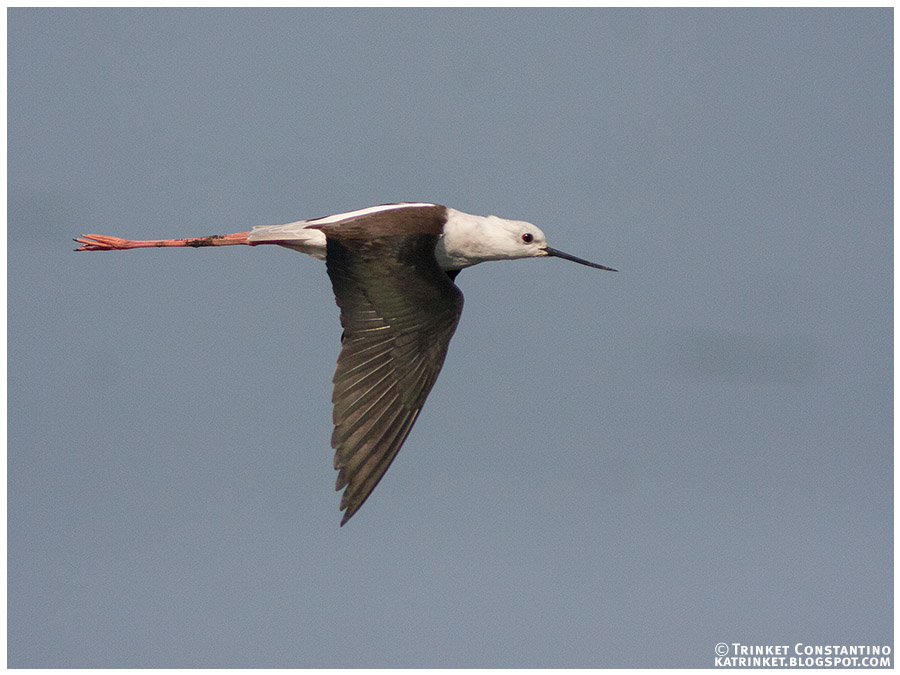
And got a good laugh trying to outdo each other with stilts-in-flight shots.


Some of the stilts were flying back and forth right in front of us!  Sometimes they were too close!


We were not the only humans on the beach, several meters away was a man busy with his boat, being ignored by most of the birds.


A few greenshanks decided to join the stilts.


And one of the beach dogs also came out to inspect the debris that had been carried in by the tide.


Soon the tide began to turn and we could tell the ground breaking event had finished, because we could see large groups of people descending on the beach.  In the distance, a large group in orange jackets were busy cleaning up the coast.


Nearby, a group decided to take the DENR trash boat (it had a huge net to catch floating trash out at sea) for a quick spin.  The Black-winged Stilts paid no attention to the people (probably because the people were not paying any attention to them either!)


The tide was eating up the thin stretch of beach so we decided to start heading back.  We ran into some of the participants and volunteers who were with Rey Aguinaldo (DENR Region IV and LPPCEHA Project Manager).  We were happy to show them some of the stilts through the scope.  They expressed their surprise at the number of birds along the beach, even commenting that they were happy that the event (with its many people and loud sound system) did not flush or scare them away.


As we walked back to the car along the more shaded inland trail, we spotted other migrants: a noisy Brown Shrike and a confiding Arctic Warbler.


We also ran into several groups of Barred Rails and Common Moorhens foraging under the mangroves.

At the end of the beach near the car, we saw a small group of three enjoying a swim in the water.  It was not something I would recommend!  I am still hopeful though, that one day, Manila Bay will be clean enough for more recreational activities.  With the threat of reclamation looming, perhaps a wetland park is just what LPPCHEA needs. Not just for humans, but for all the other wild ones that need it too.


Keeping my fingers crossed.


Monday, May 1

The nesting neighbors, Part 2

While the barbets were busy with their family, the Yellow-vented Bulbuls were also off to a prolific start.  As I was seated on a garden bench, a pair of bulbuls kept  circling around me, busy catching moths in flight and looking around, under and over each and every bush.  That they were too busy to  pay me much mind was a sure sign that they had only one goal: to feed a growing nestling!  I watched them closely and sure enough both of them headed straight for a low branch of the rambutan tree, to be met with the eager chirping of two fledglings!


A very hungry baby

I am always amazed at the amount of energy invested in raising a family.  I doubt any small insect or moth has much of a chance surviving when there is a bulbul pair agressively hunting them down to feed a hungry chick. 


An adult scouring every nook and cranny for food

In this case, there were 2 chicks - little balls of feathers with hardly any tails and huge mouths agape. They were big and strong enough to jump around nearby branches, getting uber excited when one of the adults lands nearby.  


Two balls of feathers patiently waiting for mom and dad...

... and they go crazy when mom/dad come with food!

I was quite afraid they would miss their mark as they tried to out jump/ out fly each other in order to get to the parent before its sibling.

Knowing there was a pair of fledglings in the yard, it was easy to keep track of them over the days.  The eager chirping would easily give away which tree they were in. They stayed around the garden for a couple of weeks, and began to stray from back to front yard as they grew more confident in their flight.


Growing older and getting bigger

But no less demanding!


Sadly, only one of the fledglings apparently made it to adulthood from what I could tell. While watering the plants in the garden, Kuya Ramil found a young dead bulbul in the leaf litter, being consumed by ants.


Over before it really began for this little one.

"I think it was one of the ones we were keeping track off," he told me.

Sure enough, an adult flew past us followed by a single noisy, nagging young bird.  I remember WBCP-er Des telling us that only one in ten tropical nests are successful, so it shouldn't have come as a surprise to find the young dead bird.

I wonder what caused its death though?  It was quite strong and developed already.  Did the parents not have enough energy to raise 2 birds to full adulthood?  Did it meet an untimely death with an encounter with a predator?  Was it an accident?

I suppose we will never know.  

I've seen at least two new bulbul nests in the yard, most probably from different pairs, but maybe a second nest for the season for the parents.


Hopefully, this one made it.

And life goes on for the garden bulbuls. 


Sunday, April 16

Kites and other fishers

Operation Sagip Sawi (Save the Grey-faced Buzzards) was in full swing in Northern Luzon, and I was off for the weekend with Jelaine and Lala to support Alex, Tere and the ARRCN (Asian Raptor Research and Conservation Network) Japanese contingent on their visit to Ilocos Norte and Cagayan Valley.

But... we had a few hours free in the morning to bird with Laoag-based Richard R.  He had once again spotted a rare migrant visiting his birding spot and was keen to show it to birders who traveled the long road north to see it. For our trio, the opportunity was perfect for a twitch.

And so, fresh off the bus from Cubao, at 500am, a smiling Richard picked us up at the terminal, and we were on our way (with a breakfast stop at Jollibee, of course!).


Walking along the banks of the Laoag river, many fishers were already out and about.  In the far beach where the river mouth opened to the ocean, we could see through our binoculars that they were already unloading their catch, large jacks (talakitok), catching light in the morning sun as they were transfered to baskets.

Along the river, men and children were alredy preparing a new set of nets, baiting them with small fish, mostly halfbeaks (looking weird with their "beaks" snapped off).


We parked ourselves at the last of a series of public terraces, excellent (i.e. roofed) vantage points to watch out for our target.

People were not the only the early fishers out.  Dozens (literally: I counted 28 perched on one tree across the river) of Brahminy Kites were already busy catching their breakfast.


Several egrets, mostly Great Egrets, were also perched on the fish pens, un-moving sentinels shining white in the golden light.


While waiting, we scanned the trees around us.  And sure enough, in less than 5 minutes from our arrival, we spotted it!


Do you see it? Not the white headed raptor in the foreground
but the dark one in the background, silhouetted against the sky.

Quite a distance away, in the direction of the fishponds (we had previously visited) perched on the very top of a tree, was a kite much larger than the many Brahminys flying around us: a Black Kite!

It was busy preening, despite the distance, we could clearly see the forked tail and the dark plumage.


 This one!

We kept Richard's scope trained on it, and it stayed put for so long, even the locals had a peek through it to see.  

It didn't seem like it had any intentions of moving, so while waiting for it to take flight, we entertained ourselves with the Brahminy Kites flying and fishing close by.


On a small house on top of the riverside, a man was busy cleaning and drying out his fish. He cleanly sliced each fish open, gutted and salted it.  After he had finished with all the fish, he strung them up to dry.


They joined several other fish drying in the sun - soon to be someone's breakfast: daing (dried and salted fish) with fried garlic rice and a sliced tomato. Yum.


Back to the birds...

The Black Kite was still immovable, now joined by a Brahminy Kite on a neighboring branch - just to clearly show the size and plumage difference.


Another fisher was perched nearby: a White-throated Kingfisher. It didn't seem to favor that spot though as it only stayed for a bit before flying off to find some other fishing ground.


When next we looked over the Black Kite, he was gone!  

With his disappearance was a flurry of duck activity with hundreds of Philippine Ducks taking to the air.


We were hoping for it to do a close flyby like the Brahminy Kites, but luck was no longer on our side.  We waited for as long as we could, but no sign of it along the river.

We took a quick trip to the fishponds to see if it was hanging out in that area, but no luck there either.

Still, it was a successful early morning twitch.  Thanks again to Richard who is always alert and on the lookout at his birding patch, and always generous with sharing information. Laoag is such a rare migrant magnet!

Our weekend adventure had just started and we were off to join up with the Sagip Sawi group!


To be continued...


Sunday, April 2

The nesting neighbors, Part 1

Nesting season seems to have come early this year in the garden!

Adri and I were thrilled that the neighborhood Coppersmith Barbets decided to nest on a dead branch of a Flamboyant Tree (aka Fire Tree) right above our garage! Last year, the nest was in the corner across from us.

We had already noticed a pair inspecting a nest hole from its perfectly circular entrance as early as January, and we could here them calling:  pok-pok-pok-ing loudly even before the sun as up. Although the nesting hole was just outside our bedroom window, a dry anahaw leaf conveniently hid the entrance from our view.  From the garden at ground level though, the nest hole was in full view.


Through February and March, I would see them coming in and out of the nest hole quite regularly.  I would make it a habit to glance at it right before I entered my car to leave for work in the morning (at least in March there was already enough light for me to see).


Most times one of the barbets would have its head out of the hole, looking around (and sometimes looking down at me - one inquisitive gaze at another!)


Mid-March, the pair would take turns at the nest, one calling out loudly upon arrival while the other would unobtrusively fly out as the newcomer flew in.


I lost track of them for a few weeks though, as I was busy at work and was out of town for a weekend.

This week, I was happy to see the nestling, in almost full adult plumage!  It was still hanging out at the nest (literally!), and would fly to a nearby branch on the arrival of one of its parents.


The parents would come in with mouthfuls of fruit (looked like ficus fruit or lemoncito fruit) and call out (yes, with its mouth full!) to the young one.


The parent then would fly to where the young one was and the young one would quite violently grab all the food from mom/dad!


This weekend, the young one seems to have gotten the courage to fly further and further form the nest as it followed when one of the parents took off in search for more food.


So happy to see that the nesting looks like a success!

I'll probably get to see less and less of this family. It's still early in the season though, and I'm hoping there will be a second nesting soon.

How great is it to have nesting neighbors?  I love sharing our yard with them!

IMPORTANT NOTE:   NEVER harass nesting birds, expose the nest or stay within the nest area for extended periods of time. It may seem like common sense to keep away from nests, but sometimes curiosity can get the better of us.